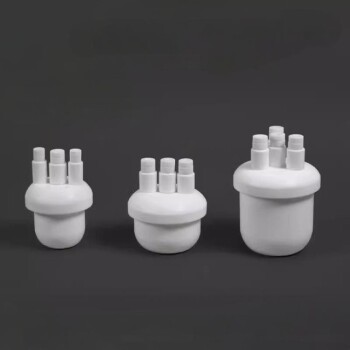
Precision and atmospheric control are the defining roles of this equipment setup. A three-neck reactor combined with a temperature control system works to establish a stable thermodynamic environment at exactly 70 °C while maintaining an inert argon atmosphere. This configuration is the physical foundation required to successfully polymerize 2-acrylamido-2-methylpropane-1-sulfonic acid (AMPS) via the RAFT process.
By strictly regulating temperature and excluding oxygen, this setup maximizes the efficiency of the Chain Transfer Agent (CTA). This ensures the creation of a uniform polymer backbone, which is a prerequisite for high-quality downstream chemical modifications.
Creating the Ideal Reaction Environment
The Function of the Three-Neck Reactor
The three-neck reactor serves as more than a simple containment vessel; it acts as a controlled isolation chamber.
Its primary function is to facilitate an inert atmosphere. By utilizing the multiple ports, the system can be continuously purged with argon gas. This protects the sensitive RAFT chemistry from oxygen, which would otherwise inhibit or terminate the polymerization process prematurely.
The Role of Magnetic Stirring
Included within the reactor setup is magnetic stirring.
This ensures that the AMPS monomer and reagents are homogeneously mixed throughout the solvent. Uniform mixing prevents localized "hot spots" or concentration gradients that could lead to inconsistent polymer chain growth.
Thermodynamic Stability via Temperature Control
The temperature control system is responsible for maintaining the reaction specifically at 70 °C.
RAFT polymerization is a thermally initiated process that requires a constant energy input to proceed at a predictable rate. The control system provides a stable thermodynamic environment, preventing fluctuations that could accelerate or stall the reaction unexpectedly.
Impact on Polymer Quality and Structure
Regulating Molecular Weight
The combined stability of the temperature and the inert atmosphere directly impacts the Chain Transfer Agent (CTA).
When the environment is stable, the CTA can effectively mediate the equilibrium between active and dormant chains. This regulation allows for precise control over the final molecular weight of the AMPS polymer.
Reducing the Polydispersity Index
A key indicator of a successful RAFT polymerization is a low polydispersity index (PDI).
The precise control provided by this hardware setup ensures that all polymer chains grow at roughly the same rate. This results in a polymer sample where chain lengths are highly uniform, rather than a chaotic mix of short and long chains.
Ensuring Structural Regularity
The ultimate output of this controlled process is a polymer backbone with a regular structure.
This structural integrity is not just for aesthetic chemical analysis; it is a functional requirement. A regular backbone is critical for the successful subsequent grafting of polyaniline chains, which appears to be the intended application for this specific synthesis.
Understanding the Trade-offs
The Cost of Instability
It is important to note that the hardware is only as effective as its calibration.
If the temperature control drifts significantly from 70 °C, the reaction kinetics change, potentially rendering the CTA ineffective. If the reactor seals fail and argon protection is lost, oxygen acts as a radical scavenger, effectively killing the polymerization.
Complexity vs. Necessity
While a simpler single-neck flask might suffice for crude free-radical polymerization, it is insufficient here.
The complexity of the three-neck setup is a necessary trade-off to achieve the living character of RAFT polymerization. Without this precise hardware interface, achieving low polydispersity and defined molecular weights is virtually impossible.
Making the Right Choice for Your Goal
To ensure the success of your AMPS polymerization, consider your specific objectives:
- If your primary focus is Structural Uniformity: Prioritize the integrity of the argon seal in the reactor to prevent oxygen-induced termination and ensure low polydispersity.
- If your primary focus is Downstream Grafting: Ensure your temperature control provides unwavering stability at 70 °C to produce the regular backbone required for polyaniline attachment.
The hardware configuration is not merely a vessel for the reaction; it is the control mechanism that dictates the molecular architecture of your final polymer.
Summary Table:
| Component | Primary Function | Impact on Polymerization |
|---|---|---|
| Three-Neck Reactor | Argon purging & isolation | Excludes oxygen to prevent premature termination |
| Temperature Control | Sustains constant 70 °C | Maintains stable kinetics for predictable chain growth |
| Magnetic Stirring | Homogeneous reagent mixing | Prevents localized hotspots and concentration gradients |
| Inert Atmosphere | Oxygen exclusion | Maximizes CTA efficiency and ensures living character |
| System Stability | Low PDI achievement | Produces uniform molecular weights and regular backbones |
Elevate Your Polymer Synthesis with KINTEK Precision
Achieving the precise molecular architecture required for RAFT polymerization demands equipment that offers unwavering stability. KINTEK specializes in high-performance laboratory solutions designed to meet the rigorous standards of advanced chemical research.
Whether you are synthesizing AMPS backbones or developing complex materials, our range of high-temperature reactors, vacuum and atmosphere-controlled furnaces, and precision magnetic stirrers provides the thermodynamic and atmospheric control necessary for low polydispersity and structural regularity.
Our value to you:
- Comprehensive Reactor Systems: Custom configurations for inert gas purging and thermal regulation.
- Specialized Lab Equipment: From crushing and milling systems to high-pressure autoclaves and cooling solutions.
- Quality Consumables: Durable PTFE, ceramics, and crucibles for sensitive chemical environments.
Ensure the success of your next synthesis—contact KINTEK today to find the perfect equipment for your laboratory.
References
- Alain Salvador Conejo-Dávila, Erasto Armando Zaragoza‐Contreras. Brush-like Polyaniline with Optical and Electroactive Properties at Neutral pH and High Temperature. DOI: 10.3390/ijms23158085
This article is also based on technical information from Kintek Solution Knowledge Base .
Related Products
- Custom PTFE Teflon Parts Manufacturer for Three-Necked Round Bottom Flask
- Electric Rotary Kiln Small Rotary Furnace Biomass Pyrolysis Plant
- Customizable High Pressure Reactors for Advanced Scientific and Industrial Applications
- Customizable Laboratory High Temperature High Pressure Reactors for Diverse Scientific Applications
- Stainless High Pressure Autoclave Reactor Laboratory Pressure Reactor
People Also Ask
- What makes PTFE bottles suitable for static leaching? Ensure Zero-Contamination for Glass Testing
- What function do baffle plates serve inside a reaction vessel? Enhance Photovoltaic Backsheet Recycling Efficiency
- What is the function of PTFE in a gas diffusion electrode? Mastering CO2 Electrolyzer Stability
- What is the best solvent for FTIR? Master Solvent Selection for Clear, Accurate Spectra
- What are the disadvantages of flash pyrolysis oil? Overcoming Key Challenges in Bio-Oil Utilization