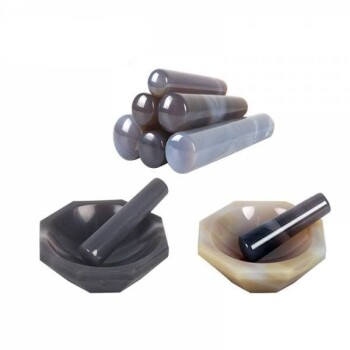
Agate grinding balls function as a high-purity, chemically compatible medium specifically designed to refine silicon nitride powders without compromising their composition. They facilitate the necessary physical crushing and mixing of the ceramic powder and its additives, while their specific chemical makeup prevents the introduction of foreign contaminants that would inhibit the sintering process.
Core Takeaway In high-performance ceramics, the purity of the powder is as critical as its particle size. Agate is utilized for silicon nitride specifically because its primary component—silicon dioxide—is chemically compatible with the host material, meaning inevitable wear from the grinding media does not introduce harmful, heterogeneous impurities.
The Critical Role of Chemical Compatibility
The Advantage of Silicon Dioxide Composition
Agate is composed primarily of silicon dioxide ($SiO_2$). When ball milling silicon nitride ($Si_3N_4$), mechanical friction inevitably causes the grinding media to wear down slightly.
Because the wear debris from agate is chemically similar to the oxidation layers often found on silicon nitride, it does not act as a foreign contaminant.
Preventing Heterogeneous Impurities
Standard steel or alumina grinding balls can introduce iron or aluminum contaminants into the mixture. These "heterogeneous elements" can drastically alter the sintering behavior and final mechanical properties of the ceramic.
Agate grinding balls are chemically inert in this context. They ensure that the powder remains free of metallic or incompatible oxide pollution, which is essential for preparing high-purity ceramic powders.
Mechanisms of Physical Refinement
Achieving Uniform Dispersion
The primary physical goal of the wet ball milling process is to achieve macroscopic and microscopic homogeneity. Agate balls mechanically mix the silicon nitride with sintering additives to create a uniform distribution.
This uniformity provides a consistent reaction interface. Without this level of dispersion, the subsequent solid-state reactions during sintering would be uneven, leading to structural defects.
Breaking Agglomerates
Raw ceramic powders often clump together in "agglomerates" that resist densification. The high hardness of agate grinding balls allows them to effectively crush these clusters during the milling process.
By refining the particle size and breaking these agglomerates, the media increases the surface area of the powder. This enhanced reactivity is necessary for successful densification and phase formation in the final product.
Understanding the Trade-offs
The Reality of Media Wear
While agate has an extremely low wear rate, it is not impervious to abrasion. "Zero wear" is physically impossible in high-energy milling.
The trade-off here is strategic: you are accepting a minute amount of silica contamination to avoid gross metallic contamination.
Efficiency vs. Purity
Agate is chosen primarily for purity, not necessarily for maximum kinetic energy impact compared to denser metallic media.
If the grinding media is too soft compared to the powder, efficiency drops; if it is too hard/heavy, it may generate excessive heat or wear. Agate strikes a balance, offering sufficient hardness for silicon nitride while prioritizing chemical inertness.
Making the Right Choice for Your Goal
To determine if agate media is the correct choice for your specific milling parameters, consider the following:
- If your primary focus is High-Purity Sintering: Choose agate media to ensure that any media wear results only in compatible silicon dioxide, preserving the chemical integrity of the silicon nitride.
- If your primary focus is Microscopic Homogeneity: Ensure the milling duration is sufficient for the agate media to break down agglomerates and disperse additives without over-processing the material.
Agate grinding balls convert the inevitable physical wear of the milling process from a defect-causing liability into a chemically manageable variable.
Summary Table:
| Feature | Agate Media Impact on Silicon Nitride |
|---|---|
| Primary Composition | Silicon Dioxide (SiO2) - Chemically compatible |
| Contamination Risk | Extremely Low; avoids metallic/alumina impurities |
| Physical Function | Breaks agglomerates & ensures uniform dispersion |
| Mechanical Benefit | High hardness for effective particle size reduction |
| Key Application | High-purity ceramic sintering and powder preparation |
Elevate Your Material Purity with KINTEK Precision Solutions
Don't let inferior grinding media compromise your research or production. KINTEK specializes in high-performance laboratory equipment and consumables designed for the most demanding ceramic processing needs. Whether you require premium agate grinding balls, crushing and milling systems, or sieving equipment to achieve perfect particle distribution, our team is ready to assist you.
From high-temperature furnaces and hydraulic presses to specialized electrolytic cells and battery research tools, we provide the comprehensive tools necessary for advanced material science. Ensure the integrity of your silicon nitride powders today—contact KINTEK to discuss your specific requirements!
Related Products
- Laboratory Jar Mill with Agate Grinding Jar and Balls
- Nature Agate Mortar and Pestle for Grinding and Mixing
- Laboratory Jar Ball Mill with Alumina Zirconia Grinding Jar and Balls
- Laboratory Ball Mill Jar Mill with Metal Alloy Grinding Jar and Balls
- Laboratory Micro Tissue Grinding Mill Grinder
People Also Ask
- What are the different types of laboratory mills? Choose the Right Grinder for Your Sample Material
- What is use for grinding in the laboratory? Select the Right Mill for Accurate Sample Prep
- What laboratory apparatus is used for grinding? Match the Right Mill to Your Sample Material
- What is the function of a laboratory grinding mill? Achieve Precise Sample Preparation for Accurate Results
- Why are agate milling jars and balls used for Mo-La2O3 powder mixing? Ensure High-Purity Material Dispersion