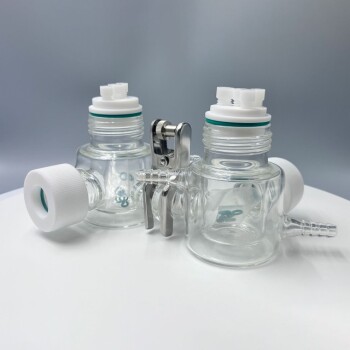
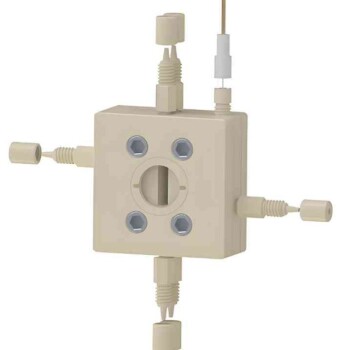
A double-chamber electrochemical permeation cell serves as the primary instrument for isolating and measuring the movement of hydrogen through 9% Cr steel. By physically using the steel sample as a wall between two distinct chemical environments, the device separates the creation of hydrogen from its detection, allowing for a precise calculation of how easily hydrogen diffuses through the material.
The cell’s unique configuration decouples the hydrogen charging process from the oxidation detection process. This separation is essential for generating accurate time-dependent flux data and calculating the effective diffusion coefficient of the metal.
The Mechanics of the Permeation Cell
To understand how this tool characterizes 9% Cr steel, one must look at how it manages two opposing chemical reactions simultaneously.
Physical Separation of Environments
The core component of the cell is the thin metal membrane—in this case, the sample of 9% Cr steel.
This membrane completely separates the device into two isolated compartments: the cathode chamber and the anode chamber.
The Cathode Chamber: Hydrogen Generation
The cathode compartment contains an acidic electrolyte.
By applying a constant current, this chamber generates hydrogen atoms on the entry surface of the steel.
This creates the driving force required for hydrogen atoms to absorb into the steel lattice and begin their migration.
The Anode Chamber: Hydrogen Detection
On the exit side of the membrane, the anode chamber utilizes an alkaline solution.
This side operates under potential control, designed specifically to capture hydrogen atoms as they emerge from the steel.
Once captured, the hydrogen is oxidized, generating an electrical current that is directly proportional to the amount of hydrogen passing through.
Decoupling Generation from Detection
The defining role of the double-chamber design is decoupling.
It ensures that the harsh acidic conditions required to force hydrogen into the steel do not interfere with the sensitive alkaline environment needed to measure it.
Quantifying Hydrogen Behavior
The ultimate goal of using this cell is to convert chemical reactions into quantitative data regarding the steel's performance.
Measuring Time-Dependent Flux
The system continuously records the current in the anode chamber, providing a real-time graph of hydrogen flux.
This data reveals exactly how long it takes for hydrogen to breakthrough the material and how the flow rate changes over time.
Calculating Diffusion Coefficients
By analyzing the time lag and the steady-state current, researchers can calculate the effective diffusion coefficient.
This provides a definitive numerical value representing how fast hydrogen travels through the 9% Cr steel microstructure.
Critical Operational Considerations
While the double-chamber cell is the standard for these measurements, the reliability of the data depends on maintaining the integrity of the separation.
Membrane Integrity
Because the 9% Cr steel acts as the barrier, the sample must be a thin metal membrane free of physical defects.
If the membrane is compromised, the acidic and alkaline solutions will mix, instantly invalidating the experiment.
Electrolyte Maintenance
The accuracy of the diffusion coefficient relies on the chemical stability of the chambers.
The cathode must remain strictly acidic to maintain constant generation, while the anode must remain alkaline to ensure complete capture and oxidation.
Making the Right Choice for Your Goal
When characterizing 9% Cr steel, the double-chamber cell provides specific insights depending on your data requirements.
- If your primary focus is Kinetics: Use the time-lag data from the anode chamber to determine the diffusion coefficient, which tells you how fast hydrogen moves through the lattice.
- If your primary focus is Permeability: Focus on the steady-state current to measure the total hydrogen flux, indicating how much hydrogen the material allows to pass through at saturation.
This apparatus remains the most effective method for decoupling chemical interference to reveal the true hydrogen transport properties of the material.
Summary Table:
| Feature | Cathode Chamber | Anode Chamber |
|---|---|---|
| Primary Function | Hydrogen Generation | Hydrogen Detection/Oxidation |
| Electrolyte Type | Acidic Solution | Alkaline Solution |
| Control Mode | Constant Current | Potential Control |
| Key Outcome | Hydrogen absorption into lattice | Electrical current (Hydrogen flux) |
| Key Metric | Driving force (Charging) | Time-lag & Diffusion coefficient |
Optimize Your Hydrogen Diffusion Research with KINTEK
Precision in material science starts with the right equipment. KINTEK specializes in high-performance laboratory solutions, providing the specialized electrolytic cells and electrodes necessary to study the hydrogen transport properties of materials like 9% Cr steel with unmatched accuracy.
Our extensive portfolio supports your entire workflow—from high-temperature furnaces (muffle, tube, and vacuum) for sample preparation to crushing and milling systems for material refinement. Whether you are conducting advanced battery research, electrochemical analysis, or high-pressure studies using our high-pressure reactors and autoclaves, KINTEK delivers the durability and precision your lab demands.
Ready to elevate your research standards? Contact KINTEK today to discuss your laboratory equipment needs.
References
- Michael Rhode, Alexander Nitsche. Thickness and microstructure effect on hydrogen diffusion in creep-resistant 9% Cr P92 steel and P91 weld metal. DOI: 10.1007/s40194-021-01218-9
This article is also based on technical information from Kintek Solution Knowledge Base .
Related Products
- H-Type Double-Layer Optical Electrolytic Electrochemical Cell with Water Bath
- Double-Layer Water Bath Electrolytic Electrochemical Cell
- Double Layer Five-Port Water Bath Electrolytic Electrochemical Cell
- Customizable PEM Electrolysis Cells for Diverse Research Applications
- Multifunctional Electrolytic Electrochemical Cell Water Bath Single Layer Double Layer
People Also Ask
- What is the overall structure of the H-type double-layer optical water bath electrolytic cell? Precision Design for Controlled Experiments
- How is the electrolyte managed in H-type electrolytic cells for specific reactions? Achieve Precise Control and High Purity
- What checks should be performed on the H-type electrolytic cell before use? Ensure Accurate Electrochemical Data
- What is important regarding temperature control for the H-type electrolytic cell? Ensure Precision and Data Integrity
- What is the overall structure of the H-type electrolytic cell? Understanding Dual-Chamber Electrochemical Designs