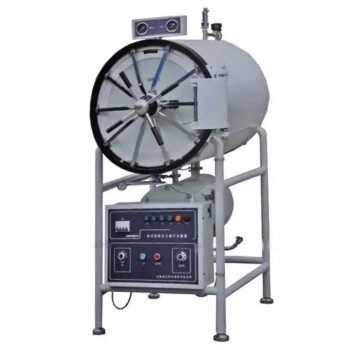
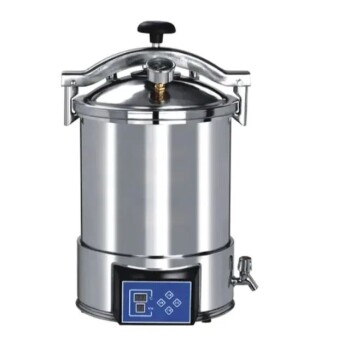
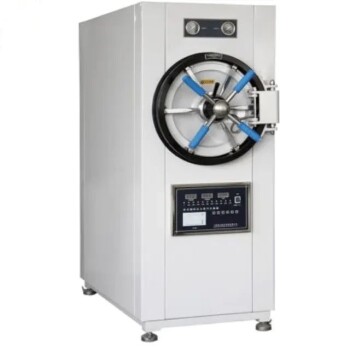
In the synthesis of Antimony Selenosulfide ($Sb_2(S,Se)_3$) absorber thin films, the high-pressure autoclave acts as the critical reactor for controlled hydrothermal growth. This equipment creates a sealed, high-temperature, and high-pressure environment that allows precursor salts—containing antimony, sulfur, and selenium—to react and crystallize. By maintaining conditions impossible at standard atmospheric pressure, the autoclave enables the formation of films with superior crystallinity and specific crystal orientations necessary for high-performance solar cells.
The high-pressure autoclave facilitates the hydrothermal synthesis of $Sb_2(S,Se)_3$ by providing the energy required for dense crystal growth and precise phase control. This process is essential for creating large-grain absorber layers that minimize energy loss through grain boundary recombination.
The Mechanics of Hydrothermal Synthesis
Overcoming Atmospheric Boiling Points
The primary role of the autoclave is to maintain solvents in a liquid state at temperatures far exceeding their standard boiling points. This high-energy environment significantly accelerates chemical reaction rates between the antimony, sulfur, and selenium sources.
Facilitating Precursor Reactions
Within the Teflon-lined chamber, precursor salts undergo rapid dissolution and recrystallization. The sealed environment ensures that volatile components, particularly selenium and sulfur sources, remain in the system to react fully rather than escaping as vapor.
Driving Nucleation and Oriented Growth
The pressurized environment provides the kinetic energy necessary for the oriented growth of crystals. This allows researchers to induce specific morphologies and nano-sizes that are difficult or impossible to achieve under normal laboratory conditions.
Enhancing Structural Properties for Photovoltaics
Promoting Large Grain Sizes
A major advantage of using an autoclave is the ability to produce absorber films with large grain sizes. In photovoltaic applications, larger grains mean fewer grain boundaries, which are often sites for charge carrier entrapment.
Controlling Crystal Orientation
The autoclave environment favors the development of specific preferred orientations, such as the (120) and (221) crystal planes. These orientations are critical because they facilitate better charge transport and effectively reduce grain boundary recombination, directly improving solar cell efficiency.
Achieving High Crystallinity
The stable, pressurized heat within the reactor ensures that the resulting $Sb_2(S,Se)_3$ thin films possess high crystallinity. This structural purity is essential for ensuring the material can efficiently absorb light and convert it into electrical energy without significant internal resistance.
Understanding the Trade-offs
Safety and Operational Complexity
Operating high-pressure autoclaves requires rigorous safety protocols to manage the risks associated with thermal expansion and pressure buildup. Failure to properly seal the Teflon liner or exceeding temperature limits can lead to equipment failure or hazardous leaks.
Scalability and Processing Time
While excellent for laboratory-scale precision, hydrothermal synthesis in an autoclave is a batch process that can be time-consuming. Achieving the desired crystal growth often requires several hours of "dwell time" at high temperatures, which may limit high-throughput manufacturing compared to continuous vacuum processes.
Equipment Maintenance
The corrosive nature of sulfur and selenium precursors necessitates the use of specialized liners (like Teflon). These liners must be inspected frequently for degradation, as any contamination from the steel autoclave body can poison the semiconductor film and degrade its electronic properties.
How to Apply This to Your Research
Making the Right Choice for Your Goal
The use of an autoclave is highly dependent on your specific material requirements and the desired efficiency of the final device.
- If your primary focus is Maximizing Efficiency: Utilize the autoclave to target the (120) and (221) crystal planes, as these orientations specifically minimize recombination losses.
- If your primary focus is Material Purity: Ensure the use of a high-quality Teflon liner to prevent metallic contamination from the reactor walls during the high-pressure reaction.
- If your primary focus is Morphological Control: Precisely calibrate the temperature and pressure parameters to induce specific nano-sizes that optimize light-harvesting capabilities.
The high-pressure autoclave remains an indispensable tool for engineering the complex crystalline structures required for next-generation $Sb_2(S,Se)_3$ photovoltaics.
Summary Table:
| Key Function | Impact on Sb2(S,Se)3 Thin Films |
|---|---|
| Hydrothermal Energy | Overcomes boiling points to accelerate precursor reactions and crystallization. |
| Sealed Environment | Prevents loss of volatile sulfur and selenium, ensuring precise stoichiometric control. |
| Pressure Control | Drives oriented growth of (120) and (221) planes to reduce charge recombination. |
| Thermal Stability | Promotes large grain sizes and high crystallinity for improved light absorption. |
Elevate Your Thin-Film Research with KINTEK Precision
Are you looking to achieve superior crystallinity and optimized crystal orientation in your $Sb_2(S,Se)_3$ solar cells? KINTEK specializes in advanced laboratory equipment designed for the most demanding material science applications. Our high-performance high-pressure high-pressure reactors and autoclaves provide the stability and safety required for precise hydrothermal growth, featuring high-quality PTFE/Teflon liners to ensure zero metallic contamination.
Beyond reactors, KINTEK offers a comprehensive portfolio including:
- Thermal Processing: Muffle, tube, and vacuum furnaces for precise annealing.
- Material Preparation: Crushing, milling, and hydraulic pellet presses.
- Lab Essentials: High-purity ceramics, crucibles, and cooling solutions like ULT freezers.
Whether you are aiming to maximize photovoltaic efficiency or scale up batch processing, our team is ready to provide the reliable tools and technical support your research deserves.
Ready to optimize your synthesis process? Contact KINTEK today for a customized solution!
References
- Changxue Wang, Ru Zhou. Interfacial defect healing of In<sub>2</sub>S<sub>3</sub>/Sb<sub>2</sub>(S,Se)<sub>3</sub> heterojunction solar cells with a novel wide-bandgap InOCl passivator. DOI: 10.1039/d3ta01736b
This article is also based on technical information from Kintek Solution Knowledge Base .
Related Products
- Mini SS High Pressure Autoclave Reactor for Laboratory Use
- High Pressure Laboratory Autoclave Reactor for Hydrothermal Synthesis
- Stainless High Pressure Autoclave Reactor Laboratory Pressure Reactor
- Desktop Fast High Pressure Laboratory Autoclave Sterilizer 16L 24L for Lab Use
- Laboratory High Pressure Horizontal Autoclave Steam Sterilizer for Lab Use
People Also Ask
- Why use high-pressure reactors for molecular sieve synthesis? Unlock Superior Crystallinity and Framework Control
- What are the advantages of using a high-pressure reactor like an autoclave? Maximize Liquefaction Speed & Yield
- Why are high-pressure reactors or autoclaves necessary for the synthesis of new functional materials? Unlock Precision.
- What is the function of a high-pressure reactor autoclave? Enhancing Cu/N Co-Doped Carbon Catalyst Synthesis
- How are high-pressure reactors used to prepare metaphosphate electrocatalysts? Master In-Situ Precursor Growth