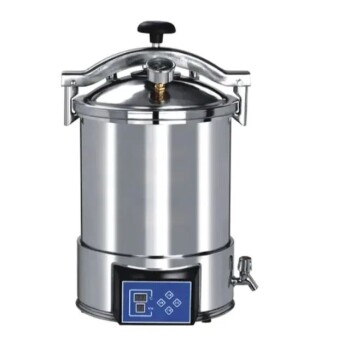
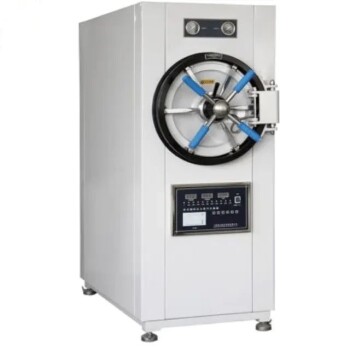
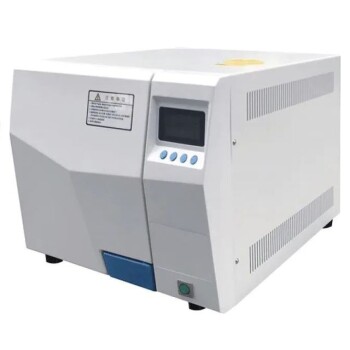
A high-pressure autoclave serves as the central control chamber for the hydrothermal synthesis of porous hydroxyapatite (HA). It creates a sealed, high-temperature, and high-pressure environment that forces liquid-phase precursors to undergo uniform physicochemical transformations, which are impossible to achieve under standard ambient conditions.
By establishing a subcritical state within a closed system, the autoclave significantly enhances the solubility and reaction kinetics of precursors. This allows operators to precisely manipulate the dissolution and recrystallization processes, directly determining the material's final porosity, surface area, and catalytic efficiency.
The Hydrothermal Environment
The autoclave is not merely a containment vessel; it is an active instrument that alters the physical properties of the solvent (usually water).
Creating a Subcritical State
By heating the aqueous solution inside a sealed volume, the autoclave raises the pressure significantly. This brings the water into a subcritical state, where its properties change to facilitate the solubility of precursors that are typically insoluble.
Driving Dissolution and Recrystallization
The high-pressure environment promotes a continuous cycle of dissolution and recrystallization. This mechanism ensures that the raw materials are broken down and re-formed in an equilibrium state, leading to superior phase reproducibility.
Guiding Self-Assembly
This controlled environment guides the ordered self-assembly of hydroxyapatite crystals. Instead of random precipitation, the autoclave conditions encourage the formation of a mesoporous structure (a material containing pores with diameters between 2 and 50 nm), which is the defining feature of effective HA catalysts.
Impact on Catalyst Performance
The primary goal of using an autoclave is to enhance the functional properties of the HA powder as a heterogeneous catalyst.
Tuning Surface Area and Porosity
The specific active sites of a catalyst are located on its surface. By adjusting the residence time and temperature, the autoclave maximizes the specific surface area. A higher surface area allows for greater interaction between the catalyst and reactants.
Enhancing Ion Exchange and Adsorption
The mesoporous structure developed in the autoclave significantly improves the material's ion exchange capacity. This structural feature is critical for the material's adsorption performance, particularly in oxidation reactions or when incorporating dopants like molybdate anions.
Controlling Crystal Phase Composition
Catalytic activity depends on the purity of the material. The autoclave ensures the uniform incorporation of components and precise control over the crystal phase, preventing the formation of unwanted impurities that could hinder catalytic performance.
Understanding the Trade-offs
While the autoclave enables precision, it requires a delicate balance of parameters.
Crystallinity vs. Porosity
There is often a trade-off between high crystallinity and high porosity. Excessive temperature or pressure can lead to "over-crystallization," where crystals grow too large, causing the porous framework to collapse and reducing the specific surface area.
Sensitivity to Process Duration
The residence time is critical. If the synthesis is stopped too early, the phase transformation may be incomplete. If it runs too long, the mesoporous structure may degrade due to Ostwald ripening (where larger particles grow at the expense of smaller ones), diminishing catalytic activity.
Making the Right Choice for Your Goal
To maximize the utility of your high-pressure autoclave, you must align your process parameters with your specific catalytic requirements.
- If your primary focus is Maximum Reactivity: Prioritize parameters that maximize specific surface area and pore volume, even if it means accepting slightly lower crystallinity.
- If your primary focus is Structural Stability: Increase the temperature or duration slightly to ensure a more robust, highly crystalline phase, which improves durability during aggressive chemical oxidation reactions.
The autoclave provides the levers to control the material's destiny; your success depends on tuning the pressure and temperature to balance structural integrity with active surface exposure.
Summary Table:
| Parameter Influence | Effect on Hydroxyapatite (HA) Synthesis | Impact on Catalyst Performance |
|---|---|---|
| Subcritical State | Increases solubility of precursors | Ensures uniform phase reproducibility |
| High Pressure | Drives dissolution and recrystallization | Enhances ion exchange & adsorption |
| Temperature Control | Guides ordered self-assembly | Tunes porosity & specific surface area |
| Residence Time | Manages crystal growth (Ostwald ripening) | Balances crystallinity vs. porosity |
Elevate Your Material Research with KINTEK Precision
Unlock the full potential of your catalyst synthesis with KINTEK’s high-performance high-temperature high-pressure reactors and autoclaves. Our laboratory equipment is designed to provide the rigorous environmental control necessary for the hydrothermal synthesis of hydroxyapatite and other advanced porous materials.
Why partner with KINTEK?
- Unmatched Precision: Achieve the subcritical states required for superior phase purity.
- Comprehensive Solutions: Beyond autoclaves, we offer crushing and milling systems, furnaces, and essential consumables like crucibles and ceramics.
- Dedicated Support: Our tools are tailored for researchers focusing on battery tools, dental applications, and advanced chemical oxidation.
Ready to optimize your mesoporous structure and catalytic efficiency? Contact us today to find the perfect autoclave for your lab!
References
- Malgorzata Rybczynska, Artur Sikorski. Multicomponent crystals of nimesulide: design, structures and properties. DOI: 10.21175/rad.abstr.book.2023.23.1
This article is also based on technical information from Kintek Solution Knowledge Base .
Related Products
- Mini SS High Pressure Autoclave Reactor for Laboratory Use
- High Pressure Laboratory Autoclave Reactor for Hydrothermal Synthesis
- Stainless High Pressure Autoclave Reactor Laboratory Pressure Reactor
- Desktop Fast High Pressure Laboratory Autoclave Sterilizer 16L 24L for Lab Use
- Laboratory High Pressure Horizontal Autoclave Steam Sterilizer for Lab Use
People Also Ask
- Why use high-pressure reactors for molecular sieve synthesis? Unlock Superior Crystallinity and Framework Control
- What are the advantages of using a high-pressure reactor like an autoclave? Maximize Liquefaction Speed & Yield
- What is the function of a high-pressure reactor autoclave? Enhancing Cu/N Co-Doped Carbon Catalyst Synthesis
- Why are high-pressure reactors or autoclaves necessary for the synthesis of new functional materials? Unlock Precision.
- How are high-pressure reactors used to prepare metaphosphate electrocatalysts? Master In-Situ Precursor Growth