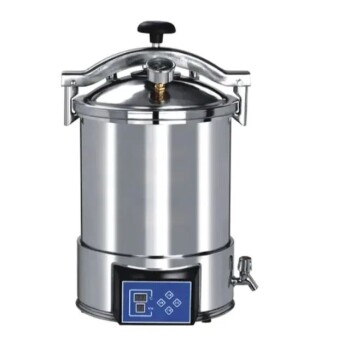
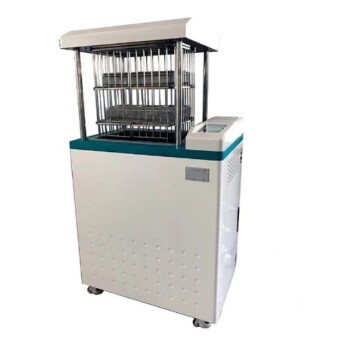
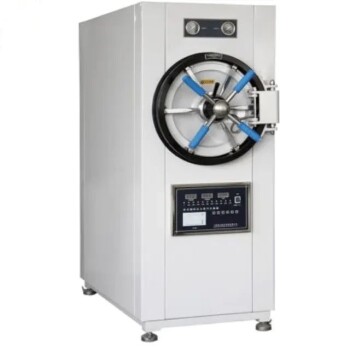
The high-pressure digestion tank or autoclave serves as the essential reaction vessel that creates a sealed, high-energy environment for the hydrothermal synthesis of $A_xWO_3$. By allowing temperatures to exceed the atmospheric boiling point of the solvent, the autoclave generates the pressure and thermal energy necessary to drive the complex redox reactions and ion insertion processes required to form stable tungsten bronze crystals.
Core Takeaway: The autoclave is not merely a container; it is a thermodynamic tool that enables the thorough contact, reduction, and crystallization of tungstic acid into $A_xWO_3$ by maintaining extreme physical conditions that facilitate alkali metal ion insertion and precise crystal growth.
The Critical Role of the Hydrothermal Environment
Exceeding Atmospheric Boiling Points
In a standard open-air environment, aqueous reactions are limited by the boiling point of water. The sealed autoclave allows the precursor solution to reach temperatures significantly higher (often 180°C or more), which provides the kinetic energy needed for tungstic acid to react.
Accelerating Reaction Kinetics
The high-pressure environment within the tank facilitates the accelerated dissolution and recrystallization of reactants. This acceleration is vital for ensuring that the precursors interact thoroughly at a molecular level, leading to more uniform material properties.
Facilitating Tungsten Bronze Crystallization
Driving Redox and Ion Insertion
The synthesis of tungsten bronze requires a redox reaction between tungstic acid and reducing agents like hydrazine hydrate. The autoclave's pressurized environment ensures that alkali metal salts (such as sodium or potassium nitrate) can be successfully inserted into the tungsten oxide lattice.
Precision in Nucleation and Growth
The controlled hydrothermal environment allows for heterogeneous nucleation, where crystals grow in an organized manner. This is critical for achieving the specific crystal planes and stable structures that define $A_xWO_3$ materials.
Ensuring Material Integrity and Purity
The Importance of PTFE Lining
Most high-pressure digestion tanks utilize a Polytetrafluoroethylene (PTFE) or Teflon liner. This liner is chemically inert and resists the highly acidic environments common in tungsten synthesis, preventing the introduction of metallic impurities from the tank walls.
Achieving High Crystallinity
The stable high-temperature conditions promote the formation of materials with high crystallinity and specific morphologies, such as nanorod arrays. This structural precision is essential for the material's performance in catalytic or electronic applications.
Understanding the Trade-offs and Pitfalls
Safety and Pressure Limits
While high pressure is necessary for synthesis, it introduces significant safety risks. If the temperature is increased too rapidly or exceeds the rated limit of the vessel, the pressure can cause mechanical failure or explosions.
Scaling and Throughput Challenges
Autoclave synthesis is typically a batch process, which can limit production scalability. The time required for the vessel to heat up and cool down adds significant "dead time" to the manufacturing cycle compared to continuous flow processes.
Maintenance of Seal Integrity
The effectiveness of the autoclave relies entirely on its ability to maintain a hermetic seal. Wear and tear on the PTFE liner or the tank's gaskets can lead to pressure leaks, which drop the reaction temperature and result in incomplete ion insertion or poor crystallinity.
How to Apply This to Your Project
Making the Right Choice for Your Goal
- If your primary focus is material purity: Ensure your autoclave uses a high-quality PTFE liner to prevent corrosion and metallic contamination from the reactor body.
- If your primary focus is specific crystal morphology: Prioritize reactors with precise temperature control systems, as even small fluctuations can alter the nucleation rate and the resulting nano-size.
- If your primary focus is safety and longevity: Regularly inspect the gaskets and the structural integrity of the stainless steel outer shell to prevent failure under high-pressure conditions.
By mastering the pressurized environment of the autoclave, researchers can precisely control the chemical and structural evolution of tungsten bronze materials for advanced applications.
Summary Table:
| Function | Impact on $A_xWO_3$ Synthesis | Key Component |
|---|---|---|
| High Pressure/Temp | Drives redox reactions and alkali metal ion insertion. | Sealed Stainless Vessel |
| Kinetic Acceleration | Speeds up dissolution and recrystallization for uniformity. | Thermal Energy |
| Contamination Control | Resists acidic corrosion to maintain high material purity. | PTFE (Teflon) Liner |
| Structural Precision | Enables heterogeneous nucleation for stable nanorod arrays. | Temperature Control |
Elevate Your Hydrothermal Synthesis with KINTEK
Precision and reliability are paramount when synthesizing advanced $A_xWO_3$ materials. KINTEK specializes in high-performance laboratory equipment designed to meet the rigorous demands of material science.
We offer a comprehensive range of high-temperature high-pressure reactors and autoclaves, essential PTFE products and crucibles, and precise muffle and tube furnaces to ensure your research achieves maximum crystallinity and purity. Whether you are focusing on battery research, catalysis, or electronic applications, our robust solutions provide the safety and control your lab requires.
Ready to optimize your synthesis process? Contact KINTEK today to find the perfect equipment for your specific research goals!
References
- Zi-Xiang Liu, Jin‐Ku Liu. Rapid Synthesis of A<sub><i>x</i></sub>WO<sub>3</sub> (A = H, Na, K) Tungsten Bronze Materials with Strong Near‐Infrared Absorption and Enhanced Photoelectric Anticorrosion Properties. DOI: 10.1002/adem.202301003
This article is also based on technical information from Kintek Solution Knowledge Base .
Related Products
- Mini SS High Pressure Autoclave Reactor for Laboratory Use
- High Pressure Laboratory Autoclave Reactor for Hydrothermal Synthesis
- Stainless High Pressure Autoclave Reactor Laboratory Pressure Reactor
- Desktop Fast High Pressure Laboratory Autoclave Sterilizer 16L 24L for Lab Use
- Portable High Pressure Laboratory Autoclave Steam Sterilizer for Lab Use
People Also Ask
- Why use high-pressure reactors for molecular sieve synthesis? Unlock Superior Crystallinity and Framework Control
- Why are high-pressure reactors or autoclaves necessary for the synthesis of new functional materials? Unlock Precision.
- What are the advantages of using a high-pressure reactor like an autoclave? Maximize Liquefaction Speed & Yield
- What is the function of a high-pressure reactor autoclave? Enhancing Cu/N Co-Doped Carbon Catalyst Synthesis
- How are high-pressure reactors used to prepare metaphosphate electrocatalysts? Master In-Situ Precursor Growth