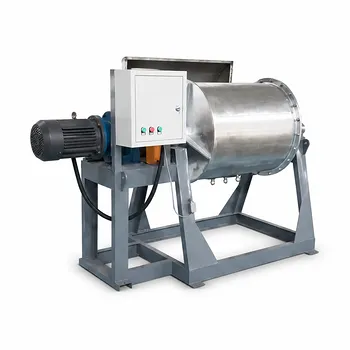
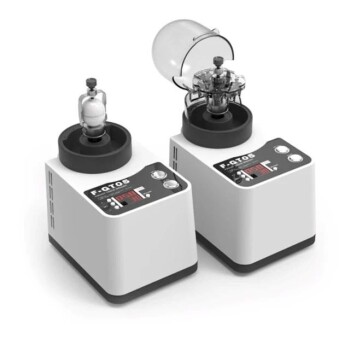
The planetary ball mill serves as the primary mechanism for mechanical activation and homogenization in the synthesis of Ta-LLZO.
In the preparation of Tantalum-doped Lithium Lanthanum Zirconium Oxide (Ta-LLZO), the planetary ball mill uses high-energy impact and shear forces to refine raw materials like lithium hydroxide, tantalum oxide, zirconium oxide, and lanthanum oxide. This process reduces particle sizes to the micrometer or nanometer scale and ensures atomic-level mixing of the dopants. By increasing the contact surface area and lowering the reaction activation energy, the ball mill facilitates the formation of a high-purity cubic garnet structure during subsequent thermal processing.
The planetary ball mill is essential for transforming inert raw powders into a highly reactive, uniform precursor. This mechanical processing ensures the structural integrity and high ionic conductivity required for high-performance solid-state electrolytes.
Mechanical Refinement and Particle Size Reduction
Increasing Reaction Surface Area
High-energy milling breaks down the large agglomerates of raw oxides and hydroxides into much finer particles. This drastic increase in surface area provides more contact points between the different chemical species, which is vital for efficient solid-phase diffusion.
Reaching Nanoscale Dimensions
Refining the powders to a micrometer or nanometer scale is a prerequisite for achieving a dense final ceramic. Fine particles pack more efficiently during the shaping process and sinter more readily at lower temperatures.
Achieving Atomic-Level Homogeneity
Uniform Distribution of Tantalum Dopants
Tantalum must be distributed perfectly throughout the lattice to stabilize the cubic garnet phase of LLZO. The planetary ball mill prevents localized concentration gradients, ensuring the dopant is present at every atomic site required for stability.
Preventing Chemical Segregation
A uniform precursor leads to a homogeneous microstructure in the final solid-state electrolyte. This prevents the formation of "dead zones" or high-resistance grain boundaries that could impede lithium-ion movement within the battery.
Lowering the Synthesis Energy Barrier
Mechanical Activation of Precursors
The intense mechanical energy of the ball mill induces structural defects and strains in the crystal lattices of the raw materials. This state of "mechanical activation" makes the chemicals more reactive and ready for the next phase of synthesis.
Facilitating Pure Phase Formation
By lowering the energy barrier for the solid-state reaction, the ball mill ensures that the pure cubic garnet phase forms more easily. Without this high-energy mixing, the reaction might result in undesirable secondary phases that lower ionic conductivity.
Understanding the Trade-offs and Pitfalls
Contamination from Grinding Media
The high-energy nature of the process can cause wear on the milling jars and balls, potentially introducing impurities like alumina or zirconia into the Ta-LLZO. Users must carefully select grinding media that are chemically compatible with the electrolyte.
Heat Generation and Powder Agglomeration
Prolonged milling at high speeds generates significant heat, which can lead to the re-agglomeration of fine powders or the loss of volatile components like lithium. Proper cooling intervals or "rest periods" are often necessary to maintain the quality of the precursor.
Optimizing Your Ta-LLZO Preparation
To achieve the highest quality solid-state electrolyte, the milling strategy must be tailored to your specific performance goals.
- If your primary focus is phase purity: Use moderate milling speeds over longer durations to ensure the tantalum dopant is perfectly incorporated into the precursor without excessive heat buildup.
- If your primary focus is high ionic conductivity: Utilize high-purity zirconia grinding media and an anhydrous milling medium (like ethanol) to minimize contamination and ensure a ultra-fine particle size distribution.
Properly executed ball milling is the foundational step that dictates the electrochemical success of the final Ta-LLZO solid-state electrolyte.
Summary Table:
| Function | Impact on Ta-LLZO Synthesis | Key Benefit |
|---|---|---|
| Particle Size Reduction | Breaks agglomerates to micro/nanoscale | Increases surface area for faster solid-phase diffusion |
| Atomic Homogenization | Uniformly distributes Tantalum dopants | Stabilizes the cubic garnet phase and prevents segregation |
| Mechanical Activation | Induces structural defects and lattice strain | Lowers the reaction energy barrier for pure phase formation |
| Microstructure Control | Ensures dense ceramic packing | Minimizes high-resistance grain boundaries in the electrolyte |
Elevate Your Solid-State Battery Research with KINTEK
Achieving the perfect cubic garnet structure for Ta-LLZO requires precision at the foundational level. KINTEK specializes in high-performance laboratory equipment designed for advanced materials synthesis. From our high-energy planetary ball mills and crushing systems for flawless precursor homogenization to our high-temperature muffle and vacuum furnaces for precise sintering, we provide the tools necessary to maximize ionic conductivity.
Whether you need ultra-pure zirconia grinding media, high-purity crucibles, or specialized hydraulic pellet presses for electrolyte shaping, KINTEK offers a comprehensive ecosystem for battery innovation.
Ready to optimize your Ta-LLZO preparation? Contact our experts today to find the ideal equipment for your laboratory.
References
- Changmin Shi, Eric D. Wachsman. High Sulfur Loading and Capacity Retention in Bilayer Garnet Sulfurized‐Polyacrylonitrile/Lithium‐Metal Batteries with Gel Polymer Electrolytes. DOI: 10.1002/aenm.202301656
This article is also based on technical information from Kintek Solution Knowledge Base .
Related Products
- High Energy Planetary Ball Mill for Laboratory Horizontal Tank Type Milling Machine
- High-Energy Omnidirectional Planetary Ball Mill Milling Machine for Laboratory
- Laboratory Planetary Ball Mill Rotating Ball Milling Machine
- High Energy Planetary Ball Mill Milling Machine for Laboratory
- High Energy Planetary Ball Mill Machine for Laboratory Horizontal Tank Type
People Also Ask
- What is the role of a planetary ball mill in sulfide-based solid-state batteries? Engineer High-Performance Cathodes
- What are the parameters of a planetary ball mill? Master Speed, Time, and Media for Perfect Grinding
- What is the function of a planetary ball mill for nanostructured eutectic steel? Essential Prep for High-Strength Alloys
- What role does a planetary ball mill play in the preparation of NASICON-type solid electrolytes like LATP and LAGP?
- What is the function of a planetary ball mill in solid-state electrolyte prep? Milling vs. SDS Methods Explained