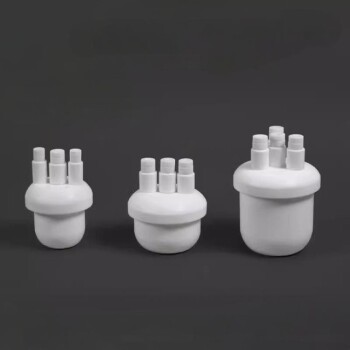
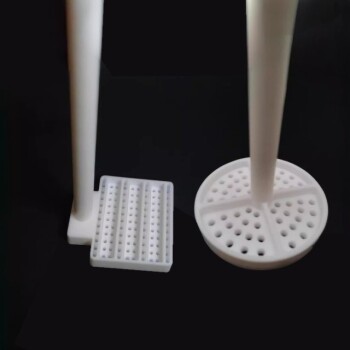
A PTFE multi-port manifold acts as the structural foundation for electrochemical cells operating in harsh, acidic environments. It serves a dual purpose: ensuring the physical durability of the setup against nitric acid corrosion and guaranteeing the geometric precision required for accurate electrical measurements.
The PTFE manifold is not merely a lid; it is a precision tool that stabilizes the three-electrode system to prevent short circuits and minimize ohmic (IR) drop errors, ensuring data integrity even in aggressive micro-electrolytes.
The Critical Function of Material Selection
Resisting Chemical Aggression
In environments involving strong acid corrosion, such as nitric acid, standard materials degrade rapidly.
PTFE (Polytetrafluoroethylene) is utilized specifically for its chemical inertness. This prevents the dissolution of the manifold, which would otherwise contaminate the electrolyte and compromise the experiment.
Ensuring Electrical Isolation
Accuracy in electrochemical measurement relies on ensuring current flows only through the intended pathways.
The manifold provides superior electrical insulation. This isolates the sensing components from the structural components, ensuring that the measured signals reflect the electrochemical reaction, not leakage currents.
Spatial Precision and Measurement Accuracy
Stabilizing the Three-Electrode System
The manifold provides stable spatial positioning for the essential components: the working, reference, and auxiliary electrodes.
By fixing these electrodes in place, the manifold maintains a constant geometry throughout the experiment.
Minimizing IR Drop Errors
In electrochemical measurements, particularly within micro-electrolytes, the distance between electrodes is a critical variable.
Unintended electrode displacement alters the resistance of the solution path. The PTFE manifold prevents this movement, thereby minimizing IR drop (ohmic drop) errors that can skew voltage measurements.
Preventing Component Failure
Loose electrodes in a small cell volume pose a significant risk of physical contact.
The manifold’s rigid positioning prevents short circuits that would occur if the working, reference, or auxiliary electrodes were to touch, which would immediately invalidate the test and potentially damage the potentiostat.
Common Pitfalls to Avoid
Neglecting Electrode Stability
A common oversight in cell design is underestimating the impact of electrode displacement.
Without a rigid manifold, electrodes may shift due to vibrations or solution movement. This shifting changes the potential distribution in the solution, making data noisy and unrepeatable.
Overlooking Geometric Consistency
In micro-electrolytes, even millimeter-scale variations can cause significant errors.
Failing to use a manifold that ensures fixed spacing introduces undefined variables into the experiment. For high-precision work, the geometry must be as controlled as the chemistry.
Making the Right Choice for Your Goal
When designing or selecting an electrochemical cell for acidic environments, consider your specific analytical needs:
- If your primary focus is Equipment Longevity: Prioritize the PTFE material construction to withstand prolonged exposure to strong nitric acid without degradation.
- If your primary focus is Data Accuracy: Rely on the manifold's ability to rigidly fix the three-electrode geometry to eliminate short circuits and reduce IR drop errors.
The PTFE multi-port manifold converts a chaotic chemical environment into a stable, measurable system.
Summary Table:
| Feature | Function in Nitric Acid Environments | Benefit to Researcher |
|---|---|---|
| Material: PTFE | Complete chemical inertness to strong acids | Prevents electrolyte contamination and equipment degradation |
| Electrical Insulation | High dielectric strength isolates electrodes | Eliminates leakage currents for cleaner signal detection |
| Rigid Port Design | Stabilizes Working, Reference, and Counter electrodes | Maintains constant geometry and repeatable spatial data |
| Spatial Precision | Fixes electrode distance in micro-electrolytes | Minimizes IR drop (ohmic drop) errors and prevents short circuits |
Elevate Your Electrochemical Research with KINTEK Precision
Don't let corrosive environments compromise your data integrity. KINTEK specializes in high-performance laboratory solutions, providing the chemical resistance and structural precision your experiments demand.
Whether you require PTFE consumables and electrolytic cells for harsh acid environments, or advanced battery research tools and high-temperature reactors, our expert team is ready to equip your lab with the best.
Maximize your measurement accuracy and equipment longevity—contact KINTEK today to find the perfect solution for your lab!
References
- Richard J. Wilbraham, Colin Boxall. The effect of SO<sub>3</sub>-Ph-BTBP on stainless steel corrosion in nitric acid. DOI: 10.1515/nuka-2015-0117
This article is also based on technical information from Kintek Solution Knowledge Base .
Related Products
- Custom PTFE Teflon Parts Manufacturer for Centrifuge Tubes
- Custom PTFE Teflon Parts Manufacturer for Air Valve Applications
- Custom PTFE Teflon Parts Manufacturer for Three-Necked Round Bottom Flask
- Customizable PTFE Wafer Carriers for Semiconductor and Lab Applications
- Custom PTFE Teflon Parts Manufacturer for Sampling Filters
People Also Ask
- Why is slender PTFE tubing necessary for flow control in multi-channel catalyst aging? Ensure Equal Gas Distribution
- Is PTFE corrosion resistant? Discover the Ultimate Chemical Resistance for Your Lab
- What are the specific applications of PTFE in micro-batch slug flow systems? Enhance Your Microfluidic Reaction Purity
- How is PTFE utilized for insulation in Alloy 22 corrosion setups? Ensure Signal Purity & Accuracy
- What is the significance of using PTFE gas tubing for HCl? Ensure Pure, Corrosion-Free Salt Formation