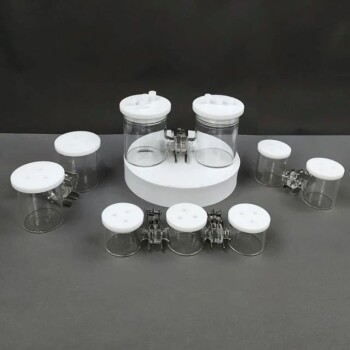
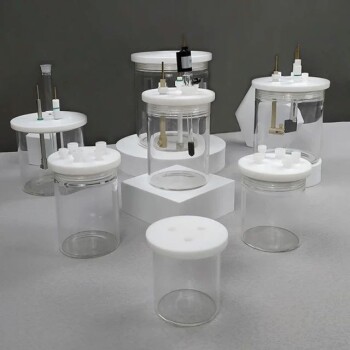
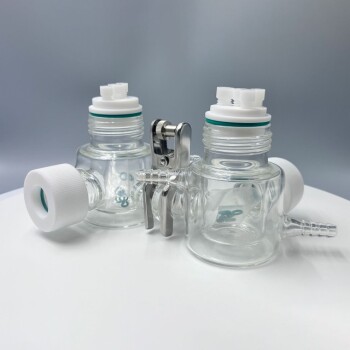
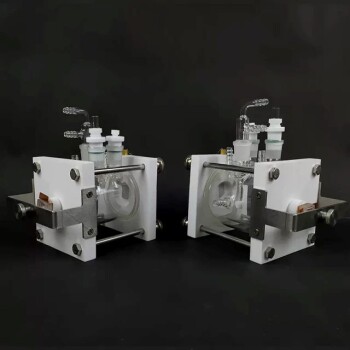
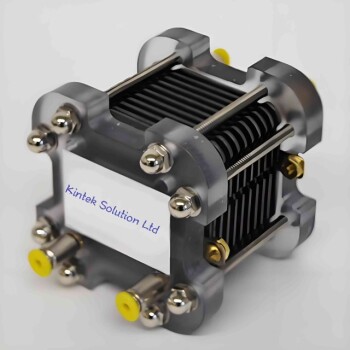
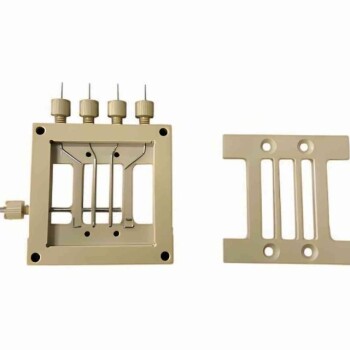
A three-electrode electrolytic cell system acts as the standardized control environment necessary for isolating and quantifying the intrinsic electrochemical properties of perovskite oxides. By employing a specific configuration of a working electrode, reference electrode, and counter electrode, this system allows researchers to precisely measure catalytic performance—such as Oxygen Evolution Reaction (OER) efficiency—without the interference of solution resistance or polarization errors.
Core Takeaway The three-electrode system decouples the circuit that carries the current from the circuit that measures the voltage. This separation allows for the rigorous quantification of a perovskite material’s reaction kinetics, impedance, and discharge capacity by eliminating potential drops caused by the electrolyte itself.
The Mechanics of Precision Measurement
Isolating the Test Sample
To test a perovskite oxide, the material is applied to the working electrode. This is physically isolated within the cell alongside a reference electrode (often Ag/AgCl) and a counter electrode (typically a graphite rod or platinum wire).
Decoupling Current and Voltage
The fundamental advantage of this design is its ability to eliminate measurement errors. The current is forced to flow primarily between the working electrode and the counter electrode.
Eliminating Polarization Errors
Simultaneously, the potential (voltage) is measured strictly between the working electrode and the reference electrode. This configuration ensures that the reference electrode does not carry significant current, preventing it from polarizing and ensuring the voltage reading reflects the true potential of the perovskite interface, not the resistance of the solution.
Evaluating Catalytic Efficiency (OER)
Quantifying Overpotential and Tafel Slopes
For perovskites used as catalysts, the primary goal is often evaluating the Oxygen Evolution Reaction (OER). The three-electrode setup, connected to an electrochemical workstation, provides the precise data needed to calculate overpotential (energy lost) and Tafel slopes (reaction kinetics).
Measuring Electrochemical Impedance
This system allows for the application of alternating current (AC) signals to measure electrochemical impedance. This data is critical for understanding the charge transfer resistance at the perovskite-electrolyte interface, revealing how easily electrons move during the reaction.
Validation in Harsh Environments
Perovskite catalysts often operate in highly alkaline or acidic electrolytes. The three-electrode cell is designed to withstand these corrosive environments while maintaining electrical connectivity, enabling the quantitative evaluation of how specific design strategies improve stability and efficiency under real-world conditions.
Analyzing Ion Transport and Battery Potential
Tracking Proton Migration
Beyond simple catalysis, this system is vital for characterizing perovskites intended for secondary batteries. It facilitates the measurement of the hydrogen diffusion coefficient and exchange current density, which are indicators of how fast protons migrate within the oxide lattice.
Temperature-Dependent Characterization
When combined with constant-temperature control equipment, the cell enables testing across a thermal range (e.g., 298 K to 333 K). This reveals how temperature fluctuations impact discharge capacity and ion transport rates, helping researchers assess the material's viability as a high-performance negative electrode.
Understanding the Trade-offs
The "iR Drop" Limitation
While the three-electrode setup minimizes errors, it does not completely remove the uncompensated solution resistance (the $iR$ drop) between the reference and working electrodes. In highly resistive electrolytes, mathematical correction is still required to obtain the true potential.
Geometric Sensitivity
The physical geometry of the cell matters. The placement of the reference electrode relative to the working electrode must be precise; if placed too far away, resistance errors increase, but if placed too close, it may shield the working electrode and disturb the current distribution.
Making the Right Choice for Your Goal
Whether you are developing a new catalyst or a battery material, the three-electrode system is your baseline for objective analysis.
- If your primary focus is OER Catalysis: Focus on extracting Tafel slopes and overpotential data to benchmark your perovskite's energy efficiency against standard materials.
- If your primary focus is Battery Applications: Utilize temperature-controlled tests to measure exchange current density and diffusion coefficients, determining how well the material handles charge-discharge cycles.
By isolating the working electrode's performance from the system's resistance, you transform raw data into a definitive understanding of your material's capabilities.
Summary Table:
| Feature | Function in Perovskite Testing | Key Benefit |
|---|---|---|
| Working Electrode | Houses the perovskite test material | Isolates specific material reactions |
| Reference Electrode | Provides a stable potential baseline | Ensures accurate voltage measurement |
| Counter Electrode | Completes the circuit with the working electrode | Prevents current flow through the reference |
| Potentiostat Link | Measures overpotential & Tafel slopes | Quantifies catalytic & OER efficiency |
| Temperature Control | Evaluates ion transport at 298K - 333K | Determines battery discharge capacity |
Elevate Your Electrochemical Research with KINTEK
Precision in perovskite characterization starts with high-quality instrumentation. KINTEK specializes in advanced laboratory solutions, providing high-performance electrolytic cells, electrodes, and electrochemical workstations tailored for OER and battery research.
Whether you are analyzing reaction kinetics or testing material durability in harsh environments, our comprehensive portfolio—including high-temperature furnaces, hydraulic presses for pellet preparation, and precision cooling solutions—ensures your lab is equipped for discovery.
Ready to optimize your testing accuracy? Contact our specialists today to find the perfect equipment for your specific research goals.
References
- Lin‐Bo Liu, Subiao Liu. Perovskite Oxides Toward Oxygen Evolution Reaction: Intellectual Design Strategies, Properties and Perspectives. DOI: 10.1007/s41918-023-00209-2
This article is also based on technical information from Kintek Solution Knowledge Base .
Related Products
- H Type Electrolytic Cell Triple Electrochemical Cell
- PTFE Electrolytic Cell Electrochemical Cell Corrosion-Resistant Sealed and Non-Sealed
- Customizable PEM Electrolysis Cells for Diverse Research Applications
- Electrolytic Electrochemical Cell Gas Diffusion Liquid Flow Reaction Cell
- Electrolytic Electrochemical Cell with Five-Port
People Also Ask
- What is a H type cell? A Guide to Divided Electrochemical Cells for Accurate Experiments
- How should the electrolyte be prepared and added to the H-type electrolytic cell? Best Practices for Purity and Safety
- What is the technical necessity of using an H-type electrolytic cell for NO3RR tests? Protect Your Ammonia Yields
- How does the design of an H-type electrolytic cell benefit the neutral water electrolysis process for metal recovery?
- What is the primary function of an H-type electrolytic cell in NitRR? Ensure Accurate Product Yields