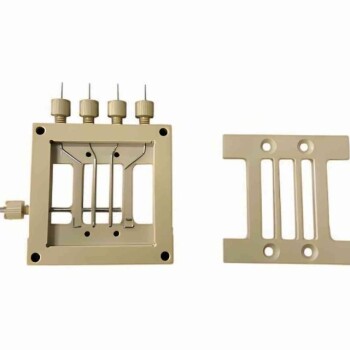
The electrolytic cell acts as the primary reaction vessel for the synthesis of Copper-Bismuth (Cu-Bi) protective coatings. It functions by creating a controlled environment where substrates are immersed in an electrolyte and subjected to an electric field. This setup drives the essential electro-reduction process, causing metal ions to deposit at specific potentials and form a solid layer on the substrate.
The electrolytic cell facilitates the precise transformation of solution-phase metal ions into a solid protective thin film, serving as the critical control point for the coating's thickness and uniformity.
The Mechanics of Deposition
Establishing the Reaction Environment
The electrolytic cell serves as the foundational equipment for the entire coating process. It holds the electrolyte solution and ensures the substrate is properly immersed.
By maintaining a stable environment, the cell allows for the consistent application of an electric field. This field is the driving force required to initiate the chemical changes necessary for coating formation.
Driving Phase Transformation
The core role of the cell is to facilitate a phase change. It transforms the materials from a liquid solution phase into a solid thin film.
This is achieved through electro-reduction. Under the influence of the electric field, metal ions in the solution are reduced and deposited onto the substrate surface.
Control Over Coating Quality
Regulating Deposition Potentials
The cell allows operators to apply specific electrical potentials during the process. This control is vital for targeting the correct reduction parameters for both Copper and Bismuth.
By managing these potentials, the cell ensures the co-deposition occurs under conditions that favor the desired material properties.
Influencing Thickness and Uniformity
The physical configuration and operation of the cell directly dictate the geometry of the final coating. The cell's setup controls the distribution of current across the substrate.
Consequently, the cell is the primary factor influencing the initial thickness of the layer. It also determines the overall uniformity of the protective film across the surface area.
Understanding the Trade-offs
Sensitivity to Cell Geometry
While the cell provides control, the resulting coating is highly sensitive to the physical setup. If the substrate is not positioned correctly relative to the counter electrode, the electric field may become distorted.
Risks to Uniformity
The cell is designed to create uniformity, but it is also the source of potential irregularities. Variations in current density within the vessel can lead to uneven deposition rates, resulting in a coating that is thicker in some areas than others.
Optimizing the Electrolytic Process
To ensure the best results when synthesizing Cu-Bi coatings, consider the following based on your specific requirements:
- If your primary focus is precise thickness: Regulate the duration and intensity of the electric field applied within the cell to strictly control the rate of ion deposition.
- If your primary focus is surface uniformity: Prioritize the geometric alignment of the substrate within the cell to ensure an even distribution of the electrochemical environment.
The electrolytic cell is the defining instrument that dictates the structural integrity and consistency of the final protective layer.
Summary Table:
| Feature | Role in Cu-Bi Coating Preparation | Impact on Quality |
|---|---|---|
| Reaction Vessel | Hosts electrolyte and ensures stable substrate immersion | Foundational process stability |
| Electric Field | Drives electro-reduction of solution-phase metal ions | Initiates phase transformation |
| Potential Control | Regulates specific reduction parameters for Cu and Bi | Ensures desired material properties |
| Current Density | Dictates the distribution of ions across the surface | Influences thickness and uniformity |
Elevate Your Coating Precision with KINTEK
Unlock superior material performance with KINTEK’s advanced laboratory solutions. Whether you are synthesizing Cu-Bi protective coatings or conducting specialized electrochemical research, our high-performance electrolytic cells and electrodes provide the stability and control you need for uniform deposition and precise thickness.
From high-temperature furnaces and vacuum systems to specialized crushing and milling equipment, KINTEK empowers researchers with the tools required for every stage of material development. Contact us today to discuss how our specialized lab equipment and consumables can optimize your research outcomes!
References
- К. К. Кадыржанов. DETERMINATION OF THE INFLUENCE OF THE PHASE COMPOSITION OF Cu-Bi COATINGS ON THE EFFICIENCY OF SHIELDING FROM IONIZING RADIATION.. DOI: 10.31489/2020no2/19-24
This article is also based on technical information from Kintek Solution Knowledge Base .
Related Products
- Electrolytic Electrochemical Cell with Five-Port
- PTFE Electrolytic Cell Electrochemical Cell Corrosion-Resistant Sealed and Non-Sealed
- Super Sealed Electrolytic Electrochemical Cell
- Electrolytic Electrochemical Cell Gas Diffusion Liquid Flow Reaction Cell
- Electrolytic Electrochemical Cell for Coating Evaluation
People Also Ask
- How does the design of an electrochemical electrolytic cell influence the coating uniformity? Optimize Your Catalysts
- What is the correct shutdown and disassembly procedure after an experiment? Ensure Safety and Protect Your Equipment
- What are the three essential components that comprise an electrolytic cell? Key Elements of Chemical Synthesis
- How does the design of an electrolytic cell affect the production yield of ferrate(VI)? Optimize Efficiency & Purity
- What is galvanic cell or electrolytic cell? Unlock the Secrets of Electrochemical Power