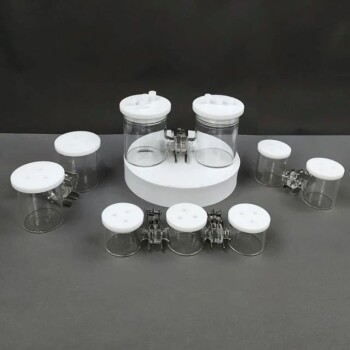
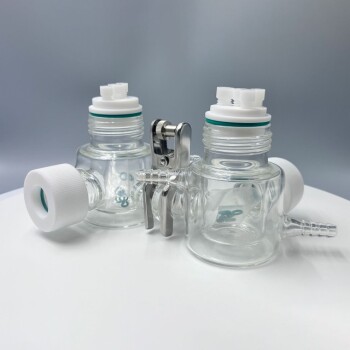
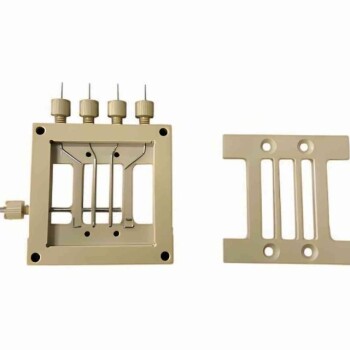
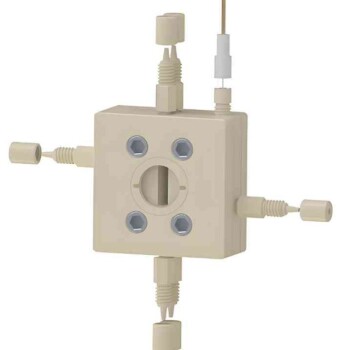
The primary function of an electrolytic cell in this context is to serve as the precise control environment that drives the conversion of solid titanium into highly ordered structures. By applying a specific DC voltage to a titanium substrate, the system initiates an electrochemical oxidation reaction. This reaction forces the directional growth of vertically aligned TiO2 nanotube arrays, rather than a random oxide layer.
Core Takeaway The electrolytic cell is not merely a vessel for chemical mixing; it is a tuning instrument that balances the rate of oxidation against chemical dissolution. By rigorously controlling voltage, temperature, and current density, the system dictates the specific geometry of the nanotubes, directly determining their surface area and electron transport efficiency.
Driving the Electrochemical Mechanism
The Role of DC Voltage
The fundamental operation involves applying a precise DC voltage to the titanium substrate.
This electrical pressure drives the oxidation reaction on the metal surface.
Without this directed energy, the titanium would simply passivate or corrode randomly, rather than forming organized structures.
Achieving Directional Growth
The cell facilitates the growth of nanotubes that are vertically aligned.
This alignment is critical because it establishes a direct physical path for electrons to travel.
The resulting structure allows for the rapid transport of photogenerated charges, which is essential for the material's electrical performance.
Creating High Surface Area
The oxidation process sculpts the titanium into a porous, nanotube array.
This architecture provides a massive specific surface area.
This increased area is vital for loading secondary materials, such as Graphene Quantum Dots (GQDs), into the matrix.
Controlling Nanotube Geometry and Quality
Balancing Etching and Growth
The electrolytic cell maintains a delicate equilibrium between two competing processes: oxidation (building the wall) and chemical dissolution (etching the pore).
This balance is often achieved in fluoride-containing electrolytes.
If managed correctly, this results in distinct, hollow nanotubes rather than a solid block of oxide.
Regulating Dimensions
By adjusting the cell's parameters, you can precisely tune the physical characteristics of the nanotubes.
Specific voltages (e.g., 55 V or 60 V) allow you to dictate the nanotube diameter (approximately 100 nm) and wall thickness.
Duration and current density controls allow for the manipulation of tube length (e.g., reaching approximately 15 μm).
Enhancing Quantum Efficiency
The geometry created by the cell directly impacts the material's performance.
The vertically oriented structure effectively reduces the recombination rate of photogenerated electrons.
This preservation of charge carriers significantly enhances the quantum efficiency of the final titanium dioxide product.
Ensuring Uniformity through System Design
Electrode Configuration
The cell typically employs a high-purity counter electrode, such as graphite or platinum.
This setup ensures a uniform distribution of current density across the titanium sheet.
Uniform current is the prerequisite for growing arrays with regular, consistent tube diameters across the entire sample.
Environmental Stability
The cell must maintain a stable physical and chemical environment to ensure reproducibility.
Factors such as stirring efficiency and temperature control (e.g., stabilizing at 25 °C) regulate ion migration rates.
Precise thermal management prevents fluctuations that could lead to uneven etching or structural collapse.
Understanding the Trade-offs
Sensitivity to Parameter Fluctuations
The "window" for successful nanotube formation is narrow.
Slight deviations in voltage or temperature can disrupt the balance between oxidation and dissolution.
This can result in disordered pores or the complete dissolution of the oxide layer, rather than distinct nanotubes.
Complexity of Optimization
While the cell allows for precise control, finding the correct recipe is complex.
Changing one variable, such as electrode spacing, alters the reaction kinetics.
This requires recalibration of voltage or time to maintain the desired nanotube morphology.
Optimizing Your Fabrication Strategy
To maximize the effectiveness of your electrolytic cell system, align your process parameters with your specific end-goal.
- If your primary focus is material loading (e.g., GQDs): Prioritize parameters that maximize tube length and pore diameter to create the largest possible specific surface area.
- If your primary focus is electron transport speed: Focus on electrode alignment and voltage stability to ensure perfect vertical orientation and minimize structural defects that trap charges.
- If your primary focus is reproducibility: Invest in precise temperature control and high-purity counter electrodes to guarantee uniform current density across the substrate.
The electrolytic cell is the architect of your material; the precision of your input controls directly dictates the performance of the final nanostructure.
Summary Table:
| Parameter Controlled | Role in Fabrication | Impact on TiO2 Nanotube |
|---|---|---|
| DC Voltage | Drives electrochemical oxidation | Dictates tube diameter & wall thickness |
| Current Density | Ensures uniform reaction rate | Maintains consistent tube distribution |
| Fluoride Balance | Equilibrium of growth vs. etching | Determines pore formation & tube length |
| Temperature | Regulates ion migration rates | Prevents structural collapse/uneven etching |
| Electrode Type | Distributes electrical charge | Ensures high-purity, vertical alignment |
Precision is the foundation of high-performance nanomaterials. KINTEK specializes in advanced laboratory solutions, providing the high-stability electrolytic cells and electrodes essential for the anodic oxidation of titanium. Whether you are maximizing surface area for GQD loading or optimizing electron transport, our comprehensive range of high-temperature furnaces, cooling solutions, and specialized lab equipment ensures your research achieves unmatched reproducibility. Enhance your fabrication precision—contact KINTEK today!
References
- Anuja Bokare, Folarin Erogbogbo. TiO2-Graphene Quantum Dots Nanocomposites for Photocatalysis in Energy and Biomedical Applications. DOI: 10.3390/catal11030319
This article is also based on technical information from Kintek Solution Knowledge Base .
Related Products
- PTFE Electrolytic Cell Electrochemical Cell Corrosion-Resistant Sealed and Non-Sealed
- Super Sealed Electrolytic Electrochemical Cell
- Electrolytic Electrochemical Cell with Five-Port
- H Type Electrolytic Cell Triple Electrochemical Cell
- Electrolytic Electrochemical Cell Gas Diffusion Liquid Flow Reaction Cell
People Also Ask
- What is the necessity of selecting a PTFE electrolytic cell? Ensure Precise Graphene Corrosion Testing Accuracy
- What is the proper method for cleaning the surface of an all-PTFE electrolytic cell? Ensure Accurate Results with a Pristine Surface
- How should an all-PTFE electrolytic cell be stored after use? Expert Maintenance Tips for Long-Lasting Performance
- What is the proper cleaning method for an all-PTFE electrolytic cell? Essential Tips for Surface Integrity
- What are the standard opening specifications for all-PTFE electrolytic cells? A Guide to Sealed vs. Non-Sealed Ports