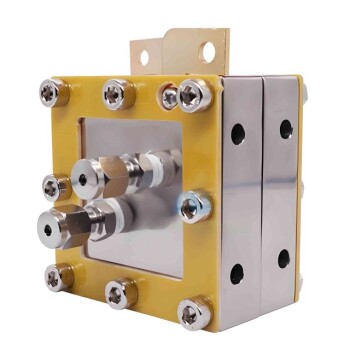
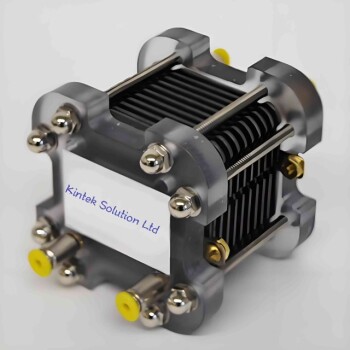
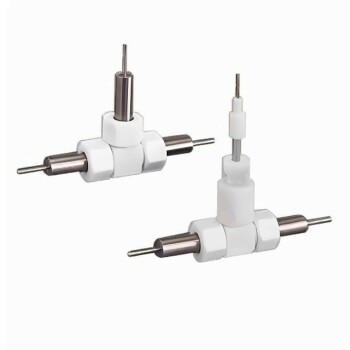
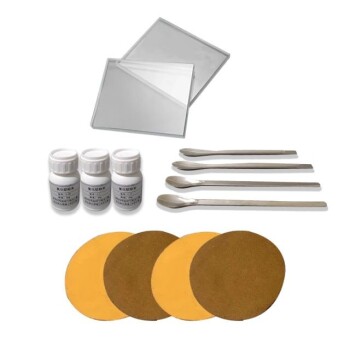
The electrolytic etching cell serves as the primary mechanism for revealing the complex internal architecture of processed stainless steel. It functions by applying a constant bias voltage to a sample submerged in an electrolyte—specifically nitric acid for Cr-Ni-Ti alloys—to induce controlled, selective dissolution of the surface. This electrochemical process exposes critical microstructural details that standard chemical etching often fails to resolve.
By leveraging controlled electrochemical potential, electrolytic etching provides superior contrast for identifying deformation features like shear bands and annealing twins. This clarity is indispensable for quantifying the structural refinement achieved during rotary swaging.
The Mechanism of Selective Dissolution
Controlled Electrical Bias
Unlike passive chemical dipping, an electrolytic cell uses an external power source to drive the etching process. By applying a constant bias voltage, the system forces the sample to act as an anode.
This electrical potential drives the dissolution of the material surface at a rate determined by the electrochemical stability of its specific phases.
The Role of the Electrolyte
For Cr-Ni-Ti stainless steel, a nitric acid electrolyte is typically employed as the conductive medium. The interaction between the acid and the electrical current targets regions of higher energy or different chemical composition.
This results in a differential etch rate, where grain boundaries and specific phases corrode faster or slower than the bulk matrix, creating visible relief and contrast under a microscope.
Revealing Critical Features in Swaged Steel
Exposing Austenite Grain Boundaries
Rotary swaging dramatically alters the grain structure of the material. Electrolytic etching clearly delineates austenite grain boundaries, allowing researchers to measure grain size and morphology accurately.
This is superior to chemical methods, which may produce uneven etching or fail to reveal the subtle boundaries of highly refined grains.
Identifying Deformation Markers
The physical impact of rotary swaging introduces specific defects and strengthening mechanisms into the steel. This etching method highlights deformation-induced shear bands, which indicate regions of intense localized strain.
It also reveals annealing twins, which are parallel sub-structures within grains that form during heat treatment or deformation. Visualizing these features is essential for evaluating how effectively the swaging process has refined the material's structure.
Understanding the Trade-offs
Precision vs. Simplicity
While electrolytic etching offers superior clarity, it requires significantly more process control than chemical etching.
Parameters such as voltage, electrolyte concentration, and etching time must be precisely calibrated. A deviation in voltage can lead to over-etching (pitting) or under-etching, obscuring the very features you intend to analyze.
Equipment Requirements
Effective analysis requires specialized hardware, often including platinum electrodes to ensure a stable current path without introducing impurities.
This adds a layer of complexity compared to simple immersion techniques, as the setup must be maintained to prevent electrolyte contamination or electrode degradation.
Making the Right Choice for Your Goal
To maximize the value of microstructural analysis for rotary swaged Cr-Ni-Ti stainless steel, align your etching strategy with your specific analytical needs:
- If your primary focus is evaluating structural refinement: Prioritize electrolytic etching with nitric acid to clearly resolve shear bands and deformation twins, which are the direct indicators of swaging intensity.
- If your primary focus is basic grain sizing: Ensure the voltage bias is optimized to distinctively outline austenite grain boundaries without pitting the grain interiors.
Electrolytic etching transforms a polished metal surface into a detailed map of its processing history, providing the visual data necessary to validate the efficacy of rotary swaging.
Summary Table:
| Feature | Chemical Etching | Electrolytic Etching |
|---|---|---|
| Mechanism | Passive chemical reaction | Active electrochemical dissolution (Constant Bias) |
| Key Electrolyte | Varies | Nitric Acid (for Cr-Ni-Ti) |
| Detail Resolution | Moderate/Uneven | High (Shear bands, annealing twins) |
| Grain Boundaries | May be obscured | Clearly delineated austenite boundaries |
| Process Control | Low (Time-based) | High (Voltage, current, & time calibration) |
Elevate Your Microstructural Analysis with KINTEK Precision
Unlock the full potential of your research with KINTEK’s industry-leading electrolytic cells and electrodes. Specifically designed for the rigorous demands of stainless steel and alloy characterization, our electrochemical systems provide the precise voltage control needed to reveal critical deformation features like shear bands and austenite grain boundaries.
Beyond etching, KINTEK offers a comprehensive suite of laboratory solutions, including:
- High-Temperature Furnaces (Muffle, Vacuum, CVD) for precise annealing.
- Crushing, Milling, and Sieving Systems for material preparation.
- High-Pressure Reactors and Autoclaves for advanced chemical processing.
- Battery Research Tools and specialized PTFE/Ceramic consumables.
Don't settle for obscured data. Contact KINTEK today to equip your lab with the tools necessary for superior structural refinement and material validation.
References
- O. V. Rybalchenko, С. В. Добаткин. Effect of Rotary Swaging on Microstructure and Properties of Cr-Ni-Ti Austenitic Stainless Steel. DOI: 10.3390/met13101760
This article is also based on technical information from Kintek Solution Knowledge Base .
Related Products
- Electrolytic Electrochemical Cell for Coating Evaluation
- Super Sealed Electrolytic Electrochemical Cell
- PTFE Electrolytic Cell Electrochemical Cell Corrosion-Resistant Sealed and Non-Sealed
- Electrolytic Electrochemical Cell with Five-Port
- Flat Corrosion Electrolytic Electrochemical Cell
People Also Ask
- What is the volume range of the coating evaluation electrolytic cell? A Guide to Choosing the Right Size
- How does the design of an electrochemical electrolytic cell influence the coating uniformity? Optimize Your Catalysts
- What is the correct shutdown and disassembly procedure after an experiment? Ensure Safety and Protect Your Equipment
- How do the electrochemical cell and three-electrode testing system collaborate? Optimize Zinc Anode Deposition Control
- What is the difference between a voltaic cell and an electrochemical cell? Understand the Two Types of Energy Conversion