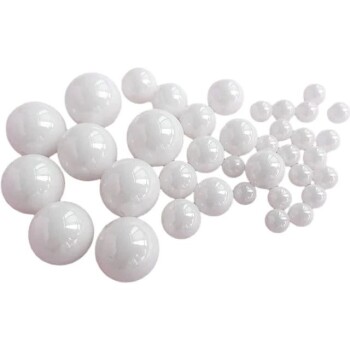
The selection of ceramic grinding balls for Rice Husk Ash (RHA) is governed by the need to balance impact energy with contact frequency. To achieve this, technical factors focus on a specific gradation of ball diameters: large balls are utilized to fracture coarse particles through heavy impact, while small balls are employed to refine the material into powder through high-frequency contact.
Effective RHA grinding relies on a "mixed gradation" strategy. By combining large balls for initial impact force and small balls for surface area coverage, you maximize grinding efficiency while using ceramic materials to maintain the strict chemical purity required for high-performance pozzolanic applications.
The Mechanics of Particle Size Reduction
The Role of Large Diameter Balls
Large ceramic balls are selected primarily to generate high impact energy.
When the mill rotates, the heavier mass of these large balls delivers the force necessary to crush and break down the initial, coarser Rice Husk Ash particles.
Without sufficient large media, the system lacks the kinetic energy to fracture the raw feed, leading to inefficient processing.
The Role of Small Diameter Balls
Small ceramic balls serve a different technical function: maximizing contact frequency.
Because smaller balls pack more densely, they provide a vastly larger total surface area within the mill.
This increases the number of contact points between the media and the ash, which is essential for grinding the pre-broken particles into a fine, uniform powder.
Optimizing Efficiency Through Gradation
The Necessity of Mixing Sizes
Selecting a single ball size is rarely efficient for RHA grinding.
The technical goal is proper gradation—combining large and small diameters in specific ratios.
This combination ensures that the grinding media can simultaneously address the breakdown of coarse feed and the refinement of the final product.
Improving Grinding Efficiency
A mixed-media approach prevents the "dead zones" often associated with uniform ball sizes.
The interaction between different diameters ensures that particles of all sizes are subjected to the appropriate mechanical forces.
This results in a faster throughput and a more consistent particle size distribution in the final ash.
Material Purity and Performance
Preventing Metallic Contamination
A critical factor in selecting ceramic over steel is the prevention of impurities.
Grinding media inevitably wears down during the process; if metallic balls are used, iron and other metals are introduced into the ash.
Ceramic balls are chemically inert regarding the RHA, ensuring the final product remains free of metallic contaminants.
Preserving Pozzolanic Quality
RHA is valued as a high-performance pozzolanic material for use in cement and concrete.
The introduction of foreign impurities can compromise the chemical reactivity and performance of the ash.
Using ceramic media safeguards the chemical purity of the RHA, maintaining its value as a high-grade additive.
Understanding the Trade-offs
Impact Force vs. Surface Area
There is a direct trade-off between the size of the ball and the type of grinding action it performs.
Prioritizing too many large balls provides excellent impact force but reduces the surface area available for fine polishing, potentially leaving the product too coarse.
Conversely, using too many small balls maximizes surface area but may fail to generate enough force to break the largest input particles, causing the process to stall.
Making the Right Choice for Your Goal
To optimize your grinding process, you must tailor the ratio of ball sizes to your specific input material and desired output.
- If your primary focus is breaking down raw, coarse Rice Husk: Prioritize a higher ratio of large diameter balls to ensure sufficient impact energy for initial fracture.
- If your primary focus is achieving ultra-fine powder: Increase the proportion of small diameter balls to maximize contact frequency and polishing action.
- If your primary focus is high-purity applications: Strictly adhere to ceramic materials to prevent metallic wear from contaminating the pozzolanic properties of the ash.
The ideal technical setup uses a calculated mix of sizes to break, grind, and polish simultaneously without compromising chemical purity.
Summary Table:
| Factor | Large Diameter Balls | Small Diameter Balls |
|---|---|---|
| Primary Function | Initial crushing & fracturing | Fine grinding & polishing |
| Mechanism | High kinetic impact energy | High-frequency surface contact |
| Advantage | Breaks down coarse particles | Produces uniform, fine powder |
| Efficiency Focus | Kinetic force for raw feed | Total surface area for refinement |
| Material Benefit | Prevents metallic contamination | Preserves pozzolanic reactivity |
Maximize Your Material Purity with KINTEK Solutions
Optimize your Rice Husk Ash processing with KINTEK’s premium ceramic grinding media and advanced milling systems. As specialists in laboratory equipment and consumables, we understand that high-performance pozzolanic materials require both precision and purity.
Our extensive portfolio includes:
- Crushing and Milling Systems: High-efficiency solutions tailored for RHA and beyond.
- Ceramic Consumables: High-purity alumina and ceramic grinding balls, crucibles, and tubes.
- Advanced Lab Tools: From high-temperature furnaces and hydraulic presses to electrolytic cells and cooling solutions.
Whether you are refining RHA for cement research or scaling up battery material production, KINTEK provides the technical expertise and high-quality equipment you need. Contact us today to enhance your grinding efficiency!
References
- Junho Kim, Manabu Kanematsu. Effects of Rice Husk Ash Particle Size and Luxan Value Influence on Mortar Properties and Proposal of Hydration Ratio Measurement Method. DOI: 10.3390/ma18010021
This article is also based on technical information from Kintek Solution Knowledge Base .
Related Products
- Precision Machined Zirconia Ceramic Ball for Engineering Advanced Fine Ceramics
- Stainless Steel Laboratory Ball Mill for Dry Powder and Liquid with Ceramic Polyurethane Lining
- Laboratory Jar Ball Mill with Alumina Zirconia Grinding Jar and Balls
- Laboratory Jar Mill with Agate Grinding Jar and Balls
People Also Ask
- What are the applications of zirconia ceramics? Unlock High-Performance Solutions for Extreme Environments
- What is the physical mechanism for selecting hard grinding media? Optimize Your ZrC-Al Matrix Composite Production
- Why are zirconia milling balls preferred for P2-type layered oxides? Ensure High Purity and Grinding Efficiency
- What is the purpose of using zirconia milling balls of different diameters? Optimize Solid Electrolyte Processing
- Why are zirconia grinding jars and balls required for solid-state electrolyte powders? Ensure High Purity & Performance