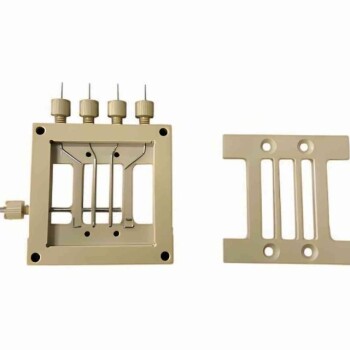
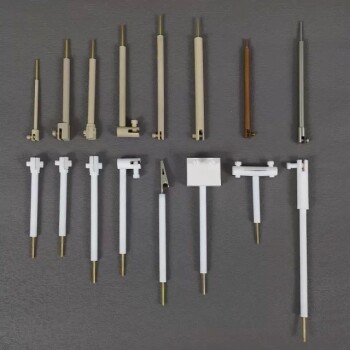
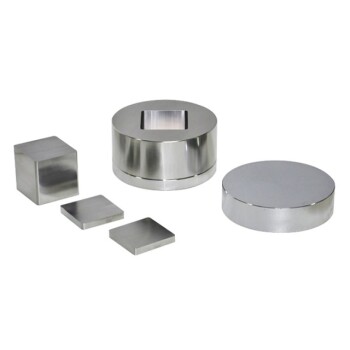
To accurately investigate composite cathode microstructure using Electrochemical Impedance Spectroscopy (EIS), you require a specialized battery test fixture or pressurized mold designed to create a "blocking electrode" configuration. This setup typically involves a sandwich structure—specifically stainless steel/composite cathode/stainless steel—to isolate transport mechanisms. Crucially, the fixture must apply stable, consistent pressure to the sample to ensure reliable contact throughout the analysis.
Accurate EIS analysis of composite cathodes depends heavily on the sample's physical environment, not just the measurement electronics. You must use a fixture that maintains a blocking electrode configuration under controlled pressure to successfully distinguish between ionic and electronic conductivity.
The Role of the Blocking Electrode Configuration
Isolating Conductivity Mechanisms
Composite cathodes are complex materials that facilitate both ionic and electronic transport. To understand how microstructure influences performance, you must be able to separate these two distinct behaviors.
The Sandwich Structure
The primary reference explicitly recommends a stainless steel/composite cathode/stainless steel sandwich. This specific arrangement acts as a "blocking" setup. By utilizing materials that block specific charge carriers (ions) while allowing others (electrons) to pass, or vice versa, the EIS response can effectively decouple ionic conductivity from electronic conductivity.
The Critical Importance of Pressure Control
Ensuring Consistent Contact
The test fixture is not merely a holder; it is an active variable in your experiment. It must provide a mechanism to apply stable, tunable pressure to the sandwich structure.
Eliminating Interfacial Artifacts
Without consistent pressure, contact resistance between the electrode and the current collector can fluctuate. These fluctuations create noise in the impedance spectrum, making it impossible to distinguish between the material's intrinsic performance and artifacts caused by poor connectivity.
Common Pitfalls and Trade-offs
Misinterpreting Contact Resistance
A common error occurs when the pressure applied by the fixture is insufficient. This leads to high contact impedance that can mask the high-frequency response related to the microstructure you are trying to study.
Over-Pressurization Risks
Conversely, applying excessive pressure can physically alter the microstructure of the composite cathode during the test. It is vital to use a fixture that allows for pressure regulation to maintain the sample's structural integrity while ensuring electrical contact.
Making the Right Choice for Your Goal
To maximize the value of your EIS data when linking microstructure to performance, consider the following recommendations:
- If your primary focus is isolating electronic conductivity: Ensure your fixture utilizes a blocking configuration (like stainless steel) that effectively blocks ionic flow.
- If your primary focus is data reproducibility: Prioritize a test fixture that offers precise, mechanical control over the pressure applied to the sample stack.
Select a fixture that transforms your sample into a stable, controlled system, allowing the true properties of the composite cathode to emerge.
Summary Table:
| Requirement | Purpose | Key Feature |
|---|---|---|
| Configuration | Blocking Electrode Setup | Stainless steel/cathode/stainless steel sandwich |
| Function | Conductivity Decoupling | Separates ionic from electronic transport mechanisms |
| Pressure Control | Interfacial Stability | Ensures consistent contact and eliminates noise artifacts |
| Material Integrity | Accurate Microstructure | Prevents deformation while ensuring low contact resistance |
Elevate Your Battery Research with KINTEK Precision
Unlock the full potential of your Electrochemical Impedance Spectroscopy (EIS) studies with KINTEK’s specialized battery test fixtures and hydraulic presses. To accurately correlate cathode microstructure with performance, you need more than just measurement tools—you need a controlled physical environment.
KINTEK provides the advanced laboratory equipment necessary for high-precision battery research, including:
- Pressurized Battery Test Fixtures for stable blocking electrode configurations.
- Manual and Automatic Hydraulic Presses (pellet, hot, and isostatic) for precise sample preparation and pressure regulation.
- Battery Research Consumables, including electrolytic cells, electrodes, and high-purity ceramic components.
Don't let contact resistance or inconsistent pressure compromise your data. Contact us today to find the perfect fixture for your lab and ensure your material's true properties emerge with KINTEK's expert solutions.
Related Products
- Custom Ion Conductivity Test Fixtures for Fuel Cell Research
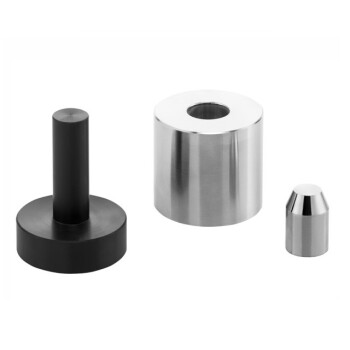
- Button Battery Tablet Press Sealing Mold for Lab Use
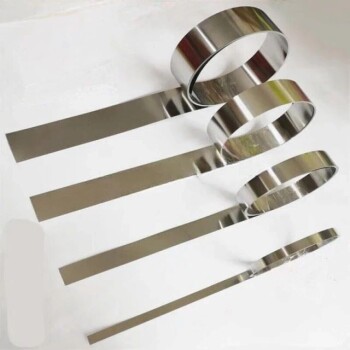
- Battery Lab Equipment 304 Stainless Steel Strip Foil 20um Thick for Battery Test
- Laboratory Hydraulic Press Lab Pellet Press for Button Battery
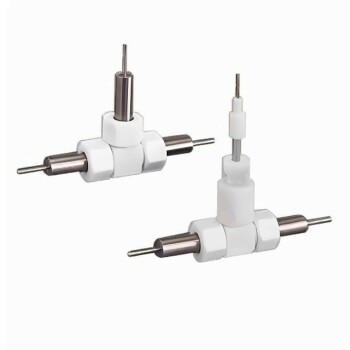
- Customizable Swagelok Type Test Cells for Advanced Battery Research Electrochemical Analysis
People Also Ask
- What is the purpose of using a high-precision capacitance manometer to monitor pressure during cathodic cage nitriding?
- What is the function of a battery test fixture? Essential Mechanical Stabilization for All-Solid-State Battery Testing
- Why is a capacitance manometer preferred for RF plasma systems? Ensure Precise Gas-Independent Pressure Monitoring
- Which thing is determined in ash content? Measure Inorganic Material for Quality Control
- Does strain hardening affect conductivity? Understanding the Strength vs. Conductivity Trade-Off