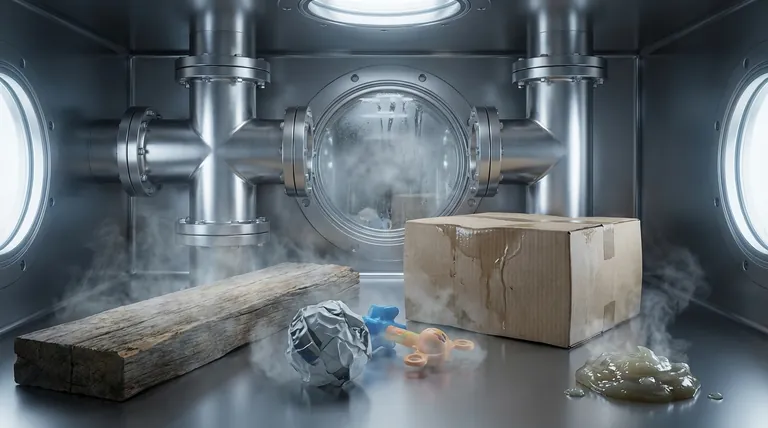
At a fundamental level, any material that releases gases or vapors under low pressure should not be used inside a vacuum chamber. The most common culprits are porous materials like wood and paper, many standard plastics like PVC and acrylic, and volatile substances such as oils, greases, and most adhesives. These materials compromise the vacuum level and contaminate the chamber environment through a process called outgassing.
The single most important factor for material selection in a vacuum is its outgassing rate. The goal is to choose materials that release the absolute minimum amount of trapped gas and volatile compounds, ensuring you can achieve and maintain a clean, deep vacuum.
The Core Problem: Outgassing
The primary challenge inside a vacuum chamber is not what you put in, but what comes out of it. This phenomenon, known as outgassing, is the enemy of any vacuum system.
What is Outgassing?
Outgassing is the slow release of gas that was dissolved, trapped, or absorbed in a material. When the pressure outside the material drops, these trapped gases and volatile molecules are no longer held in place and escape into the vacuum chamber. Water vapor is by far the most common outgassing molecule.
Why Outgassing Matters
Uncontrolled outgassing has two critical consequences. First, it limits the ultimate pressure your vacuum pump can achieve, as the pump must constantly work to remove the molecules being released. Second, these released molecules can contaminate sensitive surfaces within the chamber, such as optics, sensors, or the sample you are working on.
The Role of Vapor Pressure
Every material has a vapor pressure, which is the pressure at which it will begin to evaporate or sublimate (turn directly from a solid to a gas). In a vacuum, the ambient pressure can easily drop below a material's vapor pressure, causing it to actively degrade and turn into a gas, ruining your vacuum and coating everything in the chamber.
A Breakdown of Problematic Materials
While the list is long, problematic materials generally fall into a few key categories.
Plastics and Polymers
Many common, everyday plastics are unsuitable for vacuum. They often contain volatile plasticizers and readily absorb water from the atmosphere.
- Avoid: PVC, acrylic (Plexiglas), nylon, and vinyl.
- Problem: They outgas water vapor and other volatile organic compounds. Nylon is particularly hygroscopic (absorbs water).
- Acceptable Alternatives: Specialty polymers like PEEK, Vespel (polyimide), and PTFE (Teflon) have very low outgassing rates.
Porous and Organic Materials
These materials act like sponges, trapping vast amounts of air and water vapor within their structure.
- Avoid: Wood, paper, cardboard, cotton (including from gloves), and unsealed ceramics.
- Problem: It is nearly impossible to remove all the trapped gas, leading to extremely long pump-down times and a poor ultimate vacuum.
Adhesives, Tapes, and Greases
Most off-the-shelf glues, tapes, and lubricants are not designed for a vacuum and will outgas significantly.
- Avoid: Rubber cement, superglue, electrical tape, and hydrocarbon-based greases (like Vaseline).
- Problem: The solvents and volatile components in these products will evaporate rapidly, contaminating the entire system.
- Acceptable Alternatives: Use specific vacuum-rated epoxies (like Torr Seal), Kapton tape, and specialized vacuum greases (like Apiezon or Krytox).
Volatile Metals
Even some metals can be a problem, particularly in high-vacuum (HV) or ultra-high vacuum (UHV) systems where temperature may be involved.
- Avoid: Zinc and Cadmium. Brass (an alloy of copper and zinc) can also be problematic.
- Problem: These metals have a relatively high vapor pressure and can sublimate, coating surfaces inside the chamber. This is why fasteners are often stainless steel or silver-plated instead of zinc-plated.
Understanding the Trade-offs
Choosing a vacuum-compatible material is often a balancing act between performance, cost, and practicality.
Cleanliness is Paramount
The history of a material matters. A piece of otherwise acceptable stainless steel that is contaminated with cutting oils or fingerprints will outgas heavily. All components must be meticulously cleaned with appropriate solvents before being placed in the chamber.
The "Good Enough" Principle
The level of vacuum dictates your material choice. For a rough vacuum application, you have much more flexibility and some outgassing may be acceptable. For an ultra-high vacuum (UHV) system, material choice is non-negotiable and requires strict adherence to UHV-compatible materials.
The Cost of Compatibility
Materials engineered for low outgassing, such as PEEK, OFHC (Oxygen-Free High-Conductivity) copper, and machined aluminum or stainless steel, are significantly more expensive than their common counterparts. The cost is for purity and performance.
Selecting the Right Material for Your Goal
Your choice depends entirely on the level of vacuum you need to achieve and the sensitivity of your process.
- If your primary focus is High Vacuum (HV) or Ultra-High Vacuum (UHV): You must use materials specifically rated for this environment, such as stainless steel, aluminum, ceramics, PEEK, Vespel, and Kapton.
- If your primary focus is a Rough or Medium Vacuum: You have more flexibility, but you should still avoid highly porous materials like wood and paper to ensure reasonable pump-down times.
- If you absolutely must use a questionable material: Consider performing a "vacuum bake-out," where the component is heated under vacuum in a separate chamber to force out most of its volatile compounds before it is used.
By prioritizing low-outgassing materials from the start, you take control of your vacuum environment and ensure the integrity and success of your process.
Summary Table:
| Material Category | Examples to Avoid | Primary Issue | Acceptable Alternatives |
|---|---|---|---|
| Plastics & Polymers | PVC, Acrylic, Nylon | High outgassing of water vapor and VOCs | PEEK, PTFE (Teflon), Vespel |
| Porous & Organic Materials | Wood, Paper, Cardboard, Cotton | Trap large amounts of air and moisture | Sealed ceramics, metals |
| Adhesives, Tapes & Greases | Rubber cement, Superglue, Electrical tape | Solvents and volatiles evaporate | Vacuum-rated epoxies, Kapton tape, Apiezon grease |
| Volatile Metals | Zinc, Cadmium, Brass | High vapor pressure, can sublimate | Stainless steel, silver-plated components |
Ensure your vacuum processes are contamination-free and efficient with the right equipment. KINTEK specializes in high-quality lab equipment and consumables designed for optimal vacuum performance. Our experts can help you select the right materials and components to minimize outgassing and maintain a clean chamber environment. Contact us today to discuss your specific vacuum application needs and discover how KINTEK can support your laboratory's success.
Visual Guide

Related Products
- 56L Vertical Laboratory Vacuum Drying Oven
- Stainless Steel Quick Release Vacuum Chain Three-Section Clamp
- 23L Laboratory Vacuum Drying Oven
- 304 316 Stainless Steel Vacuum Ball Valve Stop Valve for High Vacuum Systems
- Vacuum Heat Treat Furnace with Ceramic Fiber Liner
People Also Ask
- Why is a vacuum drying oven recommended for the post-processing of recovered cadmium sponge? | KINTEK
- Why is a vacuum drying oven necessary for Li2MnSiO4/C battery electrodes? Ensure Stability and Performance.
- What is the necessity of using a vacuum drying oven for nZVI catalysts? Protect Reactivity and Prevent Oxidation
- What role does a laboratory vacuum drying oven play in the preparation of modified multi-walled carbon nanotubes?
- What role does a laboratory vacuum drying oven play in processing nanoparticle powder samples? Protect Sample Integrity