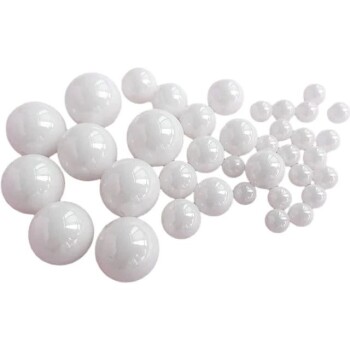
The selection of 0.1 mm zirconia grinding balls is a deliberate engineering choice driven by the need for high-frequency impact and chemical inertness. The 0.1 mm diameter increases the number of contact points within the mill to grind LLZTO powder to ultra-fine nanometer levels, while the zirconia material ensures that this aggressive processing does not introduce metallic impurities that would ruin the electrolyte's performance.
Core Insight Achieving high-performance LLZTO requires a delicate balance between mechanical refinement and chemical purity. The 0.1 mm micro-bead geometry provides the sheer volume of impacts necessary for nanometer-scale reduction, while the zirconia composition safeguards the electrolyte's ionic conductivity against contamination.
The Physics of Micro-Bead Milling
Maximizing Impact Frequency
The primary advantage of using a 0.1 mm diameter bead is the massive increase in the number of grinding media per unit volume compared to larger balls. This creates a high-frequency impact environment where the powder is subjected to continuous, rapid micro-collisions.
Achieving Nanometer Granularity
This high density of contact points is essential for "finishing" or refining steps. While larger balls deliver heavy distinct blows, the 0.1 mm media acts closer to a fluid abrasive, effectively eroding particles down to the ultra-fine nanometer level required for advanced solid-state electrolytes.
Material Compatibility and Purity
Eliminating Metallic Contamination
LLZTO (Lithium Lanthanum Zirconium Oxide) is a solid-state electrolyte, making it exceptionally sensitive to impurities that could alter its electrochemical properties. Unlike stainless steel media, zirconia is chemically inert and does not shed metal ions that could decrease ionic conductivity or cause short circuits.
Hardness and Wear Resistance
LLZTO precursors form hard, garnet-type ceramic particles that are abrasive to softer media. Zirconia provides the necessary density and hardness to fracture these tough oxide layers without the media itself wearing down significantly during long-term, high-energy milling cycles.
Preserving Elemental Stoichiometry
Because zirconia is chemically stable, it prevents cross-contamination. This ensures that the delicate ratio of Lithium, Lanthanum, and Zirconium remains consistent, which is critical for obtaining the pure-phase cubic garnet structure that dictates performance.
Understanding the Trade-offs
Separation Challenges
While 0.1 mm beads are superior for ultra-fine grinding, they can be difficult to separate from the final slurry or powder. The small diameter requires specialized sieving or filtration techniques to ensure no media remains in the final product.
Kinetic Energy Limitations
Smaller beads carry less mass, meaning individual impacts have lower kinetic energy than larger balls. If the starting material is too coarse, 0.1 mm beads may lack the force to break the initial large particles. They are best utilized for the final refinement stage rather than the initial crushing phase.
Making the Right Choice for Your Process
If you are establishing a milling protocol for LLZTO, consider these factors:
- If your primary focus is Final Particle Size: Use 0.1 mm beads in a secondary milling stage to achieve the nanometer-scale surface area required for optimal sintering and densification.
- If your primary focus is Electrochemical Purity: Prioritize zirconia media over all other materials to prevent conductive metal impurities from compromising the electrolyte's ionic conductivity.
Successful LLZTO synthesis relies on using the smallest possible media that can still fracture the material, ensuring maximum surface area with zero contamination.
Summary Table:
| Feature | 0.1 mm Zirconia Beads | Advantage for LLZTO |
|---|---|---|
| Impact Frequency | Ultra-high contact points | Efficiently reduces particles to nanometer scale |
| Material Composition | Chemically inert YSZ | Prevents metallic impurities and maintains ionic conductivity |
| Hardness | High wear resistance | Withstands abrasive garnet-type ceramic precursors |
| Processing Stage | Final refinement | Optimizes surface area for superior sintering and densification |
Elevate Your Solid-State Electrolyte Research with KINTEK
Precision milling is the foundation of high-performance LLZTO. At KINTEK, we specialize in providing the advanced laboratory equipment and consumables needed to achieve ultra-fine granularity without compromising chemical purity.
Whether you require high-density zirconia grinding media, high-energy crushing and milling systems, or precision sieving equipment to separate micro-beads, our technical team is ready to support your process optimization. Beyond milling, we offer a comprehensive portfolio including high-temperature furnaces, vacuum systems, and battery research tools designed for the most demanding material science applications.
Ready to achieve superior particle refinement? Contact KINTEK today for a customized quote and see how our expertise in laboratory consumables can enhance your research outcomes.
Related Products
- Laboratory Jar Ball Mill with Alumina Zirconia Grinding Jar and Balls
- Precision Machined Zirconia Ceramic Ball for Engineering Advanced Fine Ceramics
- Laboratory Jar Mill with Agate Grinding Jar and Balls
- Laboratory Ball Mill Jar Mill with Metal Alloy Grinding Jar and Balls
- High Energy Planetary Ball Mill Milling Machine for Laboratory
People Also Ask
- What are the primary functions of using a ball mill for BZCY72 powder? Achieve High Purity and Enhanced Sintering
- In what way does a laboratory ball mill affect material properties when modifying PHBV/pulp fiber composites?
- Why is a laboratory ball mill required for ultra-fine fly ash? Unlock Nano-Scale Adsorption Power
- What is the function of a laboratory ball mill in the preparation of AMMCs? Optimize Dispersion & Grain Refinement
- What is the function of a laboratory ball mill in the pretreatment of waste tire char (WTC)? Optimize Material Reactivity