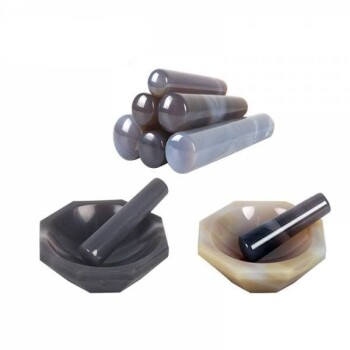
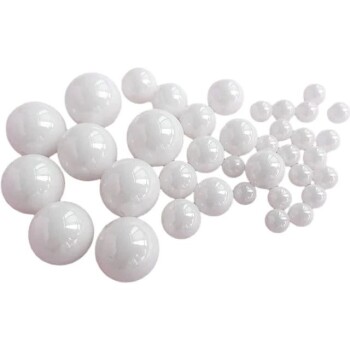
Agate grinding jars and agate grinding balls are preferred for this specific application because they provide a contamination-free environment essential for sensitive sulfide chemistry. They are chosen primarily for their chemical inertness and hardness, which effectively prevents the introduction of performance-killing metallic impurities during the high-energy synthesis process.
Core Insight: The synthesis of Li2S-P2S5 electrolytes relies on maintaining strict chemical purity. Agate media offers a robust, non-metallic solution that eliminates the risk of iron contamination—a common issue with steel tools—thereby preserving the electrochemical stability and ionic conductivity of the final solid-state material.
The Critical Role of Purity in Sulfide Electrolytes
Preventing Metallic Contamination
The most significant advantage of agate is its ability to prevent metallic pollution.
During the prolonged high-energy ball milling required to synthesize Li2S-P2S5, the grinding media undergoes significant stress. If stainless steel jars were used, abrasive wear would introduce microscopic iron particles into the mixture.
These metallic impurities are disastrous for solid-state electrolytes. They can create electronic pathways that lead to short circuits or unwanted side reactions, compromising the battery's performance. Agate eliminates this specific risk entirely.
Chemical Inertness and Stability
Sulfide-based electrolytes are chemically sensitive and highly reactive.
Agate is composed of silica (SiO2), which is chemically inert relative to the sulfide precursors. This ensures that the grinding jar itself does not participate in the chemical reaction.
By remaining neutral, agate allows the mechanical energy to focus solely on the reaction between the lithium sulfide (Li2S) and phosphorus pentasulfide (P2S5), ensuring the final product matches the intended stoichiometry without degradation.
Mechanical Requirements for Synthesis
Withstanding High-Energy Impact
While purity is the primary driver, the material must also be mechanically robust.
Agate possesses high hardness, allowing it to withstand the repetitive, high-velocity impacts of planetary ball milling. It effectively pulverizes the precursors without shattering or degrading rapidly under the physical load.
Resisting Surface Wear
The structural integrity of agate minimizes the volume of foreign material entering the sample.
Even though all grinding media wear down eventually, the wear rate of high-quality agate is low enough to maintain the structural integrity of the sample throughout the long milling durations required for mechanical alloying.
Understanding the Trade-offs
Impact Energy vs. Density
While agate is excellent for purity, it is less dense than other ceramic alternatives like Zirconia.
Lower density translates to lower impact energy during milling. Consequently, using agate may require longer milling times to achieve the same degree of amorphization or powder refinement compared to heavier ceramic media.
Thermal Conductivity
Agate has lower thermal conductivity than metal.
During high-energy milling, significant heat is generated. Agate jars may retain this heat longer, potentially raising the internal temperature of the batch. This requires careful monitoring to ensure the temperature does not exceed the stability limits of the heat-sensitive sulfide materials.
Making the Right Choice for Your Goal
When selecting consumables for solid-state electrolyte preparation, align your choice with your specific experimental priorities:
- If your primary focus is absolute electrochemical purity: Rely on agate to strictly eliminate the possibility of metallic iron contamination, which causes electronic leakage in cells.
- If your primary focus is minimizing side reactions: Use agate for its superior chemical inertness to ensure the reaction vessel does not alter the stoichiometry of the sensitive sulfide precursors.
By utilizing agate components, you safeguard the chemical identity of your electrolyte, ensuring that the material's ionic conductivity is defined by its design, not by its impurities.
Summary Table:
| Feature | Advantage for Li2S-P2S5 Synthesis |
|---|---|
| Material Composition | Natural high-purity silica (SiO2) prevents metallic (Fe) contamination |
| Chemical Properties | Chemically inert; does not react with sensitive sulfide precursors |
| Hardness | High wear resistance ensures structural integrity during high-energy milling |
| Electrochemical Impact | Eliminates electronic pathways/short circuits caused by metal impurities |
| Ideal Application | High-energy ball milling for solid-state electrolyte amorphization |
Elevate Your Battery Research with KINTEK Precision
Don't let metallic impurities compromise your solid-state electrolyte's ionic conductivity. KINTEK specializes in high-performance laboratory solutions tailored for advanced material science. Whether you are synthesizing Li2S-P2S5 or developing next-generation battery components, our premium agate grinding jars and balls, crushing and milling systems, and vacuum furnaces provide the contamination-free environment your research demands.
From high-temperature reactors to specialized battery research tools, KINTEK delivers the reliability and purity essential for breakthrough results.
Ready to optimize your synthesis process? Contact our technical experts today to find the perfect equipment and consumables for your laboratory.
Related Products
- Laboratory Jar Mill with Agate Grinding Jar and Balls
- Laboratory Jar Ball Mill with Alumina Zirconia Grinding Jar and Balls
- Nature Agate Mortar and Pestle for Grinding and Mixing
- Laboratory Ball Mill Jar Mill with Metal Alloy Grinding Jar and Balls
- Laboratory Four-Body Horizontal Jar Mill
People Also Ask
- What are the different types of laboratory mills? Choose the Right Grinder for Your Sample Material
- What is use for grinding in the laboratory? Select the Right Mill for Accurate Sample Prep
- What laboratory apparatus is used for grinding? Match the Right Mill to Your Sample Material
- What is the function of a laboratory grinding mill? Achieve Precise Sample Preparation for Accurate Results
- Why are agate milling jars and balls used for Mo-La2O3 powder mixing? Ensure High-Purity Material Dispersion