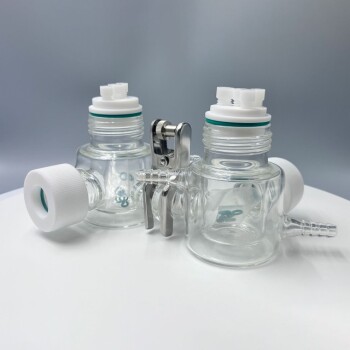
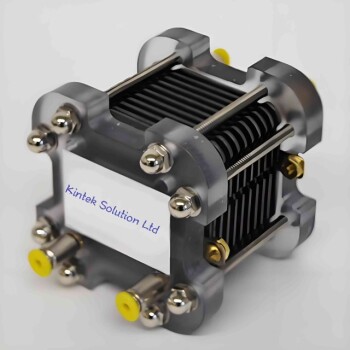
Beaker-type electrolytic cells are the standard choice for initial electrosynthesis research primarily due to their structural simplicity and low cost. These cells provide an accessible, open platform that allows researchers to easily manipulate key variables, such as electrode spacing and stirring conditions, facilitating rapid process screening and data collection.
The combination of an easily manageable open environment and low operational complexity makes beaker cells the ideal tool for establishing standardized datasets and validating electrochemical processes before moving to complex systems.
The Strategic Value of Simplicity
Lowering the Barrier to Entry
The fundamental advantage of the beaker-type cell is its simple structure. This straightforward design minimizes the learning curve and setup time required to begin experiments.
Because of their low cost, these cells are accessible to a wide range of researchers, from beginners to experts. This economic efficiency allows resources to be directed toward materials and analysis rather than expensive reactor hardware.
Establishing Reliable Baselines
In the early stages of research, consistency is paramount. Beaker cells are ideal for creating standardized datasets.
By removing the complexities of advanced reactor geometries, researchers can isolate variables more effectively. This makes them perfect for preliminary process screening, ensuring the fundamental chemistry works before further investment.
Operational Flexibility in the Lab
The Open Environment Advantage
Unlike sealed or continuous-flow systems, beaker cells offer an open environment. This physical accessibility makes the system highly manageable during active experimentation.
Researchers can intervene, add reagents, or adjust configurations without dismantling the entire setup. This "hands-on" capability is critical during the exploratory phase of nanomaterial synthesis.
Real-Time Variable Adjustment
The open architecture allows for convenient adjustments of electrode spacing. Changing the distance between electrodes is a primary method for tuning the electric field and current density, which directly impacts nanomaterial growth.
Furthermore, stirring conditions can be easily modified. Whether the reaction requires vigorous agitation or a stagnant solution, the beaker setup accommodates these changes instantly.
Accelerating Experimental Cycles
The ultimate goal of initial research is the rapid acquisition of results. Beaker cells streamline the workflow, allowing for quick assembly, reaction execution, and cleaning.
This speed facilitates fast iteration cycles. Researchers can evaluate the feasibility of an electrochemical process quickly, discarding failures and refining successes with minimal downtime.
Understanding the Limitations
Designed for Preliminary Evaluation
It is important to recognize that these cells are optimized for initial research and screening. They serve as a testing ground to validate hypotheses rather than a final production method.
The Trade-off of Open Systems
While the open environment provides convenience, it also exposes the reaction to the ambient atmosphere. Researchers must ensure that the specific nanomaterial synthesis does not require a strictly inert atmosphere that a simple open beaker cannot provide.
Making the Right Choice for Your Research
To maximize the effectiveness of your electrosynthesis experiments, align your tool choice with your immediate research goals.
- If your primary focus is rapid feasibility testing: Use beaker cells to perform preliminary screenings and gather initial data without investing in complex setups.
- If your primary focus is parameter optimization: Leverage the open architecture to manually adjust electrode spacing and stirring speeds to determine the optimal conditions for material growth.
By starting with a beaker-type cell, you ensure a cost-effective and flexible foundation for your electrochemical discoveries.
Summary Table:
| Feature | Advantage for Initial Research |
|---|---|
| Structural Design | Simple, open architecture for easy manual intervention |
| Cost-Efficiency | Low initial investment, allowing focus on materials and analysis |
| Flexibility | Easy adjustment of electrode spacing and stirring conditions |
| Workflow Speed | Rapid assembly and cleaning for fast experimental iterations |
| Application | Ideal for preliminary process screening and baseline data collection |
Elevate Your Electrochemical Research with KINTEK
Transitioning from feasibility testing to precise nanomaterial synthesis requires the right tools. KINTEK specializes in high-performance laboratory equipment, providing everything from beaker-type electrolytic cells and specialized electrodes to advanced high-temperature furnaces and hydraulic presses for your research needs.
Whether you are screening new processes or optimizing reaction parameters, our comprehensive range of electrolytic cells, battery research tools, and high-precision consumables ensures your lab achieves consistent, reproducible results. Our experts are ready to help you select the ideal configuration for your specific application.
Ready to accelerate your laboratory discoveries? Contact us today to explore our full range of solutions!
References
- G. Malathi G. Malathi, M.I. Niyas Ahamed. Extensive Research and Evaluation of Electro-Organic Synthesis of Nanomaterials. DOI: 10.13005/ojc/380511
This article is also based on technical information from Kintek Solution Knowledge Base .
Related Products
- Side Window Optical Electrolytic Electrochemical Cell
- Double-Layer Water Bath Electrolytic Electrochemical Cell
- PTFE Electrolytic Cell Electrochemical Cell Corrosion-Resistant Sealed and Non-Sealed
- H Type Electrolytic Cell Triple Electrochemical Cell
- Optical Water Bath Electrolytic Electrochemical Cell
People Also Ask
- What are the critical safety and operational precautions when using a side-window optical electrolytic cell? Ensure Safe and Accurate Experiments
- What is the correct procedure for post-experiment shutdown and cleaning of a side-window optical electrolytic cell? Ensure Safety and Data Accuracy
- What maintenance procedures are recommended for a side-window optical electrolytic cell? Ensure Data Accuracy & Extend Cell Lifespan
- What are the ideal storage conditions for a side-window optical electrolytic cell? Ensure Long-Term Accuracy and Performance
- What is a side-window optical electrolytic cell? See Your Electrochemical Reactions in Action