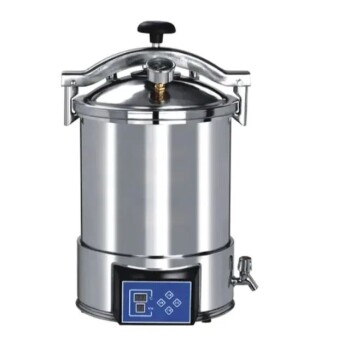
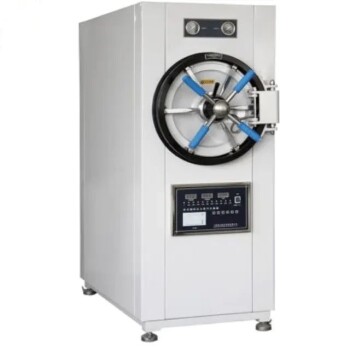
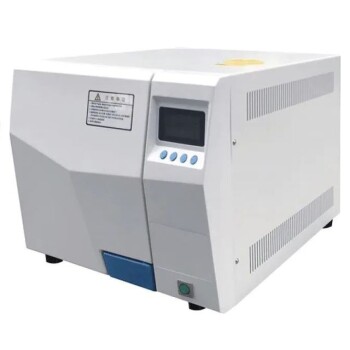
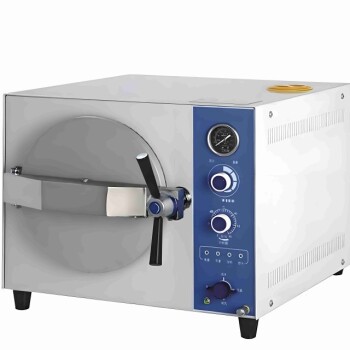
High-pressure autoclaves are critical because they are the only experimental tools capable of accurately replicating the extreme service environments of Light Water Reactors (LWR). By subjecting Zirconium alloys to controlled high-temperature and high-pressure water chemistry, researchers can empirically verify if the ZrO2/Cr2O3 interface successfully suppresses corrosion kinetics in real-world scenarios.
The Core Insight Theoretical models suggest that a ZrO2/Cr2O3 interface improves corrosion resistance by altering the "space charge region" at the atomic level. However, high-pressure autoclaves are required to validate this by measuring actual oxidation rates and hydrogen absorption under the crushing pressures (approx. 15.5 MPa) and temperatures (320–350°C) found in active nuclear reactors.
Simulating the Service Environment
To trust that a Zirconium alloy will survive in a nuclear core, you cannot rely on standard laboratory conditions. You must replicate the operational stresses of the reactor.
Replicating Light Water Reactor Conditions
Light Water Reactors (LWR), including Pressurized Water Reactors (PWR), operate under extreme physical stress.
Standard corrosion testing is insufficient because it lacks the necessary high-temperature (320–350°C) and high-pressure (approx. 15.5 MPa) parameters characteristic of these environments.
Controlled Water Chemistry
The autoclave allows researchers to manipulate water chemistry precisely while maintaining high pressure.
This ensures that the Chromium-containing Zirconium alloys are tested against the specific coolant conditions they will face in service, isolating chemical reactions from other variables.
Long-Duration Exposure
Corrosion is a cumulative process that requires time to manifest.
Autoclaves facilitate long-duration immersion experiments, allowing researchers to observe the kinetic formation of oxide layers over time rather than just capturing a momentary snapshot.
Validating the Corrosion Mechanism
The primary scientific goal is not just to see if the material corrodes, but why and how the specific interface prevents it.
Testing the Space Charge Region
Theoretically, the ZrO2/Cr2O3 interface suppresses corrosion by manipulating the space charge region.
The goal is to deplete oxygen vacancies and electrons in this region, which slows down the transport of ions that cause oxidation. Autoclave testing confirms if this atomic-level mechanism holds up under macroscopic pressure.
Measuring Real-World Oxidation Rates
Models predict how fast an oxide layer will grow, but empirical data often differs.
Autoclave experiments provide the kinetic data necessary to measure the actual growth rate of the oxide film, validating or correcting the predictive codes used for fuel performance evaluation.
Quantifying Hydrogen Absorption
Corrosion in nuclear environments often leads to hydrogen pickup, which degrades the metal (embrittlement).
The autoclave environment allows for the precise measurement of hydrogen absorption rates, ensuring that the improved corrosion resistance does not come at the cost of structural integrity due to hydrogen intake.
Understanding Experimental Trade-offs
While high-pressure autoclaves are the gold standard for validation, it is vital to distinguish between the creation of the sample and the testing of the sample.
Sample Fabrication vs. Testing
It is a common misconception to conflate the sample preparation with the environmental testing.
A laboratory hydraulic press is used to create the dense ZrO2/Cr2O3 interface (the "green compact") by eliminating porosity prior to sintering. The autoclave does not create the interface; it stresses the interface to test its durability.
The Limits of Simulation
An autoclave simulates heat, pressure, and chemistry, but it does not perfectly replicate every aspect of a reactor core.
For example, while it simulates the chemical media, it may not fully replicate the intense neutron radiation flux of an active core unless specifically designed for in-pile testing. Therefore, autoclave data is a chemical and thermal validation, not a full nuclear operational test.
Making the Right Choice for Your Goal
When designing your experimental validation plan, your objectives determines your equipment and metrics.
- If your primary focus is validating theoretical models: Prioritize autoclave settings that precisely match LWR pressure and temperature to confirm the depletion of oxygen vacancies in the space charge region.
- If your primary focus is material fabrication: Focus on using a hydraulic press to minimize porosity and ensure a flat, continuous contact interface before the sample ever reaches the autoclave.
- If your primary focus is fuel performance coding: Ensure your autoclave runs are of sufficient duration to generate robust kinetic data on oxide layer formation for code calibration.
Ultimately, the high-pressure autoclave is the bridge that transforms a theoretical interface design into a validated structural solution for next-generation nuclear reactors.
Summary Table:
| Key Parameter | Requirement for Validation | Research Objective |
|---|---|---|
| Temperature | 320–350°C | Replicate LWR thermal stress levels |
| Pressure | Approx. 15.5 MPa | Mimic operational reactor environments |
| Chemistry | Controlled Water Chemistry | Isolate specific chemical reactions |
| Exposure | Long-Duration Immersion | Measure kinetic oxide growth & hydrogen pickup |
Elevate Your Nuclear Material Research with KINTEK
Precision is non-negotiable when validating materials for next-generation reactors. KINTEK specializes in high-performance laboratory solutions, providing the high-temperature high-pressure reactors and autoclaves essential for replicating extreme LWR environments.
Beyond testing, we support your entire workflow—from sample fabrication using our precision hydraulic presses (pellet, hot, isostatic) and crushing and milling systems to essential consumables like ceramics and crucibles.
Ready to bridge the gap between theoretical models and empirical success? Contact our experts today to equip your lab with the industry's most reliable testing and fabrication tools.
References
- Jing Yang, Bilge Yildiz. Predicting point defect equilibria across oxide hetero-interfaces: model system of ZrO<sub>2</sub>/Cr<sub>2</sub>O<sub>3</sub>. DOI: 10.1039/c6cp04997d
This article is also based on technical information from Kintek Solution Knowledge Base .
Related Products
- Mini SS High Pressure Autoclave Reactor for Laboratory Use
- High Pressure Laboratory Autoclave Reactor for Hydrothermal Synthesis
- Stainless High Pressure Autoclave Reactor Laboratory Pressure Reactor
- Desktop Fast High Pressure Laboratory Autoclave Sterilizer 16L 24L for Lab Use
- Customizable High Pressure Reactors for Advanced Scientific and Industrial Applications
People Also Ask
- Why use high-pressure reactors for molecular sieve synthesis? Unlock Superior Crystallinity and Framework Control
- What is the function of a high-pressure reactor autoclave? Enhancing Cu/N Co-Doped Carbon Catalyst Synthesis
- What are the advantages of using a high-pressure reactor like an autoclave? Maximize Liquefaction Speed & Yield
- Why are high-pressure reactors or autoclaves necessary for the synthesis of new functional materials? Unlock Precision.
- How are high-pressure reactors used to prepare metaphosphate electrocatalysts? Master In-Situ Precursor Growth