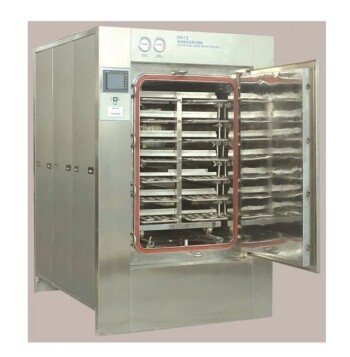
High-pressure stainless steel hydrothermal autoclaves equipped with Para-Polyphenyl (PPL) liners are the critical infrastructure for synthesizing vanadium dioxide (M/R) nanorods because they generate the extreme thermodynamic conditions required for crystallization while preventing chemical contamination. The stainless steel shell contains the immense pressure generated at temperatures up to 280°C, while the PPL liner serves as a chemically inert barrier that survives these temperatures to protect the purity of the final nanomaterial.
Core Takeaway: Synthesizing high-quality vanadium dioxide nanorods requires a precise balance of brute force and delicate protection. The autoclave provides the supercritical pressure and heat to drive phase transformation, while the PPL liner ensures chemical isolation, preventing iron contamination from the vessel that would otherwise ruin the material's phase purity.
The Role of the Stainless Steel Autoclave
The stainless steel vessel acts as the pressure containment system, enabling reactions that are impossible under standard atmospheric conditions.
Achieving Supercritical Conditions
To synthesize vanadium dioxide nanorods, the reaction environment must reach temperatures around 280°C.
In an open vessel, the solvent would simply boil away. The sealed autoclave traps the solvent, creating a high-pressure, near-supercritical environment where precursors dissolve and recrystallize efficiently.
Driving Phase Transformation
Vanadium precursors require high energy to overcome the activation barrier and transform into the highly crystalline monoclinic/rutile (M/R) phase.
The closed system allows for sustained elevated temperatures and pressures. This creates the thermodynamic drive necessary to convert amorphous precursors into a structured, crystalline lattice.
Controlling Nanorod Morphology
The sealed environment allows for precise control over nucleation and growth kinetics.
By managing the pressure and filling degree of the autoclave, you can direct the crystal growth. This forces the vanadium dioxide to grow anisotropically, resulting in high-aspect-ratio nanorods rather than irregular particles.
The Critical Function of the PPL Liner
While the steel provides the strength, the polymer liner provides the chemical integrity. PPL (Para-Polyphenyl) is specifically chosen over standard polymers for its superior thermal stability.
Why PPL is Essential at 280°C
Standard PTFE (Teflon) liners typically degrade or deform at temperatures exceeding 240–260°C.
Because the synthesis of vanadium dioxide nanorods often requires temperatures up to 280°C, PPL liners are mandatory. They maintain structural integrity and chemical inertness at these higher thermal thresholds where other polymers would fail.
Preventing Metallic Contamination
Hydrothermal synthesis often utilizes acidic precursor solutions to facilitate reaction kinetics.
Without a liner, these acidic liquids would react with the stainless steel body. This would leach iron, chromium, or nickel ions into the solution, acting as dopants that destroy the monoclinic phase purity of the vanadium dioxide.
Ensuring Corrosion Resistance
The PPL liner creates a complete seal between the harsh reaction fluid and the metal reactor.
This extends the lifespan of the expensive stainless steel autoclave by preventing corrosion. Simultaneously, it ensures that the synthesized nanorods remain free of impurities, which is vital for their performance in electronic or optical applications.
Understanding the Trade-offs
While this setup is ideal for synthesis, there are operational limitations to consider.
Scale-up Limitations
Hydrothermal synthesis is inherently a batch process.
Scaling up production of nanorods using autoclaves is difficult because the thermal gradients in larger vessels can lead to uneven heating, resulting in inconsistent particle sizes or mixed phases.
Safety Risks
Operating at 280°C creates immense internal pressure.
If the autoclave is overfilled or if the PPL liner degrades unnoticed, catastrophic failure can occur. Rigorous safety protocols regarding filling ratios and seal inspections are non-negotiable.
Making the Right Choice for Your Goal
To achieve the best results in your synthesis, align your equipment choice with your specific scientific objectives.
- If your primary focus is Phase Purity: Ensure you use a PPL liner exclusively, as even minor leaching from a degrading PTFE liner or exposed steel will introduce impurities that alter the electronic properties of vanadium dioxide.
- If your primary focus is Morphology Control: Experiment with the filling degree of the autoclave (e.g., 40% vs. 80%), as the resulting pressure variance directly influences the aspect ratio of the nanorods.
Summary: The combination of a high-pressure steel vessel for kinetic energy and a PPL liner for chemical isolation is the only reliable method to produce pure, highly crystalline vanadium dioxide nanorods.
Summary Table:
| Feature | Purpose in VO2 Synthesis | Key Advantage |
|---|---|---|
| Stainless Steel Vessel | High-pressure containment | Enables supercritical conditions for phase transformation |
| PPL (Para-Polyphenyl) Liner | Thermal stability up to 280°C | Outperforms PTFE; prevents metallic leaching & contamination |
| Sealed System | Kinetic control | Directs anisotropic growth for high-aspect-ratio nanorods |
| Acidic Resistance | Chemical isolation | Protects reactor integrity from corrosive precursor solutions |
Elevate Your Nanomaterial Synthesis with KINTEK
Precision matters in hydrothermal synthesis. KINTEK provides high-performance high-pressure reactors and autoclaves equipped with specialized PPL liners to ensure your vanadium dioxide research achieves maximum phase purity and morphological control.
Whether you need robust high-temperature furnaces, hydrothermal reactors, or essential PTFE and ceramic consumables, our laboratory solutions are engineered for durability and scientific accuracy.
Ready to optimize your lab's performance? Contact KINTEK experts today to find the perfect equipment for your research goals.
References
- Youbin Hao, Jie Yang. One-Step Hydrothermal Synthesis, Thermochromic and Infrared Camouflage Properties of Vanadium Dioxide Nanorods. DOI: 10.3390/nano12193534
This article is also based on technical information from Kintek Solution Knowledge Base .
Related Products
- Stainless High Pressure Autoclave Reactor Laboratory Pressure Reactor
- High Pressure Laboratory Autoclave Reactor for Hydrothermal Synthesis
- Portable High Pressure Laboratory Autoclave Steam Sterilizer for Lab Use
- Mini SS High Pressure Autoclave Reactor for Laboratory Use
- Desktop Fast High Pressure Laboratory Autoclave Sterilizer 16L 24L for Lab Use
People Also Ask
- Why is a laboratory high-pressure reactor used in the hydrothermal synthesis of hydroxyapatite catalysts?
- What role does a laboratory high-pressure reactor play in the leaching process of spent cathode materials? Optimize Recovery
- Why is a laboratory high-pressure reactor necessary for synthesizing fly ash-based zeolite? Achieve Pure Crystallization
- What conditions do laboratory high-pressure reactors provide for HTC? Optimize Your Biochar Production Processes
- What is the function of a high-pressure reactor autoclave? Enhancing Cu/N Co-Doped Carbon Catalyst Synthesis