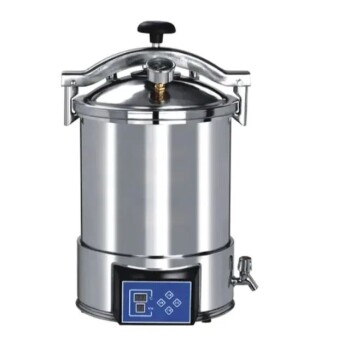
A high-pressure hydrothermal autoclave acts as a specialized reaction vessel that facilitates the synthesis of BiVO4@PANI nanocomposites by generating a sealed, subcritical environment. By maintaining high temperature and pressure, the device forces the in-situ nucleation and rearrangement of Bismuth and Vanadium precursors directly onto Polyaniline (PANI) nanotubes, driving the formation of complex nanostructures that would not form under standard atmospheric conditions.
Core Takeaway The autoclave’s ability to sustain subcritical conditions is the key driver for transforming simple precursors into BiVO4 hollow cage-like structures. This unique morphology significantly increases specific surface area and photocatalytic activity, optimizing the material for high-performance applications.
Creating the Subcritical Environment
The Role of High Pressure and Temperature
The autoclave functions by sealing the reaction solution within a chemically resistant chamber (often Teflon-lined stainless steel).
As the temperature rises, the sealed volume generates significant internal pressure.
This creates subcritical conditions where the solvent (water) remains liquid well above its normal boiling point.
Enhanced Reactivity
Under these conditions, the physical properties of water change drastically.
The permeability and reactivity of water molecules are significantly enhanced.
This accelerated environment promotes chemical interactions that are kinetically sluggish or impossible at ambient pressure.
The Mechanism of Synthesis
Efficient Hydrolysis
The high-pressure environment drives the efficient hydrolysis of bismuth and vanadium precursors.
Rather than precipitating randomly, these precursors undergo a controlled chemical breakdown within the solution.
In-Situ Nucleation on PANI
The synthesis is not merely a mixture of components; it is a surface-mediated process.
The hydrolyzed precursors undergo in-situ nucleation, anchoring directly onto the surface of the existing PANI nanotubes.
Structural Rearrangement
Once nucleated, the precursors do not just accumulate; they rearrange.
The thermal energy and pressure facilitate the organization of these atoms into a specific crystalline order along the PANI template.
Resulting Topology and Performance
Formation of Hollow Cage-Like Structures
The defining outcome of this autoclave process is the resulting morphology.
The BiVO4 forms into hollow cage-like structures, a topology that is distinct from solid bulk materials.
Nanobead Composition
These hollow structures are composed of smaller, aggregated nanobeads.
This hierarchical structure creates a high density of reaction sites.
Critical Impact on Activity
The unique topology directly correlates to performance.
By maximizing the specific surface area, the nanocomposite offers more active sites for photocatalytic reactions, significantly boosting its overall efficiency.
Understanding the Trade-offs
Process Control Challenges
While effective, hydrothermal synthesis requires precise control over temperature and time.
Deviations in the heating profile can lead to inconsistent crystal growth or the collapse of the delicate hollow cage structures.
Scalability Limitations
Autoclaves typically operate as batch reactors.
Scaling this synthesis up for industrial production requires large, expensive pressure vessels or a shift to continuous flow systems, which introduces new engineering complexities compared to atmospheric processes.
Making the Right Choice for Your Goal
When deciding whether to utilize high-pressure hydrothermal synthesis for your nanocomposites, consider your specific material requirements:
- If your primary focus is maximizing active surface area: The autoclave is essential for creating the hollow, cage-like topologies that bulk synthesis cannot achieve.
- If your primary focus is intimate interfacial bonding: The high-pressure environment is the best method to ensure strong in-situ coupling between the BiVO4 and the PANI substrate.
The high-pressure autoclave is not merely a heating device; it is a structural engineering tool that defines the ultimate geometry and performance of your nanocomposite.
Summary Table:
| Feature | Impact on BiVO4@PANI Synthesis |
|---|---|
| Subcritical Conditions | Enables solvent reactivity well above standard boiling points |
| In-Situ Nucleation | Anchors bismuth and vanadium precursors directly onto PANI nanotubes |
| Structural Rearrangement | Facilitates the formation of complex hollow cage-like morphologies |
| Surface Area Optimization | Increases density of active sites for superior photocatalytic efficiency |
Elevate Your Material Research with KINTEK Precision
Are you looking to synthesize high-performance nanocomposites like BiVO4@PANI with unparalleled structural integrity? KINTEK specializes in advanced laboratory equipment, providing the high-temperature high-pressure reactors and autoclaves essential for creating the subcritical environments required for complex nanostructure engineering.
Our comprehensive range of equipment—from hydrothermal autoclaves to high-temperature furnaces (muffle, vacuum, CVD) and crushing and milling systems—is designed to meet the rigorous demands of modern material science and battery research.
Take the next step in your research innovation:
- Achieve superior morphology control with our precision-engineered pressure vessels.
- Ensure consistent results with our industry-leading thermal processing solutions.
- Access expert support for your laboratory setup and consumable needs (PTFE, ceramics, and crucibles).
Contact KINTEK Today to Request a Quote!
References
- Jari S. Algethami, Amal F. Seliem. Bismuth Vanadate Decked Polyaniline Polymeric Nanocomposites: The Robust Photocatalytic Destruction of Microbial and Chemical Toxicants. DOI: 10.3390/ma16093314
This article is also based on technical information from Kintek Solution Knowledge Base .
Related Products
- High Pressure Laboratory Autoclave Reactor for Hydrothermal Synthesis
- Mini SS High Pressure Autoclave Reactor for Laboratory Use
- Stainless High Pressure Autoclave Reactor Laboratory Pressure Reactor
- Laboratory High Pressure Horizontal Autoclave Steam Sterilizer for Lab Use
- Customizable High Pressure Reactors for Advanced Scientific and Industrial Applications
People Also Ask
- What role does a high-pressure reactor (autoclave) play in the synthesis of NiCuFe-LDH? Master Hydrothermal Growth
- What Role Does a High-Pressure Reactor or Autoclave Play in HA Catalyst Synthesis? Achieve High Surface Area Materials
- What equipment is required for hydrothermal synthesis of Ga0.25Zn4.67S5.08? Optimize Your Semiconductor Production
- What is the function of a high-pressure reactor in the hydrothermal synthesis of boehmite? Expert Process Insights
- What role does an autoclave play in the synthesis of MnO2 nanofibers? Mastering Hydrothermal Growth