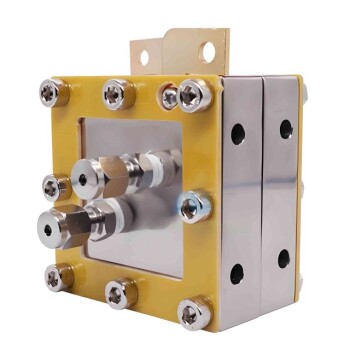
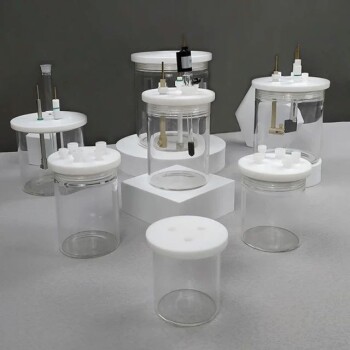
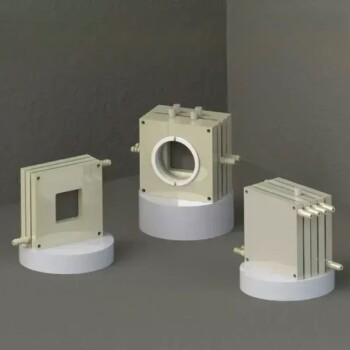
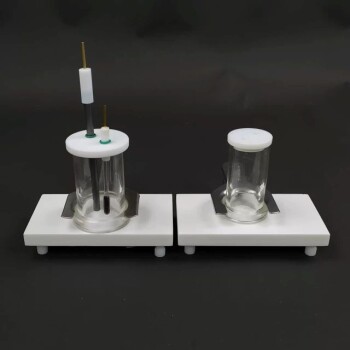
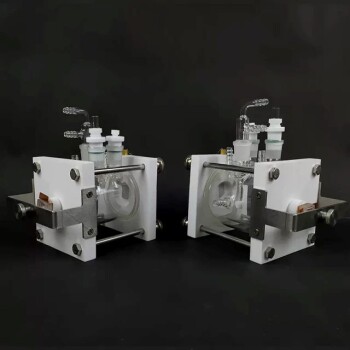
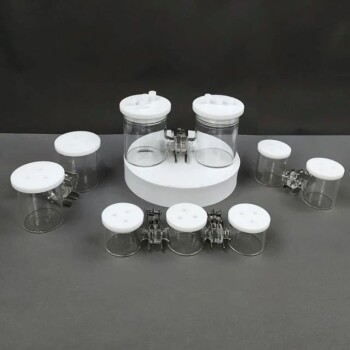
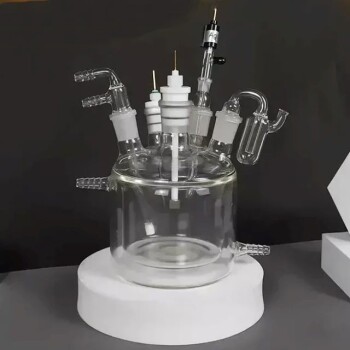
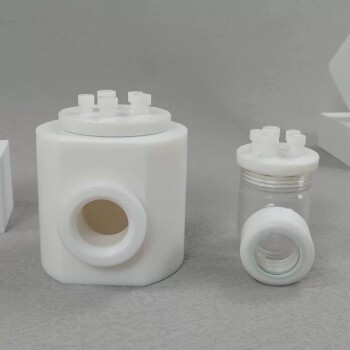
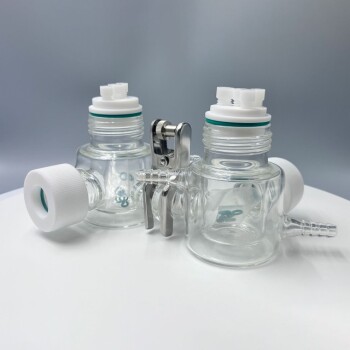
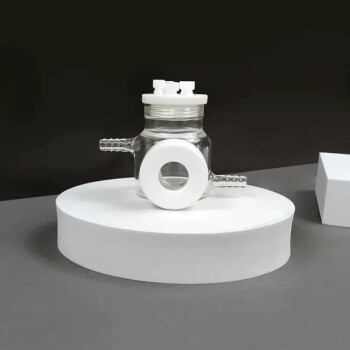
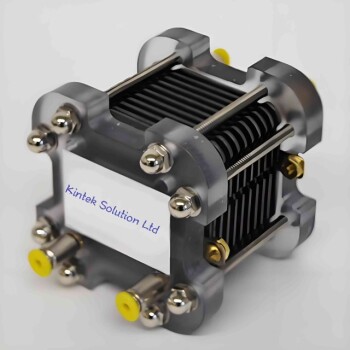
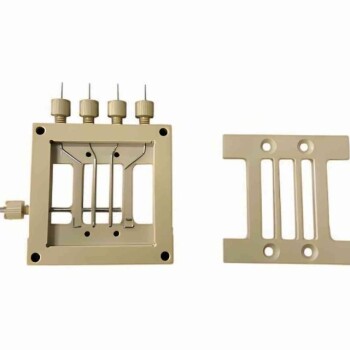
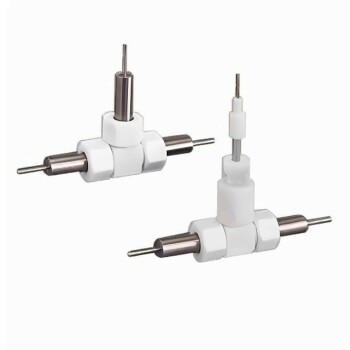
Specialized micro-electrolytic cells are the critical interface that allows high-precision optics and electrochemistry to coexist. By confining a small volume of electrolyte to a specific micro-area using an open-top design, these cells minimize the liquid layer thickness between the probe and the sample. This reduction is essential to eliminate fluid disturbance, ensuring the AFM probe maintains the stability required to capture high-resolution images of corrosion initiation in real time.
The core function of the micro-electrolytic cell is to minimize the "noise" created by the liquid environment. By reducing the liquid layer thickness, the cell prevents fluid dynamics from distorting the imaging contrast, enabling the visualization of nanoscale events that would otherwise be obscured.
The Engineering Behind the Cell
Confining the Electrolyte
Standard electrochemical setups often involve submerging a large portion of the sample. In contrast, specialized micro-cells restrict the electrolyte solution to a specific micro-area on the specimen surface.
This confinement isolates the region of interest. It allows for precise control over the electrochemical environment immediately surrounding the scanning area.
The Open-Top Architecture
To function with Atomic Force Microscopy (AFM), the cell utilizes an open-top design.
This architecture is non-negotiable for physical access. It allows the AFM probe to descend into the liquid environment and operate stably without mechanical interference from the cell walls.
Why Liquid Layer Thickness Matters
Reducing Fluid Disturbance
The primary technical challenge in EC-AFM is the interference caused by the liquid itself. A thick layer of electrolyte can act as a dampener or a source of noise for the sensitive AFM cantilever.
Specialized cells are designed to minimize the liquid layer thickness. By keeping this layer as thin as possible, the system significantly reduces fluid disturbance.
Preserving Imaging Contrast
When fluid disturbance is minimized, imaging contrast is preserved.
If the liquid layer is too deep or uncontrolled, the feedback loop of the AFM can become unstable. The specialized cell ensures that the topography is read accurately, rather than measuring the dynamics of the fluid.
Capturing Real-Time Corrosion Events
Visualizing Initiation
The stability provided by these cells moves the technique beyond static "before and after" images. It enables the real-time capture of corrosion processes as they happen.
Because the probe is stable, researchers can pinpoint the exact moment and location where corrosion initiates.
Observing Microstructural Interactions
High stability allows for the resolution of specific microstructural features.
For instance, the reference highlights the ability to observe interactions with niobium carbides at grain boundaries. This level of detail during electrochemical polarization is only possible because the cell environment is strictly controlled.
Understanding the Trade-offs
Field of View Limitations
The design relies on confining the electrolyte to a "micro-area."
This inherently limits the field of view. While you gain high resolution and stability, you lose the ability to monitor the entire specimen surface simultaneously. You must know where to look before you begin the scan.
Complexity of Setup
Operating an open-top cell with a minimized liquid layer requires precise physical alignment.
The user must carefully balance the need for a thin liquid layer with the risk of the electrolyte evaporating or the meniscus breaking during long-term polarization experiments.
Making the Right Choice for Your Goal
To maximize the effectiveness of your EC-AFM observations, align your setup with your specific research objectives:
- If your primary focus is detecting corrosion initiation: Prioritize a cell design that offers the absolute minimum liquid layer thickness to ensure the highest sensitivity to minute topographical changes.
- If your primary focus is correlating microstructure to corrosion: Ensure your cell placement is precise enough to target specific features, such as grain boundaries or carbide inclusions, within the confined micro-area.
Success in EC-AFM depends not just on the microscope, but on how effectively you control the liquid environment between the probe and the sample.
Summary Table:
| Feature | Specialized Micro-Cell Benefit | Impact on EC-AFM |
|---|---|---|
| Cell Architecture | Open-top, micro-area confinement | Allows physical probe access and stable scanning |
| Liquid Layer | Minimized thickness | Reduces fluid disturbance and noise for the AFM cantilever |
| Imaging Quality | Preserved contrast | Enables visualization of nanoscale corrosion initiation |
| Temporal Resolution | Real-time stability | Captures dynamic interactions at grain boundaries |
| Environment Control | Precise electrochemical isolation | High sensitivity to minute topographical changes |
Elevate Your Corrosion Research with KINTEK Precision
Unlock unprecedented clarity in your electrochemical studies. KINTEK specializes in high-performance laboratory solutions, from advanced electrolytic cells and electrodes to high-temperature high-pressure reactors and specialized crushing systems. Whether you are investigating nanoscale corrosion or developing next-generation battery materials, our comprehensive range of equipment—including hydraulic presses, dental furnaces, and cooling solutions—is designed to meet the rigorous demands of modern science.
Ready to optimize your lab's performance? Contact our specialists today to find the perfect fit for your application!
References
- R. Clark, G. Williams. The role of niobium carbides in the localised corrosion initiation of 20Cr-25Ni-Nb advanced gas-cooled reactor fuel cladding. DOI: 10.1016/j.corsci.2019.108365
This article is also based on technical information from Kintek Solution Knowledge Base .
Related Products
- Customizable PEM Electrolysis Cells for Diverse Research Applications
- Electrolytic Electrochemical Cell with Five-Port
- PTFE Electrolytic Cell Electrochemical Cell Corrosion-Resistant Sealed and Non-Sealed
- Electrolytic Electrochemical Cell Gas Diffusion Liquid Flow Reaction Cell
- Electrolytic Electrochemical Cell for Coating Evaluation
People Also Ask
- What are the risks of improper voltage control in an electrolysis cell? Avoid Costly Damage and Inefficiency
- What are the opening configurations for the non-sealed and sealed versions of the electrolysis cell? Optimize Your Electrochemical Setup
- What is an electrolysis cell? A Guide to Driving Chemical Reactions with Electricity
- What parameters must be strictly controlled during the electrolysis process? Ensure Precision and Efficiency
- What are the precautions for heating or sterilizing an electrolysis cell? Avoid Damaging Sensitive Components