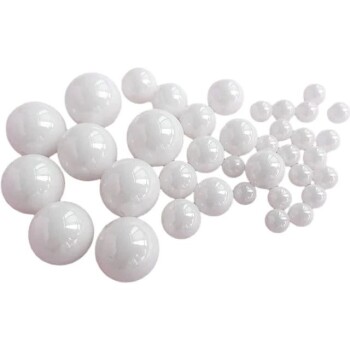
Zirconia grinding balls are the industry-preferred media for mixing High-Entropy Mixed Ionic-Electronic Conductor (HE-O-MIEC) materials because they offer a unique combination of extreme hardness and chemical inertness. This dual nature allows for the aggressive refinement of raw materials without compromising the chemical composition of the final product.
Core Takeaway Synthesizing high-entropy materials requires a delicate balance between applying sufficient mechanical force and maintaining absolute purity. Zirconia succeeds where other media fail by providing the impact necessary to fracture hard ceramics while resisting degradation during extended processing, ensuring the final material retains high electrochemical purity.
Achieving Mechanical Refinement
Overcoming Hard Ceramic Precursors
HE-O-MIEC materials are composed of complex, high-entropy ceramic raw materials that are inherently difficult to process.
Exceptional hardness is required to break these materials down effectively. Zirconia grinding balls provide the sufficient impact force needed to crush and refine these resilient raw components into a uniform powder.
Withstanding Extended Processing
The synthesis of high-entropy conductors often requires extended grinding periods to achieve the necessary homogeneity.
Zirconia possesses superior wear resistance, allowing it to withstand prolonged high-energy milling. Unlike softer media, it maintains its structural integrity over time, ensuring consistent grinding efficiency throughout the duration of the mix.
Preserving Electrochemical Purity
Eliminating Metallic Contamination
The most critical risk during the mixing process is the introduction of foreign impurities, particularly from the grinding media itself.
Zirconia offers high chemical stability, which acts as a safeguard against contamination. This prevents the introduction of metallic impurities that typically occur when using steel or other reactive grinding media.
Ensuring Electrochemical Performance
The performance of an HE-O-MIEC depends entirely on its purity.
By preventing impurity ingress, zirconia ensures the synthesized material maintains high electrochemical purity. This is essential, as even trace contaminants can disrupt the material's ability to conduct ions and electrons efficiently.
Understanding Process Variables
Criticality of Stoichiometry
Beyond simple purity, the ratio of elements in a high-entropy material must remain exact.
Because zirconia has high wear resistance, it does not shed significant mass into the mixture. This ensures the chemical stoichiometric ratio of the product remains accurate, preventing the grinding media from becoming an unintentional ingredient in the formula.
The Necessity of Inertness
While physical wear is one factor, chemical reactivity is another.
Zirconia is chemically inert, meaning it will not react with active precursors during the milling process. This stability is vital for maintaining the integrity of the material structure, specifically avoiding reactions that could alter the conductive properties of the final ceramic.
Making the Right Choice for Your Goal
When designing your material synthesis process, consider your specific priorities:
- If your primary focus is process efficiency: Zirconia provides the high hardness and impact force requisite for breaking down tough high-entropy ceramic precursors rapidly.
- If your primary focus is device performance: The chemical inertness of zirconia is non-negotiable for preventing metallic contamination that would otherwise degrade ionic and electronic conductivity.
Select zirconia to ensure that the rigorous mechanical processing required for synthesis does not come at the cost of material purity.
Summary Table:
| Feature | Benefit for HE-O-MIEC Processing | Why It Matters |
|---|---|---|
| Extreme Hardness | Breaks down tough ceramic precursors | Achieves uniform particle size refinement |
| Wear Resistance | Minimizes media degradation | Maintains stoichiometric accuracy and purity |
| Chemical Inertness | Prevents metallic contamination | Preserves ionic and electronic conductivity |
| High Impact Force | Efficient mechanical alloying | Ensures homogeneity in high-entropy structures |
Elevate Your Advanced Material Synthesis with KINTEK
Precision in High-Entropy Mixed Ionic-Electronic Conductor (HE-O-MIEC) research starts with the right tools. At KINTEK, we specialize in providing the high-performance laboratory equipment and consumables necessary for rigorous material science. From our ultra-durable zirconia grinding media to our precision crushing and milling systems, we ensure your samples remain pure and your results reproducible.
Whether you are refining precursors in our high-temperature furnaces, processing powders with hydraulic presses, or conducting electrochemical tests using our specialized reactors and electrodes, KINTEK delivers the quality your lab demands. Don't let contamination compromise your innovation.
Ready to optimize your milling process? Contact KINTEK today to discuss your specific laboratory needs!
Related Products
- Laboratory Jar Ball Mill with Alumina Zirconia Grinding Jar and Balls
- Precision Machined Zirconia Ceramic Ball for Engineering Advanced Fine Ceramics
- Laboratory Jar Mill with Agate Grinding Jar and Balls
- Laboratory Ball Mill Jar Mill with Metal Alloy Grinding Jar and Balls
- Laboratory Micro Tissue Grinding Mill Grinder
People Also Ask
- What are the primary functions of using a ball mill for BZCY72 powder? Achieve High Purity and Enhanced Sintering
- In what way does a laboratory ball mill affect material properties when modifying PHBV/pulp fiber composites?
- Why is a laboratory ball mill required for ultra-fine fly ash? Unlock Nano-Scale Adsorption Power
- What is the function of a laboratory ball mill in the preparation of AMMCs? Optimize Dispersion & Grain Refinement
- What is the function of a laboratory ball mill in the pretreatment of waste tire char (WTC)? Optimize Material Reactivity