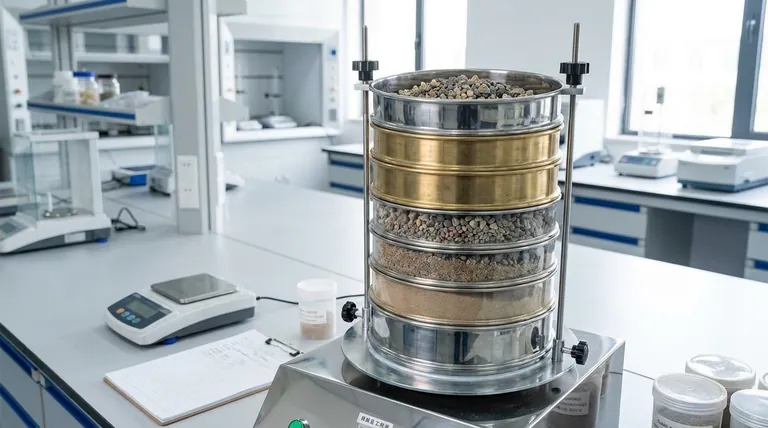
At its core, you need sieve analysis because it is a fundamental quality control method for determining the particle size distribution of a granular material. This analysis provides critical insight into the physical characteristics of materials like sand, powders, grains, and crushed rock, ensuring they meet the specific requirements for performance, safety, and consistency in their final application.
Understanding a material's particle size isn't just an academic exercise; it directly dictates how that material will behave. Sieve analysis offers a reliable, cost-effective, and universally understood method to measure and control this critical variable.
The Role of Particle Size in Material Performance
The distribution of particle sizes within a sample has a direct and measurable impact on its bulk properties. Controlling this distribution is essential for achieving predictable and desirable outcomes.
Ensuring Product Consistency
For manufacturers, consistency is paramount. Whether producing concrete, pharmaceuticals, or food products, a consistent particle size distribution ensures that each batch behaves the same way as the last. Sieve analysis is the primary tool for verifying this consistency from batch to batch.
Predicting Material Behavior
Particle size directly influences key physical properties. The surface area, flowability, compaction density, and even the chemical reactivity of a powder are all functions of its particle size. By measuring the distribution, engineers and scientists can predict how the material will perform.
Meeting Industry and Safety Standards
Many industries, particularly construction and pharmaceuticals, operate under strict standards (such as ASTM) that specify acceptable particle size ranges. Sieve analysis provides the auditable, traceable data required to prove that a material is compliant and fit for purpose.
Why Sieve Analysis Remains a Standard Method
Despite the availability of more advanced technologies, traditional sieve analysis has remained a cornerstone of particle analysis for centuries due to its compelling practical advantages.
Simplicity and Ease of Use
The procedure is straightforward and mechanical. It does not require highly specialized operators, making it accessible for routine quality control on a factory floor or in a field lab.
Cost-Effectiveness
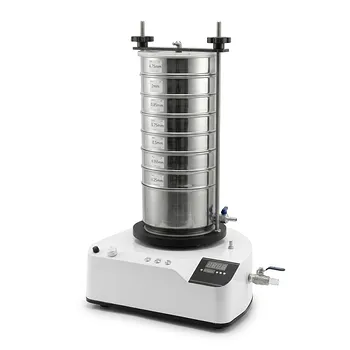
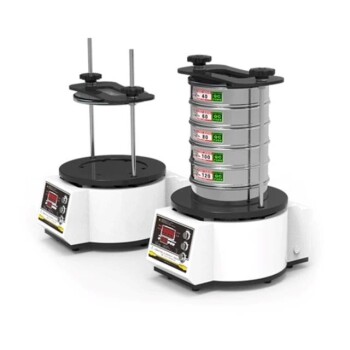
The required equipment—a standardized set of sieves, a mechanical shaker, and a balance—represents a minimal investment. This makes it the most economical method for many applications.
Accuracy and Reproducibility
When performed according to a standardized method, sieve analysis delivers accurate and repeatable results. This reliability is why it is so often cited in industrial and material specifications.
Broad Applicability
The method is effective for a vast range of organic and non-organic granular materials. It is used for everything from sand, clay, and crushed rock to coal, manufactured powders, seeds, and grains.
Understanding the Trade-offs and Limitations
While powerful, sieve analysis is not the solution for every scenario. Acknowledging its limitations is key to using it effectively.
Limited Resolution
A standard sieve stack uses a maximum of about eight sieves. This means your final particle size distribution curve is based on only a few data points, which may not capture the full complexity of the material.
Constraints on Particle Shape
Sieve analysis measures the second-smallest dimension of a particle, as elongated or flat particles can orient themselves to pass through a mesh opening. This can provide a misleading picture if the particle shape is highly irregular.
Lower Size Limit
The effectiveness of mechanical sieving diminishes for very fine powders. The practical lower limit for this method is typically around 50 micrometers (µm); below this, particles can agglomerate and blind the mesh.
Only for Dry, Free-Flowing Materials
The standard method is designed for dry materials that can pass freely through the sieves. It is not suitable for cohesive materials, slurries, or substances that stick together when agitated.
Making the Right Choice for Your Goal
Use this guidance to determine if sieve analysis fits your specific need.
- If your primary focus is foundational quality control for granular materials: Sieve analysis is the industry-standard, most cost-effective method for verifying material specifications.
- If your primary focus is high-resolution analysis of very fine powders (<50 µm): You will need to supplement or replace sieve analysis with more advanced methods like laser diffraction or dynamic image analysis.
- If your primary focus is ensuring compliance with established industrial standards: Sieve analysis is often the prescribed method, providing the necessary documentation and traceability for certification.
By understanding both its purpose and its practical limits, you can leverage sieve analysis to make confident and informed decisions about your material quality and process control.
Summary Table:
| Key Aspect | Why It Matters |
|---|---|
| Product Consistency | Ensures uniform performance from batch to batch in manufacturing. |
| Predictable Behavior | Determines critical properties like flowability, compaction, and reactivity. |
| Regulatory Compliance | Provides auditable data to meet strict industry standards (e.g., ASTM). |
| Cost-Effectiveness | Offers a simple, reliable, and economical method for routine quality control. |
Ready to ensure your materials meet exact specifications?
KINTEK specializes in high-quality laboratory equipment and consumables for precise particle analysis. Our range of reliable sieves and shakers helps laboratories maintain the highest standards of quality control for materials like sand, powders, and aggregates.
Contact our experts today to find the perfect sieve analysis solution for your laboratory's needs and achieve consistent, reliable results.
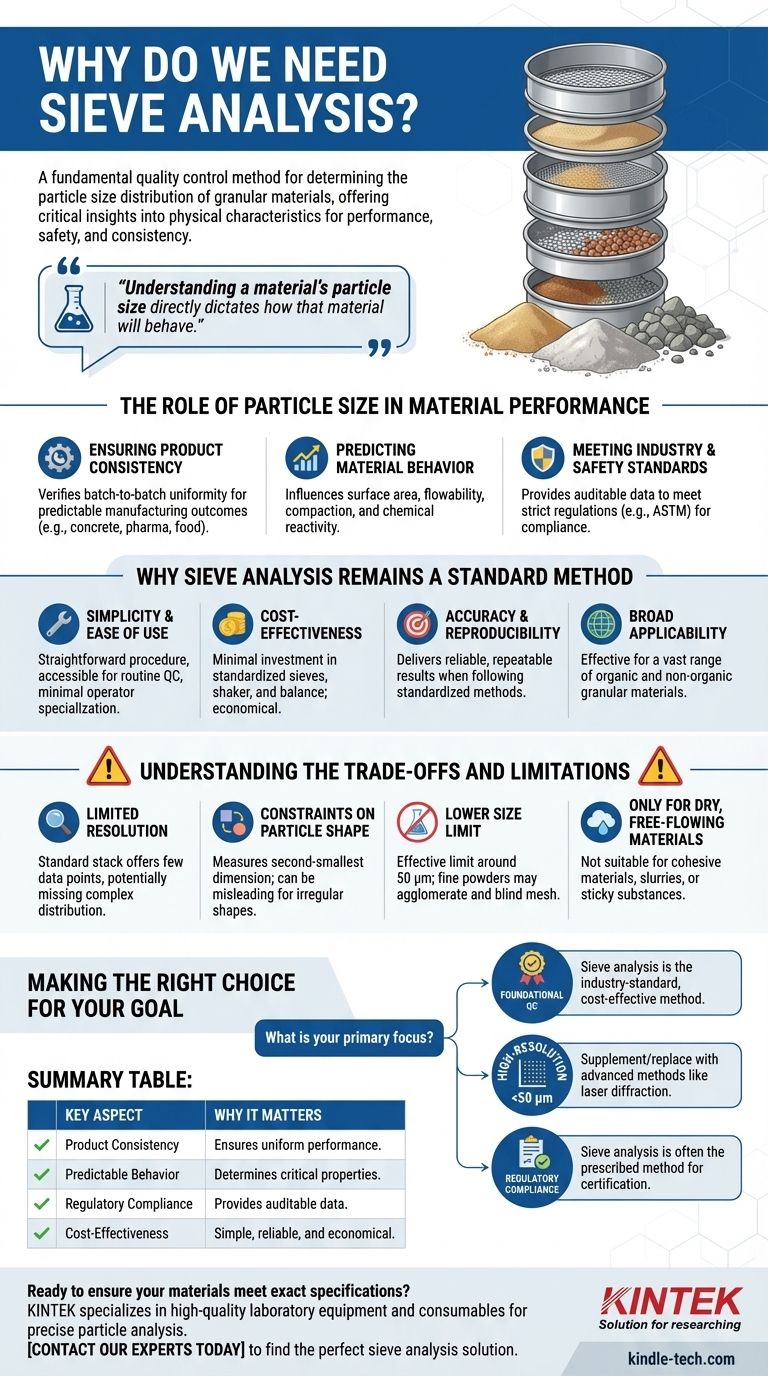
Visual Guide
Related Products
- Laboratory Test Sieves and Vibratory Sieve Shaker Machine
- Laboratory Test Sieves and Sieving Machines
- Laboratory Vibratory Sieve Shaker Machine for Dry and Wet Three-Dimensional Sieving
- Laboratory Vibratory Sieve Shaker Machine Slap Vibrating Sieve
- Three-dimensional electromagnetic sieving instrument
People Also Ask
- How is a standard sieve shaker utilized in pure mineral flotation tests for magnesite? Achieve Reliable Lab Results
- What role does a laboratory vibrating sieve shaker play in the LiFePO4 powder processing workflow? Ensure Batch Quality
- How do you use a sieve shaker? Master Particle Size Analysis for Quality Control
- What is the use of vibratory sieve shaker? Achieve Precise Particle Size Analysis for Your Lab
- Why use a vibratory sieve shaker for PET powder? Achieve Precise Particle Size Control for Chemical Research