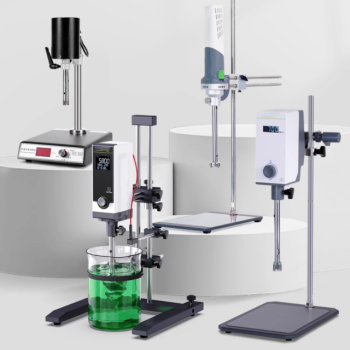
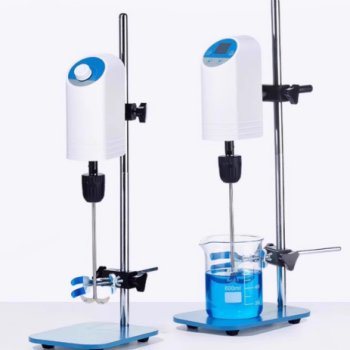
A high-power horn-type ultrasonic homogenizer is strictly necessary because it delivers the intense mechanical shear force required to break down stubborn catalyst particle agglomerates. Unlike standard stirring, which fails to separate clustered iridium-based powders, this device utilizes high-energy cavitation to ensure the catalyst is thoroughly dispersed within the isopropanol, water, and ionomer mixture.
The success of a PEM electrolyzer relies on the "micro-jets" created by ultrasonic cavitation to fracture particle clusters, ensuring full contact between the catalyst and the ionomer. This dispersion is the absolute prerequisite for creating a stable ink and a reproducible, uniform electrode coating.
The Mechanics of Effective Dispersion
Generating Intense Cavitation
The horn-type homogenizer functions by transmitting high-frequency vibrations into the liquid, creating rapid pressure fluctuations. This process generates intense cavitation bubbles that collapse violently.
Creating Shear Force via Micro-Jets
When these cavitation bubbles collapse, they produce high-energy shock waves and micro-jets. This physical force provides the high mechanical shear necessary to disrupt interactions holding particles together.
Breaking Down Agglomerates
Catalyst powders, particularly iridium-based inverse opal structures, naturally form tight clusters or agglomerates. The sheer power of the horn-type homogenizer is required to physically fracture these agglomerates into individual particles.
Optimizing the Catalyst-Ionomer Interface
Ensuring Full Contact
For a PEM electrolyzer to function efficiently, the catalyst must be in intimate contact with the ionomer (the proton-conducting binder). High-power homogenization forces the ionomer to coat the individual catalyst particles, establishing the necessary Triple Phase Boundary.
Stabilizing the Ink
A poorly mixed ink will separate or settle, leading to inconsistent application. Thorough dispersion creates a uniform and stable ink, preventing sedimentation during the subsequent coating process.
Achieving Uniform Film Thickness
The uniformity of the ink directly correlates to the quality of the final electrode. High-degree dispersion ensures that the applied catalytic layer has a uniform thickness, which is critical for reproducible performance.
Understanding the Trade-offs
Heat Generation
The high mechanical shear force required to break agglomerates inevitably converts kinetic energy into heat. Without temperature control, this can evaporate volatile solvents like isopropanol, altering the ink's concentration.
Potential for Over-Processing
While high power is necessary, excessive duration or intensity can potentially damage delicate catalyst microstructures. The goal is to achieve dispersion without pulverizing the inverse opal morphology that provides surface area.
Making the Right Choice for Your Goal
To ensure the performance of your PEM electrolyzer, match your processing parameters to your specific outcome:
- If your primary focus is Electrochemical Efficiency: Ensure the homogenization time is sufficient to fully break agglomerates, maximizing the surface area available for the reaction.
- If your primary focus is Manufacturing Consistency: Standardize the ultrasonic power and duration to guarantee that every batch of ink yields the exact same film thickness and stability.
The quality of your electrode is determined before coating begins; it is defined by the intensity of your dispersion.
Summary Table:
| Feature | Impact on PEM Catalyst Ink |
|---|---|
| High-Energy Cavitation | Generates micro-jets to fracture stubborn iridium-based clusters. |
| Shear Force | Disrupts particle interactions for individual particle dispersion. |
| Ionomer Interface | Ensures full contact between catalyst and binder for the Triple Phase Boundary. |
| Ink Stability | Prevents sedimentation and ensures reproducible, uniform coating thickness. |
Maximize Your Electrolyzer Performance with KINTEK Precision
Superior PEM electrolysis starts with a perfectly dispersed catalyst ink. At KINTEK, we understand that achieving a stable, uniform electrode requires more than just standard mixing—it requires the intense mechanical shear of high-performance laboratory equipment.
Our specialized range of ultrasonic homogenizers is designed to provide the precise energy levels needed to break down catalyst clusters without damaging delicate inverse opal structures. Beyond ink preparation, KINTEK offers a comprehensive ecosystem for energy research, including electrolytic cells, electrodes, battery research tools, and high-temperature furnaces for catalyst synthesis.
Ready to scale your green hydrogen research? Contact KINTEK today to discover how our high-power homogenization and laboratory solutions can ensure the consistency and efficiency of your PEM manufacturing process.
References
- Sebastian Möhle, Peter Strasser. Iridium Oxide Inverse Opal Anodes with Tailored Porosity for Efficient PEM Electrolysis. DOI: 10.1002/adfm.202501261
This article is also based on technical information from Kintek Solution Knowledge Base .
Related Products
- High Shear Homogenizer for Pharmaceutical and Cosmetic Applications
- High Performance Lab Homogenizer for Pharma Cosmetics and Food R&D
- Lab Sterile Slapping Type Homogenizer for Tissue Mashing and Dispersing
- Laboratory High Throughput Tissue Grinding Mill Grinder
- Laboratory Disc Rotary Mixer for Efficient Sample Mixing and Homogenization
People Also Ask
- Why Use a High Shear Homogenizer for Cathode Slurries? Optimize Double-Layer Solid-State Battery Production
- What is the function of high-shear dispersion equipment in corona-resistant nanocomposites? Elevate Your Insulation
- What is the necessity of using an industrial-grade high-shear homogenizer for biomass washing? Ensure Process Efficiency
- What are the advantages of using a high-shear homogenizer for BED/GMA coatings? Achieve Superior Nano-Dispersion
- What role does a high-shear homogenizer play in ODC catalyst suspensions? Unlock Superior Electrochemical Efficiency