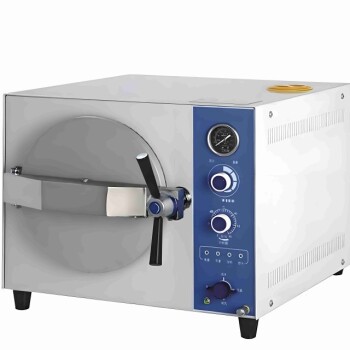
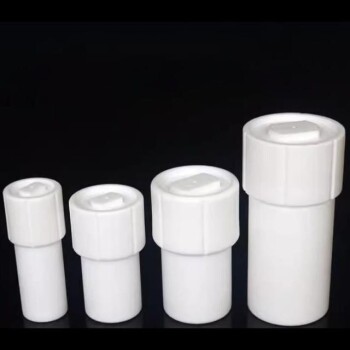
The high-pressure reactor with a titanium liner is essential because it creates the specific hydrothermal conditions required to force the dehydration and structural reorganization of reactants into anhydrous nano zinc borate. While the reactor maintains critical temperatures between 150°C and 300°C to drive the reaction, the titanium liner specifically prevents corrosion from boric acid, ensuring the final powder remains free of leached metal impurities.
Achieving the synthesis of anhydrous nano zinc borate requires a dual approach: high pressure to overcome kinetic barriers for crystallization and a chemically inert liner to guarantee the purity and spherical morphology of the final product.
The Role of the Hydrothermal Environment
Overcoming Kinetic Barriers
Standard heating methods are often insufficient for synthesizing anhydrous zinc borate. The process requires a closed high-pressure environment (autoclave) to achieve the necessary reaction kinetics.
By operating at temperatures ranging from 150°C to 300°C, the internal pressure facilitates the structural reorganization of the reactants. This pressure is the primary driver that forces the dehydration of the compound within an aqueous solution, transitioning it from a hydrated state to the desired anhydrous form.
Controlling Particle Morphology
The interplay between high temperature and pressure does more than just drive the chemical reaction; it dictates the physical shape of the material.
The hydrothermal environment promotes controlled crystal nucleation and growth. This specific environment is required to achieve the specific spherical morphology characteristic of high-quality nano zinc borate, preventing the formation of irregular or unstable structures.
Why the Titanium Liner is Non-Negotiable
Resisting Chemical Corrosion
The synthesis of zinc borate involves boric acid, which becomes highly corrosive at elevated hydrothermal temperatures.
Standard stainless steel liners degrade under these conditions. A titanium liner is critical because it possesses superior chemical resistance, effectively withstanding the aggressive attack of boric acid at temperatures up to 300°C.
Ensuring Absolute Purity
The integrity of the liner is directly tied to the purity of the final nanomaterial. If the liner corrodes, it releases metal ions into the solution.
Titanium acts as an inert barrier, preventing metal ion leaching. This ensures that foreign impurities do not contaminate the lattice of the zinc borate, resulting in a synthesized powder with high chemical purity.
Understanding the Process Trade-offs
Equipment Costs vs. Product Quality
Utilizing a titanium-lined autoclave significantly increases the initial equipment cost compared to standard Teflon-lined or stainless steel reactors.
However, this cost is a necessary trade-off. Cheaper liners (like Teflon) may not withstand the upper limits of the required temperature range (300°C), while standard metals will corrode. Investing in titanium is the only way to ensure process stability and material longevity.
Batch Processing Limitations
Hydrothermal synthesis in autoclaves is inherently a batch process. While it yields high-quality, high-purity results, it does not offer the continuous throughput of flow chemistry systems.
Producers must accept lower throughput rates to achieve the thermodynamic stability and specific anhydrous properties required for this material.
Making the Right Choice for Your Goal
To ensure your synthesis yields the expected results, prioritize the reactor specifications based on your specific quality metrics:
- If your primary focus is Chemical Purity: Ensure the titanium liner is inspected regularly for surface integrity, as its inertness is the only barrier against metal ion contamination from the reactor walls.
- If your primary focus is Particle Morphology: Strictly control the temperature profile between 150°C and 300°C, as the internal pressure generated in this range drives the spherical formation of the nanoparticles.
The success of anhydrous nano zinc borate synthesis relies not just on the chemistry, but on the precise containment of that chemistry within a corrosion-resistant, high-pressure vessel.
Summary Table:
| Feature | Role in Synthesis | Benefit for Zinc Borate |
|---|---|---|
| High Pressure | Overcomes kinetic barriers | Drives structural reorganization/dehydration |
| Hydrothermal (150-300°C) | Facilitates crystal nucleation | Achieves specific spherical morphology |
| Titanium Liner | Superior chemical resistance | Prevents corrosion from boric acid |
| Inert Barrier | Eliminates metal ion leaching | Ensures absolute chemical purity |
Optimize Your Advanced Material Synthesis with KINTEK
Precise control over temperature, pressure, and chemical purity is the foundation of high-quality nanomaterial production. KINTEK specializes in high-performance laboratory solutions designed to meet the rigorous demands of hydrothermal synthesis. From our corrosion-resistant titanium-lined high-pressure reactors and autoclaves to our comprehensive range of high-temperature furnaces (muffle, tube, vacuum, and CVD) and crushing systems, we provide the tools you need for reliable, repeatable results.
Whether you are focusing on battery research, chemical engineering, or advanced ceramics, our team is ready to equip your lab with durable, high-precision technology. Contact KINTEK today to discuss your reactor specifications and enhance your lab's efficiency!
References
- И. В. Козерожец, С. П. Губин. A New Approach for the Synthesis of Powder Zinc Oxide and Zinc Borates with Desired Properties. DOI: 10.3390/inorganics10110212
This article is also based on technical information from Kintek Solution Knowledge Base .
Related Products
- Mini SS High Pressure Autoclave Reactor for Laboratory Use
- High Pressure Laboratory Autoclave Reactor for Hydrothermal Synthesis
- Stainless High Pressure Autoclave Reactor Laboratory Pressure Reactor
- Customizable High Pressure Reactors for Advanced Scientific and Industrial Applications
- Laboratory High Pressure Horizontal Autoclave Steam Sterilizer for Lab Use
People Also Ask
- Why use high-pressure reactors for molecular sieve synthesis? Unlock Superior Crystallinity and Framework Control
- What are the advantages of using a high-pressure reactor like an autoclave? Maximize Liquefaction Speed & Yield
- Why are high-pressure reactors or autoclaves necessary for the synthesis of new functional materials? Unlock Precision.
- What is the function of a high-pressure reactor autoclave? Enhancing Cu/N Co-Doped Carbon Catalyst Synthesis
- How are high-pressure reactors used to prepare metaphosphate electrocatalysts? Master In-Situ Precursor Growth