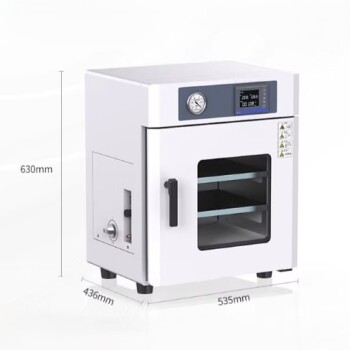
A laboratory vacuum drying oven is essential for processing single-crystal cathode powders because it enables the complete removal of trace moisture at relatively low temperatures, preserving the material's chemical integrity. By creating a low-pressure environment, this equipment prevents moisture-induced surface degradation, specifically inhibiting proton exchange and the formation of harmful impurities like sodium hydroxide.
By lowering the boiling point of liquids, vacuum drying ensures the deep removal of moisture and solvents without subjecting delicate single-crystal structures to excessive thermal stress or oxidation. This prevents immediate chemical corrosion and ensures long-term safety by eliminating gas generation triggers in the final battery assembly.
Preserving Chemical Stability
Preventing Proton Exchange
For single-crystal materials, particularly sodium-ion battery cathodes, exposure to moisture triggers a damaging chemical reaction known as proton exchange.
In this process, water molecules interact with the crystal lattice, causing protons ($H^+$) to swap places with the active metal ions (such as sodium) on the material's surface. A vacuum drying oven removes the moisture required for this reaction to occur, thereby locking in the correct stoichiometric composition of the crystal.
Inhibiting Surface Impurity Formation
When moisture is absorbed by the powder, it often leads to the formation of alkaline residues, such as sodium hydroxide, on the crystal surface.
These surface impurities are detrimental because they alter the material's pH and surface chemistry. Eliminating moisture via vacuum drying prevents these compounds from forming, ensuring the powder remains pure and reactive for subsequent processing steps.
Enhancing Processing Performance
Lowering Thermal Stress
Single-crystal powders and their precursors can be sensitive to high temperatures, which may induce unwanted phase changes or oxidation.
A vacuum environment significantly lowers the boiling point of water and residual solvents. This allows for thorough drying at much lower temperatures compared to atmospheric drying, preserving the microscopic morphology and structural stability of the particles.
Preventing Gas Generation
Any residual moisture left in the cathode powder effectively becomes a "ticking time bomb" for the assembled battery.
If water remains in the crystal structure, it can react later during battery operation to generate gas. Effective vacuum drying eliminates this risk at the source, preventing cell swelling and maintaining the electrochemical stability of the final device.
Understanding the Trade-offs
Vacuum Level vs. Drying Time
While vacuum drying lowers the required temperature, relying solely on low pressure can extend the processing time required to reach distinct dryness levels.
Operators must balance the vacuum depth with a moderate heat input. If the temperature is set too low to protect the material, the cycle time may become inefficiently long, creating a bottleneck in laboratory throughput.
Equipment Sealing and Maintenance
The effectiveness of this process is entirely dependent on the integrity of the vacuum seal.
Any leakage introduces ambient air, which not only re-introduces moisture but may also bring in oxygen. For materials sensitive to oxidation, a compromised vacuum seal can render the drying process counterproductive by exposing the heated powder to air.
Making the Right Choice for Your Goal
To optimize your drying process for single-crystal cathode powders:
- If your primary focus is Chemical Purity: Prioritize a high-vacuum setting to ensure the absolute removal of moisture, preventing proton exchange and sodium hydroxide formation on the particle surface.
- If your primary focus is Morphological Stability: Utilize the vacuum to lower the boiling point, allowing you to reduce the operating temperature and prevent thermal degradation or agglomeration of the particles.
Ultimately, the vacuum drying oven is not just a drying tool; it is a critical preservation chamber that stabilizes the active material's surface chemistry before it ever enters a battery cell.
Summary Table:
| Feature | Impact on Single-Crystal Cathode Powders |
|---|---|
| Low-Temp Drying | Prevents thermal stress and preserves crystal morphology. |
| Moisture Removal | Inhibits proton exchange and surface impurity (NaOH) formation. |
| Vacuum Environment | Prevents oxidation and ensures deep removal of residual solvents. |
| Safety Benefit | Eliminates gas generation triggers to prevent battery cell swelling. |
Elevate Your Battery Research with KINTEK Precision
At KINTEK, we understand that the performance of your single-crystal cathode powders depends on uncompromising purity and structural integrity. Our advanced laboratory vacuum drying ovens are engineered to provide the precise temperature control and high-vacuum depths required to prevent chemical degradation and ensure long-term battery safety.
Whether you are developing next-generation sodium-ion batteries or optimizing high-performance cathode materials, KINTEK offers a comprehensive suite of laboratory solutions—from high-temperature furnaces and crushing systems to isostatic presses and specialized battery research tools.
Ready to optimize your material processing? Contact our technical experts today to find the perfect equipment solution for your laboratory’s unique requirements.
References
- Qianxi Huang, Ding Zhang. Single Crystal Layered Transition Metal Oxide Cathode Materials for Sodium‐Ion Batteries: Potential and Progress. DOI: 10.1002/metm.70005
This article is also based on technical information from Kintek Solution Knowledge Base .
Related Products
- 56L Vertical Laboratory Vacuum Drying Oven
- 23L Laboratory Vacuum Drying Oven
- Laboratory Scientific Electric Heating Blast Drying Oven
People Also Ask
- Why is a laboratory vacuum drying oven recommended for rice straw residues? Protect Your Biomass Integrity
- What role does a laboratory vacuum drying oven play in the preparation of modified multi-walled carbon nanotubes?
- What is the importance of using a laboratory vacuum drying oven? Preserving Slow-Release Microcapsule Integrity
- Why is a Laboratory Vacuum Drying Oven recommended for PBAT microspheres? Protect Sensitive Polymer Integrity
- What role does a laboratory vacuum drying oven play in processing nanoparticle powder samples? Protect Sample Integrity