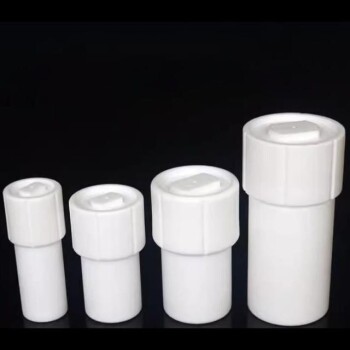
The requirement for a PTFE-lined high-pressure reactor is driven by the necessity for a chemically inert environment that can withstand extreme alkalinity and high internal pressures simultaneously. In the hydrothermal synthesis of $La_2FeCrO_6$, high concentrations of potassium hydroxide (KOH) are used as a mineralizer, which would aggressively corrode a standard stainless steel vessel. The PTFE liner acts as a sacrificial barrier that prevents structural erosion and eliminates the risk of metallic impurities leaching into the final double perovskite powder.
The PTFE-lined reactor provides a vital synergy: the inner liner offers chemical immunity to aggressive mineralizers like KOH, while the external stainless steel shell provides the mechanical strength required to safely contain the high pressures generated during hydrothermal processing.
Chemical Resilience in Extreme Alkaline Environments
Neutralizing the Threat of KOH Erosion
The synthesis of $La_2FeCrO_6$ double perovskites requires a strong alkaline mineralizer (KOH) to facilitate the dissolution and recrystallization of precursors. At the target temperature of 433 K, this concentrated alkali becomes highly corrosive to transition metals. A Polytetrafluoroethylene (PTFE) liner is essential because its molecular structure is virtually impervious to chemical attack from strong bases.
Maintaining Phase Purity through Inertness
If the reaction were performed in a bare metal vessel, the KOH would leach iron, nickel, or chromium ions from the reactor walls into the solution. These leached metallic impurities would incorporate into the crystal lattice of the $La_2FeCrO_6$, ruining the precise stoichiometry required for double perovskite properties. The PTFE liner ensures that the only elements present in the reaction are those explicitly introduced by the researcher.
Accelerating Reaction Kinetics
The sealed environment of the reactor allows water to reach temperatures well above its standard boiling point, significantly increasing the solubility of metal precursors. This "superheated" state enhances the diffusion of ions, allowing $La_2FeCrO_6$ to crystallize at much lower temperatures than the traditional solid-state ceramic method. This lower thermal budget provides better control over the final particle morphology and size distribution.
Structural Integrity Under Hydrothermal Pressure
The Synergy of PTFE and Stainless Steel
While PTFE is chemically excellent, it lacks the mechanical rigidity to hold high pressure on its own at 433 K. The stainless steel outer shell provides the necessary structural "skeleton" to prevent the liner from deforming or rupturing. This combination allows for a stable hydrothermal environment where internal pressure can be safely maintained throughout the crystallization period.
Enhancing Crystallinity and Morphology
By maintaining a constant high-pressure environment, the reactor promotes the growth of high-quality crystals with specific facets. This is critical for double perovskites, where the ordering of iron (Fe) and chromium (Cr) ions significantly impacts the material's magnetic and electronic characteristics. The sealed system prevents the evaporation of solvent, ensuring the concentration of the mineralizer remains consistent.
Understanding the Trade-offs
Thermal Limitations of PTFE
The primary downside of using PTFE liners is their strict temperature ceiling, typically around 250°C (523 K). Beyond this point, PTFE begins to soften and can release toxic fluorinated gases or undergo mechanical failure. For syntheses requiring higher temperatures, researchers must pivot to more expensive materials like PEEK or gold-lined autoclaves.
Heat Transfer Inefficiency
PTFE is an excellent thermal insulator, which means there is a significant lag between the temperature of the oven and the temperature of the reaction slurry inside the liner. This requires longer "soaking" times to ensure the internal environment has reached the target 433 K. Users must account for this thermal inertia when timing their synthesis protocols to ensure complete phase formation.
How to Apply This to Your Project
Making the Right Choice for Your Goal
- If your primary focus is Phase Purity: Ensure the PTFE liner is thoroughly cleaned with dilute acid between runs to prevent "memory effects" or cross-contamination from previous batches.
- If your primary focus is Safety and Longevity: Never fill the PTFE liner more than 60–80% of its total volume to allow sufficient headspace for liquid expansion and vapor pressure development.
- If your primary focus is Morphology Control: Use the PTFE-lined reactor to explore lower-temperature windows (150°C–200°C), which often yield more uniform nanoparticles than high-temperature routes.
By leveraging the chemical immunity of PTFE and the mechanical strength of steel, you can reliably produce high-purity double perovskites while protecting your laboratory equipment from catastrophic corrosion.
Summary Table:
| Feature | Benefit for La2FeCrO6 Synthesis |
|---|---|
| PTFE Liner | Provides immunity to highly corrosive KOH mineralizers. |
| Stainless Steel Shell | Supplies mechanical strength to contain high hydrothermal pressures. |
| Chemical Inertness | Prevents metallic leaching (Fe, Ni, Cr) into the perovskite lattice. |
| Sealed Environment | Enables superheated water to accelerate reaction kinetics and crystallinity. |
| Temp. Limit (433 K) | Safely operates within the thermal ceiling of PTFE for optimal morphology. |
Scale Your Synthesis Success with KINTEK
Precision in material science starts with the right equipment. KINTEK specializes in high-performance laboratory solutions designed to withstand the most demanding hydrothermal conditions. Our high-temperature high-pressure reactors and autoclaves feature premium PTFE liners, ensuring your $La_2FeCrO_6$ synthesis remains free from contamination and corrosive damage.
From muffle and tube furnaces for post-synthesis annealing to hydraulic presses for pelletizing your powders, KINTEK offers a comprehensive range of tools including:
- Advanced Reactors: CVD, PECVD, and high-pressure hydrothermal systems.
- Sample Preparation: Crushing, milling, and sieving equipment.
- Essential Consumables: High-purity ceramics, crucibles, and PTFE products.
Don't let impurities compromise your double perovskite research. Contact KINTEK today to discover how our reliable laboratory equipment can enhance your phase purity and experimental safety!
References
- Kang Yi, Xinhua Zhu. Microstructural Characterization and Magnetic, Dielectric, and Transport Properties of Hydrothermal La2FeCrO6 Double Perovskites. DOI: 10.3390/nano13243132
This article is also based on technical information from Kintek Solution Knowledge Base .
Related Products
- Custom PTFE Teflon Parts Manufacturer for Hydrothermal Synthesis Reactor Polytetrafluoroethylene Carbon Paper and Carbon Cloth Nano-growth
- Custom PTFE Teflon Parts Manufacturer for Reagent Wide Mouth Fine Mouth Sample High Temperature Bottles
- Stainless High Pressure Autoclave Reactor Laboratory Pressure Reactor
- Customizable High Pressure Reactors for Advanced Scientific and Industrial Applications
- Custom PTFE Teflon Parts Manufacturer for Microwave Digestion Tank
People Also Ask
- What is the function of a PTFE reactor in MXene etching? Ensure Safe, High-Purity MAX Phase Conversion
- Why is a PTFE reactor required for titanium-based nano-ceramic coating solutions? Ensure Chemical Inertness & Purity
- Why must a Polytetrafluoroethylene (PTFE) reactor be used for Ti3C2TX MXene etching? Ensure Safety and Purity
- Why are PTFE reactors preferred for silver phosphate glass testing? Ensure Purity and Kinetic Accuracy
- What are the advantages of using polytetrafluoroethylene (PTFE) liners in hydrothermal synthesis reactors? High Purity