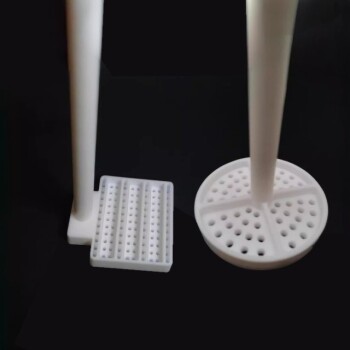
The primary purpose of using a PTFE-lined hydrothermal synthesis reactor is to generate a sealed, high-pressure, and moderate-temperature environment that drives the uniform co-precipitation of Gallium (Ga) and Magnesium (Mg). This specialized vessel facilitates chemical reactions that are inefficient or impossible under standard atmospheric conditions, specifically the controlled decomposition of urea to regulate solution pH.
Core Takeaway By maintaining a sealed environment at approximately $110^{\circ}\text{C}$, the reactor enables the decomposition of urea into ammonia and carbon dioxide. This process regulates the pH to ensure Ga and Mg crystallize uniformly in the liquid phase, effectively solving the issue of uneven particle agglomeration common in standard stirring methods.
Creating the Optimal Synthesis Environment
The Role of the Sealed Vessel
The reactor is designed to operate as a closed system. By sealing the reactants inside, the vessel allows internal pressure to build up as the temperature rises.
This high-pressure environment is critical for altering the kinetics of the chemical reaction. It forces the reactants to interact more intimately than they would in an open beaker at atmospheric pressure.
Thermal Requirements
The process specifically targets a temperature of around $110^{\circ}\text{C}$. This temperature is carefully selected to trigger specific decomposition reactions without degrading the desired precursor materials.
The PTFE lining ensures the vessel can withstand these conditions while providing a non-reactive surface for the chemical solution.
The Mechanism of Uniform Precipitation
Controlled Decomposition of Urea
The central chemical mechanism enabled by this reactor is the decomposition of urea. Under the hydrothermal conditions ($110^{\circ}\text{C}$ and high pressure), urea breaks down into ammonia and carbon dioxide.
This reaction is difficult to control precisely in open, room-temperature setups. The reactor ensures this decomposition happens at a steady, predictable rate.
Regulating pH for Co-Precipitation
The ammonia released during urea decomposition acts as a pH regulator. It gradually shifts the pH of the solution, creating the exact conditions needed for metal ions to precipitate.
This regulation allows Gallium and Magnesium to undergo co-precipitation simultaneously. This "liquid phase" reaction ensures the two elements are mixed at a molecular level.
Overcoming Common Processing Defects
Solving the Agglomeration Problem
Standard preparation methods often rely on magnetic stirring at room temperature and pressure. While simple, these methods frequently result in uneven agglomeration.
Agglomeration occurs when particles clump together irregularly. This leads to inconsistencies in the final ceramic material, creating weak points or chemical segregation.
Achieving Homogeneous Crystallization
The hydrothermal reactor eliminates these inconsistencies by fostering uniform crystallization. Because the pH changes gradually and uniformly throughout the sealed solution, the crystals grow evenly.
This results in hydrated intermediate products that possess superior homogeneity compared to those produced by mechanical mixing.
Understanding the Trade-offs
Equipment Complexity vs. Simplicity
While the hydrothermal method yields higher quality precursors, it introduces operational complexity. Using a high-pressure reactor requires stricter safety protocols and more setup time than simple beaker stirring.
Batch Processing Limitations
Hydrothermal synthesis is inherently a batch process. The reactor must be sealed, heated, reacted, cooled, and opened. This is generally slower and less continuous than room-temperature precipitation methods, potentially acting as a bottleneck in high-volume production.
Making the Right Choice for Your Goal
When selecting a preparation method for LSGM ceramic precursors, consider your specific requirements regarding quality versus throughput.
- If your primary focus is material homogeneity: Use the PTFE-lined hydrothermal reactor to ensure uniform co-precipitation and eliminate particle clumping.
- If your primary focus is process speed: Recognize that while standard stirring is faster, it significantly increases the risk of uneven agglomeration and lower-quality ceramics.
The hydrothermal approach is the definitive choice when the microstructural integrity of the final LSGM ceramic is the priority.
Summary Table:
| Feature | Hydrothermal Synthesis (Reactor) | Standard Stirring Method |
|---|---|---|
| Environment | Sealed, High-Pressure, $110^{\circ}\text{C}$ | Open, Atmospheric Pressure, Room Temp |
| PH Regulation | Gradual (via urea decomposition) | Immediate (manual titration) |
| Product Quality | Uniform molecular-level mixing | High risk of uneven agglomeration |
| Microstructure | Homogeneous crystallization | Inconsistent chemical segregation |
| Best Used For | High-integrity LSGM ceramics | Rapid batch throughput |
Elevate Your Material Research with KINTEK
Achieve unmatched homogeneity in your advanced ceramic synthesis. KINTEK specializes in high-performance laboratory equipment, including PTFE-lined hydrothermal synthesis reactors, high-temperature autoclaves, and crushing and milling systems designed to eliminate agglomeration and ensure precise crystallization.
Whether you are developing LSGM precursors or exploring battery research, our comprehensive range of high-pressure reactors, muffle furnaces, and ceramic crucibles provides the reliability your lab demands. Optimize your synthesis process today—Contact KINTEK for a tailored solution!
Related Products
- Custom PTFE Teflon Parts Manufacturer for Hydrothermal Synthesis Reactor Polytetrafluoroethylene Carbon Paper and Carbon Cloth Nano-growth
- High Pressure Laboratory Autoclave Reactor for Hydrothermal Synthesis
- Customizable Laboratory High Temperature High Pressure Reactors for Diverse Scientific Applications
- Custom PTFE Teflon Parts Manufacturer for Microwave Digestion Tank
- Custom PTFE Teflon Parts Manufacturer for PTFE Measuring Cylinder 10/50/100ml
People Also Ask
- What is the function of a PTFE reactor in MXene etching? Ensure Safe, High-Purity MAX Phase Conversion
- Why is a PTFE reactor required for titanium-based nano-ceramic coating solutions? Ensure Chemical Inertness & Purity
- Why must a Polytetrafluoroethylene (PTFE) reactor be used for Ti3C2TX MXene etching? Ensure Safety and Purity
- Why are PTFE reactors preferred for silver phosphate glass testing? Ensure Purity and Kinetic Accuracy
- What are the advantages of using polytetrafluoroethylene (PTFE) liners in hydrothermal synthesis reactors? High Purity