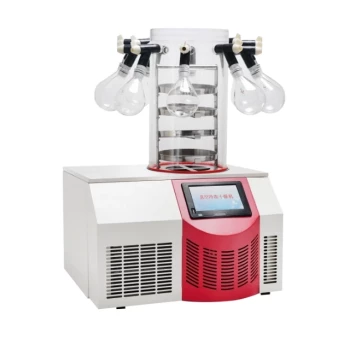
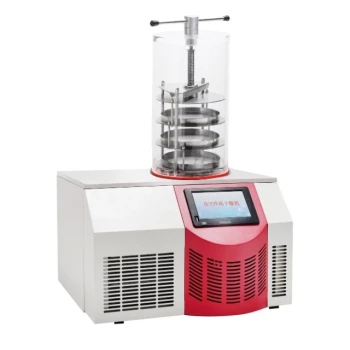
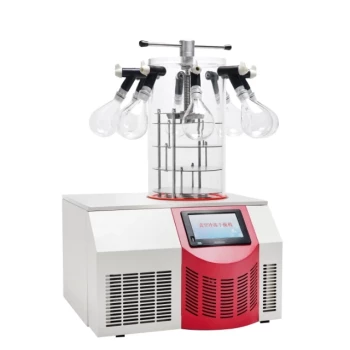
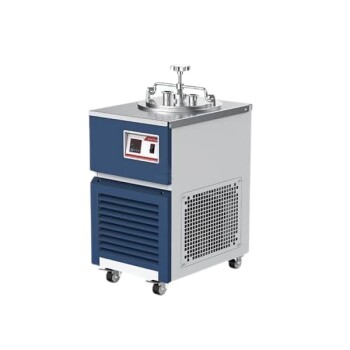
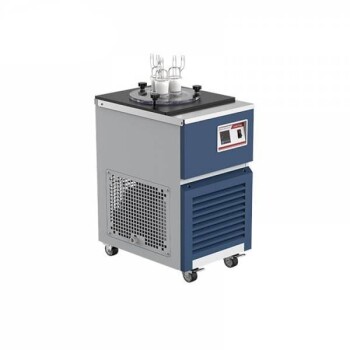
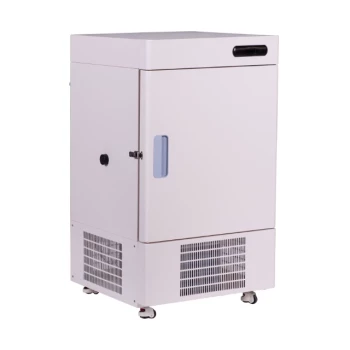
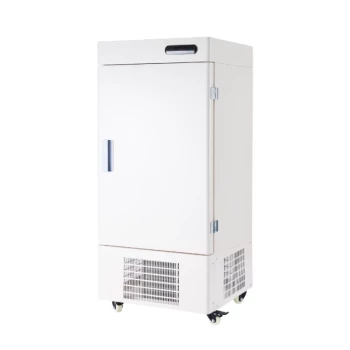
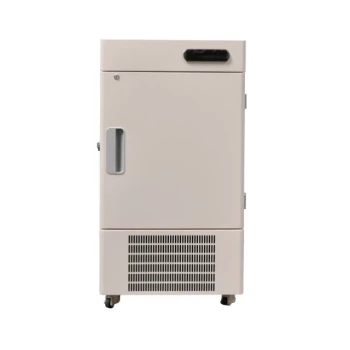
A vacuum freeze dryer is indispensable for preparing 3D graphene-based aerogels because it utilizes sublimation to remove solvents, bypassing the liquid evaporation phase entirely. This specific mechanism is the only way to eliminate the destructive capillary forces that inevitably destroy the material's delicate 3D network during standard drying processes.
The Core Insight The fundamental necessity of this equipment lies in structure preservation. Standard drying methods exert capillary pressure that crushes the aerogel's internal framework; freeze drying locks the structure in place, ensuring the high porosity and surface area required for advanced applications like catalysis are retained.
The Mechanics of Structural Preservation
The Threat of Capillary Collapse
In standard drying methods, such as oven heating, liquid solvents evaporate. As the liquid turns to gas, it exerts significant surface tension on the pore walls of the material.
These capillary forces are strong enough to pull the graphene sheets together. This results in severe agglomeration, or stacking, of the sheets.
The outcome is the total collapse of the three-dimensional network. The material shrinks, cracks, and loses the porous architecture that defines an aerogel.
The Sublimation Solution
A vacuum freeze dryer solves this by freezing the wet gel first, turning the solvent (usually water) into ice.
By lowering the pressure within the chamber via a vacuum pump, the machine forces the ice to undergo sublimation.
This means the ice transitions directly into vapor without ever becoming liquid again. Because there is no liquid phase, there are no capillary forces to damage the structure.
Critical Material Outcomes
Preserving Specific Surface Area
The primary metric for aerogel quality is specific surface area.
Freeze drying prevents the graphene oxide (GO) sheets from stacking on top of each other.
This ensures the final powder or monolith retains maximum surface exposure. This is critical for dispersibility when mixing with organic solvents or polymer matrices later.
Maintaining Hierarchical Porosity
For a 3D graphene aerogel to function, it must maintain a "hierarchical" pore structure—a complex network of interconnected voids.
Freeze drying preserves this open framework.
This integrity creates efficient mass transfer channels. In electrochemical applications, these channels allow reactants to move freely through the material to reach active sites.
Enabling Catalytic Performance
The physical structure directly dictates the material's chemical performance.
Because the freeze dryer preserves the high porosity and surface area, the aerogel becomes an ideal substrate for loading active materials.
It serves as a highly effective catalytic carrier, providing a stable, high-surface-area scaffold that enhances the efficiency of the catalyst.
Understanding the Trade-offs
Equipment Complexity vs. Result
While standard oven drying is faster and cheaper, it is functionally useless for creating high-quality aerogels.
The trade-off is that vacuum freeze drying is a time-intensive batch process that requires specialized industrial-grade equipment.
However, for applications like Metal-Organic Framework (MOF) aerogels or 3D-printed graphene frameworks, there is no viable alternative to specialized drying (freeze drying or supercritical CO2 drying) if structural integrity is required.
Making the Right Choice for Your Goal
To determine how to apply this to your specific process, consider your performance targets:
- If your primary focus is Catalytic Efficiency: You must use freeze drying to maximize specific surface area, ensuring the highest possible number of active sites for reaction.
- If your primary focus is Mechanical Stability: You must use freeze drying to prevent cracking and shrinking, which preserves the physical dimensions and strength of the 3D network.
- If your primary focus is Electrochemistry: You must use freeze drying to maintain open, interconnected pores that facilitate the rapid transport of ions and electrolytes.
Ultimately, the vacuum freeze dryer is not just a drying tool; it is the architect that locks your material's potential into place.
Summary Table:
| Feature | Vacuum Freeze Drying | Standard Oven Drying |
|---|---|---|
| Physical Process | Sublimation (Solid to Gas) | Evaporation (Liquid to Gas) |
| Capillary Forces | Eliminated (Zero liquid phase) | High (Destructive tension) |
| Material Structure | Preserved 3D porous network | Collapsed and agglomerated |
| Surface Area | Maximum (High porosity) | Low (Stacked sheets) |
| Best For | Catalysis, Sensors, Energy Storage | Low-cost bulk powders |
Elevate Your Material Science with KINTEK Precision
Don't let capillary collapse compromise your research. KINTEK provides specialized laboratory solutions designed for high-performance material synthesis. From advanced vacuum freeze dryers that lock in your aerogel's 3D architecture to our comprehensive range of high-temperature furnaces, crushing and milling systems, and hydraulic presses, we offer the tools necessary for precision engineering.
Whether you are developing next-generation catalysts, electrochemical cells, or 3D-printed frameworks, KINTEK ensures your materials retain their maximum surface area and hierarchical porosity.
Ready to optimize your drying process? Contact our technical experts today to find the perfect equipment for your laboratory.
References
- Wan Nor Roslam Wan Isahak, Ahmed A. Al‐Amiery. Oxygenated Hydrocarbons from Catalytic Hydrogenation of Carbon Dioxide. DOI: 10.3390/catal13010115
This article is also based on technical information from Kintek Solution Knowledge Base .
Related Products
- Benchtop Laboratory Vacuum Freeze Dryer
- High Performance Laboratory Freeze Dryer
- High Performance Laboratory Freeze Dryer for Research and Development
- Benchtop Laboratory Freeze Dryer for Lab Use
- Vacuum Cold Mounting Machine for Sample Preparation
People Also Ask
- What are the technical advantages of using a laboratory freeze dryer for porous carbon precursors? Preserve 3D Networks
- How do laboratory freeze dryers support scientific research? Preserve Sample Integrity for Reproducible Results
- Why is a laboratory freeze dryer preferred over traditional heating? Preserve Biochar Structure & Maximize Porosity
- What types of liquid samples can be processed using a laboratory freeze dryer? Preserve Your Sensitive Materials
- What role do laboratory freeze dryers play in the food industry? Unlock Superior Food Preservation