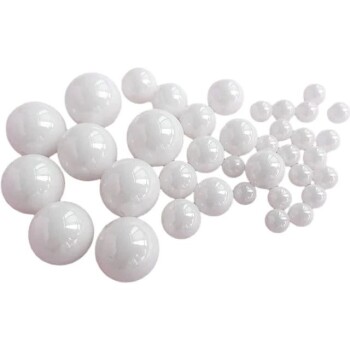
The choice of a zirconia (ZrO2) grinding jar is dictated by its exceptional hardness and wear resistance. These properties allow the jar to withstand the rigorous conditions of mechanochemical synthesis—specifically high speeds (e.g., 550 rpm) and long durations (e.g., 10 hours)—without degrading. Consequently, this prevents the introduction of wear-debris impurities, ensuring the high purity required for Na1-xZrxLa1-xCl4 solid electrolytes.
Core Takeaway The use of zirconia is fundamentally a contamination control strategy. In high-energy synthesis, the grinding media itself becomes a potential contaminant; zirconia is selected because it resists abrasion, thereby preserving the chemical integrity and electrochemical performance of the sensitive halide electrolyte.
The Critical Role of Material Hardness
Resisting Abrasion Under Stress
Mechanochemical synthesis involves high-energy collisions. The process described operates at high speeds (around 550 rpm) for extended periods (up to 10 hours).
Under these conditions, softer materials would degrade rapidly. Zirconia's superior hardness ensures the jar surface remains intact despite the continuous bombardment.
Preventing Media Wear
The primary function of the zirconia jar is to maintain its structural integrity.
If the grinding jar wears down, particles of the jar material are shed into the powder mixture. Zirconia’s wear resistance effectively eliminates this source of cross-contamination.
Ensuring Electrochemical Purity
Sensitivity of Halide Electrolytes
Na1-xZrxLa1-xCl4 is a halide solid electrolyte. These materials are highly sensitive to impurities.
Foreign contaminants can severely degrade the material's performance. Maintaining absolute purity is not optional; it is a prerequisite for functionality.
Eliminating Metallic Impurities
Standard grinding jars, such as those made of stainless steel, introduce significant risks. They often shed metallic impurities like iron or chromium into the powder during milling.
Zirconia is non-metallic and chemically inert. Its use ensures that no conductive metals are introduced that could lead to side reactions or short circuits in the final cell.
Process Efficiency and Mechanics
High-Density Impact
Beyond hardness, zirconia is a high-density material.
This density provides substantial kinetic energy during the milling process. This energy is essential for uniformly mixing reactants and refining particle sizes to the nanometer or micrometer scale.
Uniform Microstructure
The combination of high impact energy and lack of contamination leads to a consistent powder distribution.
A uniform precursor powder is critical. It ensures that subsequent processing steps, such as sintering, result in a consistent microstructure with optimal ionic conductivity.
Common Pitfalls to Avoid
The "Good Enough" Fallacy
A common mistake is assuming that standard laboratory glassware or lower-grade ceramics are sufficient for solid-state synthesis.
While cheaper, these materials lack the wear resistance required for high-energy ball milling. Using them will almost invariably result in a "doped" product containing significant amounts of jar debris.
Overlooking Chemical Inertness
It is critical to remember that physical wear is not the only risk.
Chemical reactivity between the jar and the precursors can occur with other materials. Zirconia’s chemical inertness prevents these unwanted side reactions, preserving the stoichiometry of the Na1-xZrxLa1-xCl4 synthesis.
Making the Right Choice for Your Goal
When setting up your synthesis protocol, select your grinding media based on your specific performance targets.
- If your primary focus is Electrochemical Stability: Prioritize zirconia jars to eliminate metallic impurities (Fe, Cr) that trigger side reactions during cycling.
- If your primary focus is Microstructural Uniformity: Rely on zirconia's high density to provide the kinetic energy needed for thorough refinement without media degradation.
Ultimately, zirconia is the industry standard for this application because it is the only material that can deliver high impact energy while guaranteeing the absolute purity required for high-performance solid electrolytes.
Summary Table:
| Feature | Zirconia (ZrO2) Benefit | Impact on Electrolyte Synthesis |
|---|---|---|
| Hardness | Exceptional abrasion resistance | Prevents jar debris from contaminating the powder |
| Chemical Inertness | Non-metallic and non-reactive | Eliminates risk of side reactions or short circuits |
| Material Density | High kinetic energy output | Ensures uniform particle size and refined microstructure |
| Durability | Withstands high speeds (550+ rpm) | Maintains structural integrity over long milling durations |
Elevate Your Battery Research with KINTEK Precision
Achieving the absolute purity required for Na1-xZrxLa1-xCl4 solid electrolytes demands equipment that won't compromise your chemistry. KINTEK specializes in high-performance laboratory solutions, providing the crushing and milling systems and zirconia grinding media essential for contamination-free mechanochemical synthesis.
From high-temperature furnaces and vacuum systems to specialized battery research tools and high-pressure reactors, we empower researchers with the tools needed for next-generation energy storage. Don't let jar wear-debris degrade your electrochemical performance.
Contact KINTEK today to optimize your synthesis workflow
Related Products
- Laboratory Jar Ball Mill with Alumina Zirconia Grinding Jar and Balls
- Laboratory Jar Mill with Agate Grinding Jar and Balls
- Laboratory Ball Mill Jar Mill with Metal Alloy Grinding Jar and Balls
- Precision Machined Zirconia Ceramic Ball for Engineering Advanced Fine Ceramics
- Engineering Advanced Fine Ceramics Head Tweezers with Pointed Elbow Zirconia Ceramic Tip
People Also Ask
- What are the primary functions of using a ball mill for BZCY72 powder? Achieve High Purity and Enhanced Sintering
- In what way does a laboratory ball mill affect material properties when modifying PHBV/pulp fiber composites?
- Why is a laboratory ball mill required for ultra-fine fly ash? Unlock Nano-Scale Adsorption Power
- What is the function of a laboratory ball mill in the preparation of AMMCs? Optimize Dispersion & Grain Refinement
- What is the function of a laboratory ball mill in the pretreatment of waste tire char (WTC)? Optimize Material Reactivity