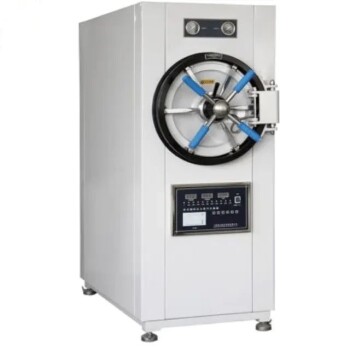
The autoclave serves as the foundational validation tool for nuclear materials because it is the only equipment capable of accurately reproducing the extreme high-temperature, high-pressure aqueous environments found inside a reactor core. Without this precise environmental simulation, it is impossible to reliably predict how zirconium alloy fuel cladding will resist corrosion, maintain structural integrity, or degrade over years of service.
Core Takeaway While simple heating tests can simulate thermal stress, only an autoclave allows for the study of corrosion kinetics under the specific hydraulic and chemical pressures of a nuclear core. This environment is strictly required to induce and analyze the growth of oxide films ($ZrO_{2-x}$), phase transformations, and the eventual breakdown of the material's protective layers.
Replicating Extreme Reactor Conditions
Achieving Critical Thermodynamics
To test zirconium alloys effectively, the testing environment must mirror the reactor's coolant conditions.
An autoclave allows water to remain in a liquid or specific steam phase at temperatures far exceeding the standard boiling point.
Typical simulation parameters include temperatures ranging from 310°C to 360°C and pressures between 14 MPa and 19.5 MPa.
Precise Chemical Control
Temperature and pressure are only part of the equation; the chemical composition of the water drives corrosion rates.
High-end autoclaves utilize circulation loops to control water chemistry parameters, such as conductivity, pH levels, and electrochemical potential.
Crucially, they allow for the introduction of specific additives found in reactor coolant, such as lithium, boron, and controlled oxygen saturation, which significantly alter how corrosion evolves on the metal surface.
Monitoring Zirconium Degradation Mechanisms
Analyzing Oxide Film Growth
The primary defense mechanism of zirconium alloys is the formation of a passivation layer.
Autoclave testing enables researchers to observe the growth kinetics of oxide films ($ZrO_{2-x}$) on the material's surface.
By simulating long-term exposure, engineers can determine how quickly this film thickens and whether it remains dense and protective or becomes porous.
Tracking Phase Transformations
Zirconium oxides undergo structural changes under heat and pressure that can compromise the cladding.
Researchers use these tests to monitor phase transformation processes, where the crystal structure of the oxide changes, potentially leading to volume expansion and cracking.
Identifying the exact conditions that trigger these transformations is vital for predicting material failure.
Evaluating the Breakdown Phenomenon
Eventually, protective films fail.
Long-term autoclave exposure allows for the observation of the breakdown phenomenon, where the corrosion rate suddenly accelerates after a period of stability.
Understanding this "transition point" helps operators establish safe service life limits for fuel assemblies.
Understanding the Trade-offs
Static vs. Dynamic Simulation
Not all autoclaves provide the same depth of data.
Static autoclaves are excellent for basic exposure testing but may fail to replicate flow-assisted corrosion or erosion effects caused by moving coolant.
Dynamic autoclaves utilize pump systems to circulate fluid, providing a more realistic assessment of coating adhesion and integrity under compressive stress and flow conditions.
The Complexity of Crack Tip Chemistry
Simulating bulk water chemistry is standard, but simulating the micro-environment inside a crack is difficult.
In stress corrosion cracking scenarios, the "occluded zone" at a crack tip can evolve into an extreme acidic or alkaline environment distinct from the bulk water.
While high-end autoclaves attempt to account for this via precise deoxygenation and chemical circulation, relying solely on bulk water parameters can sometimes underestimate localized corrosion severity.
Making the Right Choice for Your Research
To ensure your data translates effectively to real-world reactor performance, align your testing parameters with your specific engineering goals.
- If your primary focus is fundamental material science: Prioritize measuring the growth kinetics and phase stability of the oxide film ($ZrO_{2-x}$) to understand the baseline resistance of the alloy.
- If your primary focus is service life prediction: Ensure your autoclave can replicate specific chemical parameters (Lithium/Boron content) and dynamic flow conditions to test the breakdown point of the protective layer.
- If your primary focus is mechanical integrity: Use a dynamic system to evaluate coating adhesion and stress corrosion cracking under simultaneous high pressure (14+ MPa) and thermal load.
Ultimately, the reliability of zirconium fuel cladding depends on verifying its stability in an autoclave that refuses to compromise on environmental accuracy.
Summary Table:
| Feature | Reactor Simulation Parameter | Importance for Zirconium Testing |
|---|---|---|
| Temperature | 310°C to 360°C | Drives corrosion kinetics and oxide film growth. |
| Pressure | 14 MPa to 19.5 MPa | Maintains water in liquid phase; replicates hydraulic stress. |
| Water Chemistry | Li, B, and O₂ levels | Controls electrochemical potential and film stability. |
| Dynamics | Flow-assisted circulation | Evaluates coating adhesion and breakdown phenomena. |
| Phase Control | Steam or Aqueous | Monitors $ZrO_{2-x}$ transformations and cracking. |
Secure Reliable Nuclear Material Validation with KINTEK
Don't compromise on environmental accuracy. KINTEK specializes in precision laboratory equipment designed for the most demanding research environments. Our range of high-temperature high-pressure reactors and autoclaves provides the exact thermodynamic control required to simulate nuclear core conditions, ensuring your zirconium alloy testing yields reliable, actionable data.
From high-temperature furnaces and crushing systems for material preparation to advanced electrolytic cells and cooling solutions, KINTEK empowers your lab to predict material service life with confidence.
Ready to elevate your material science research? Contact KINTEK experts today to find the perfect autoclave system for your testing protocols.
References
- V. S. Trush, Sergii Lavrys. Influence of interstitial elements (oxygen, nitrogen) on properties of zirconium alloys (review). DOI: 10.15330/pcss.23.2.401-415
This article is also based on technical information from Kintek Solution Knowledge Base .
Related Products
- Mini SS High Pressure Autoclave Reactor for Laboratory Use
- Stainless High Pressure Autoclave Reactor Laboratory Pressure Reactor
- Desktop Fast Laboratory Autoclave Sterilizer 35L 50L 90L for Lab Use
- Desktop Fast High Pressure Laboratory Autoclave Sterilizer 16L 24L for Lab Use
- Desktop Fast Laboratory Autoclave Sterilizer 20L 24L for Lab Use
People Also Ask
- Why use high-pressure reactors for molecular sieve synthesis? Unlock Superior Crystallinity and Framework Control
- What is the function of a high-pressure reactor autoclave? Enhancing Cu/N Co-Doped Carbon Catalyst Synthesis
- What are the advantages of using a high-pressure reactor like an autoclave? Maximize Liquefaction Speed & Yield
- Why are high-pressure reactors or autoclaves necessary for the synthesis of new functional materials? Unlock Precision.
- How are high-pressure reactors used to prepare metaphosphate electrocatalysts? Master In-Situ Precursor Growth