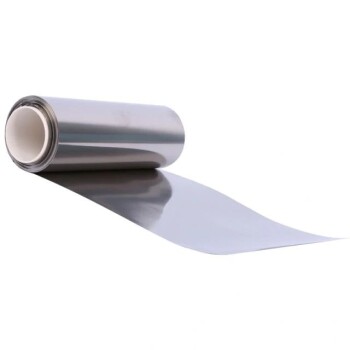
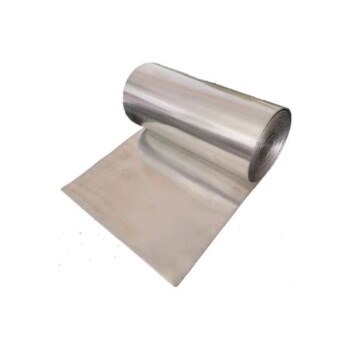
Graphite Foil serves as a critical protective interface placed between graphite mold walls and titanium alloy powders during the sintering process. Its primary purpose is to physically isolate the reactive metal from the carbon-rich mold, effectively preventing chemical contamination and mechanical seizure.
The use of Graphite Foil is essential for preserving the mechanical properties of titanium alloys. It acts as a barrier to prevent the formation of brittle reaction layers while providing the necessary lubrication to ensure the sintered part can be removed from the mold intact.
Managing Chemical Reactivity
The most significant challenge in sintering titanium in graphite molds is the element's high reactivity at elevated temperatures. Graphite foil addresses this deep chemical need.
Inhibiting Brittle Layer Formation
When titanium powder comes into direct contact with a graphite mold at high heat, a chemical reaction occurs. This reaction creates titanium carbide (TiC).
While carbides are hard, they are also extremely brittle. Excessive formation of a TiC layer on the surface of your alloy can compromise the structural integrity of the final part, leading to premature failure.
Preventing Direct Contact
The graphite foil acts as a sacrificial barrier. It physically separates the powder from the mold wall.
By blocking this direct contact, the foil significantly limits carbon diffusion into the titanium. This maintains the purity of the alloy and ensures the surface properties remain consistent with your design specifications.
Operational Advantages
Beyond chemical protection, the foil serves vital mechanical functions that streamline the manufacturing process.
Facilitating Demolding
Sintered metals often shrink or adhere to mold walls, making removal difficult. Graphite foil possesses natural lubricating properties and low reactivity.
This allows the finished sample to slide out of the mold easily. Without this liner, the sample could fuse to the mold, potentially destroying both the sample and the expensive mold hardware during extraction.
Flexible Adaptation
The primary reference notes that the foil acts as a flexible lining layer.
Because it is pliable, it can conform to the specific geometry of the mold walls. This ensures uniform protection across the entire surface area of the part, rather than just at contact points.
Understanding the Trade-offs
While graphite foil is highly effective, it introduces specific variables that must be managed to ensure success.
Application Precision
The effectiveness of the liner is entirely dependent on coverage integrity. If the foil is torn, creased, or applied with gaps, the titanium will react with the exposed mold sections immediately.
Dimensional Tolerances
Adding a liner introduces a new layer of material into the mold assembly. You must account for the thickness of the foil when calculating the final dimensions of the powder cavity to ensure the sintered part meets size tolerances.
Making the Right Choice for Your Process
The decision to use graphite foil is rarely about if you should use it, but how to apply it effectively for your specific goals.
- If your primary focus is Material Performance: Prioritize the integrity of the foil liner to ensure zero contact between the powder and mold, thereby eliminating brittle titanium carbide layers.
- If your primary focus is Equipment Longevity: Ensure the foil completely covers all wear surfaces to prevent the alloy from seizing to the mold, which extends the lifecycle of your graphite hardware.
By utilizing graphite foil effectively, you transform a potentially volatile chemical reaction into a controlled, repeatable manufacturing process.
Summary Table:
| Feature | Purpose in Sintering Titanium Alloys |
|---|---|
| Chemical Barrier | Prevents formation of brittle Titanium Carbide (TiC) layers |
| Purity Maintenance | Limits carbon diffusion to preserve alloy mechanical properties |
| Lubrication | Facilitates easy demolding and prevents part seizure |
| Flexibility | Conforms to mold geometry for uniform surface protection |
| Equipment Protection | Extends the lifespan of expensive graphite mold hardware |
Optimize Your Advanced Material Processing with KINTEK
Precision is paramount when working with reactive alloys like titanium. KINTEK specializes in high-performance laboratory equipment and consumables, providing the essential tools needed for successful sintering and heat treatment. From our precision-engineered graphite foils and crucibles to advanced vacuum and atmosphere furnaces, we offer comprehensive solutions tailored to the needs of material scientists and manufacturers.
Whether you require robust crushing and milling systems, precise hydraulic presses, or specialized high-temperature reactors, KINTEK delivers the quality and reliability your research demands.
Ready to enhance your material purity and process efficiency? Contact us today to discover how our high-temperature solutions and laboratory expertise can elevate your manufacturing outcomes.
Related Products
- Carbon Graphite Plate Manufactured by Isostatic Pressing Method
- High Purity Pure Graphite Crucible for Evaporation
- Graphite Disc Rod and Sheet Electrode Electrochemical Graphite Electrode
- Graphite Vacuum Furnace High Thermal Conductivity Film Graphitization Furnace
- High Purity Pure Graphite Crucible for Electron Beam Evaporation
People Also Ask
- What is the process of isostatic graphite manufacturing? Achieve Unmatched Material Uniformity and Performance
- What is isostatic graphite? The Ultimate Material for High-Tech and High-Temperature Applications
- What is the density of isostatic graphite? Unlock Superior Performance for Demanding Applications
- How big is the isostatic pressing market? A Deep Dive into the $1.2B+ Advanced Manufacturing Enabler
- Why Use an Isostatic or High-Precision Hydraulic Press for Li/LLZO/Li Batteries? Master Solid-State Interfaces