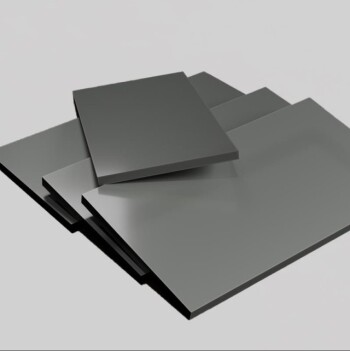
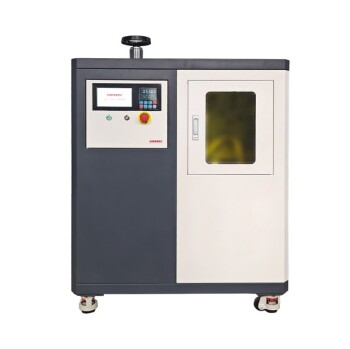
The use of graphite paper or spacers is a mandatory precaution, not an option, for successful hot pressing. These materials act as a sacrificial interface between the raw powder and the mold components (punches and die walls). Their primary function is to provide isolation and lubrication, preventing the sintered specimen from fusing to the tooling under extreme heat and pressure.
Core Insight: At sintering temperatures, many materials chemically react with or mechanically penetrate rigid graphite molds. Graphite paper creates a physical buffer that prevents this adhesion, ensuring the sample releases cleanly while protecting the expensive mold from catastrophic surface damage.
The Mechanics of Adhesion Prevention
Stopping Chemical Bonding
At elevated temperatures (often exceeding 1000°C), the reactivity between the powder and the carbon-based mold increases significantly. Without a barrier, metal or composite powders can form chemical bonds with the mold walls.
Graphite paper acts as a chemically stable isolation layer. It blocks direct contact between the reactive specimen and the rigid mold, inhibiting diffusion bonding that would weld the two together.
Blocking Melt Penetration
During liquid-phase sintering or when processing alloys with lower melting points (like aluminum), the material may partially liquefy.
The porous nature of graphite molds makes them susceptible to infiltration by these melts. Graphite paper seals the interface, preventing molten material from penetrating the mold pores and creating a mechanical lock that is nearly impossible to break.
Protecting the Tooling Investment
Preserving Mold Geometry
Graphite molds are brittle and expensive to machine. If a sample adheres to the punch or die wall, removing it often requires chipping or scraping.
This mechanical force creates surface defects, pits, or cracks in the mold. By using spacers, you ensure the mold surface remains smooth and reusable for multiple cycles, significantly extending its service life.
Facilitating Smooth Demolding
The friction between the sintered part and the die walls can be immense after cooling.
Graphite paper provides a crucial lubrication effect. It lowers the coefficient of friction at the interface, allowing the finished specimen to be ejected (demolded) easily without cracking the sample or seizing the punches.
Enhancing Process Uniformity
Compensating for Surface Roughness
Even high-quality molds have microscopic surface irregularities.
Graphite paper is slightly compliant and compressible. It acts as a buffer layer that conforms to these irregularities, ensuring that mechanical pressure is transmitted uniformly across the entire surface of the sample.
Ensuring Electrical and Thermal Contact
In processes where current or heat must pass through the mold (such as Spark Plasma Sintering or conductive hot pressing), contact resistance is a variable.
The paper helps bridge gaps caused by roughness. This ensures the uniform transmission of electrical current and heat, leading to a homogeneous microstructure in the final sintered part.
Understanding the Trade-offs
Carbon Diffusion Risks
While graphite paper prevents bulk adhesion, it is still a carbon source.
For materials highly sensitive to carbon (such as certain titanium alloys or very low-carbon steels), there is a risk of surface carburization. In these specific cases, an additional inert barrier (like Boron Nitride spray) might be required on top of or instead of the paper.
Dimensional Tolerances
Graphite paper adds thickness to the assembly.
If your setup requires extremely tight dimensional precision, you must account for the thickness of the paper or spacers in your punch travel calculations. Failure to do so can result in slight deviations in the final density or dimensions of the compact.
Making the Right Choice for Your Goal
When setting up your hot pressing assembly, consider the following to optimize your results:
- If your primary focus is Mold Longevity: Prioritize thicker graphite paper or spacers on the punches to prevent any chance of physical abrasion or adhesion during the ejection phase.
- If your primary focus is Surface Purity: Inspect the sintered surface for carbon diffusion; if present, consider applying a Boron Nitride coating to the paper to act as a secondary diffusion barrier.
- If your primary focus is Complex Geometry: Ensure the paper is cut precisely to fit the die cavity; overlaps or wrinkles in the paper will imprint permanent defects onto your sintered part.
Ultimately, graphite paper is the low-cost insurance policy that protects high-value molds and ensures the integrity of your sintered specimens.
Summary Table:
| Function | Benefit Provided | Why It Matters |
|---|---|---|
| Isolation Barrier | Prevents chemical bonding & melt penetration | Protects expensive graphite molds from permanent damage |
| Lubrication | Reduces friction during sample ejection | Ensures crack-free specimens and easy demolding |
| Pressure Buffering | Evens out microscopic surface irregularities | Promotes uniform pressure distribution and density |
| Conductivity | Bridges gaps for thermal/electrical flow | Ensures homogeneous microstructure via uniform heating |
Maximize Your Sintering Precision with KINTEK
Don't let mold adhesion or thermal inconsistencies compromise your research. KINTEK specializes in high-performance laboratory solutions, providing the expertise and equipment—from high-temperature vacuum and atmosphere furnaces to precision hydraulic presses—needed for flawless material synthesis.
Whether you are processing advanced ceramics or metal alloys, our comprehensive range of high-temperature high-pressure reactors, crushing systems, and essential graphite consumables ensures your lab achieves repeatable, high-quality results.
Ready to optimize your hot pressing workflow? Contact our technical experts today to find the perfect equipment and consumables for your specific application.
Related Products
- Carbon Graphite Plate Manufactured by Isostatic Pressing Method
- Ultra-High Temperature Graphite Vacuum Graphitization Furnace
- High Purity Pure Graphite Crucible for Evaporation
- Horizontal High Temperature Graphite Vacuum Graphitization Furnace
- Double Plate Heating Press Mold for Lab
People Also Ask
- What is the process of isostatic graphite manufacturing? Achieve Unmatched Material Uniformity and Performance
- What is isostatic graphite? The Ultimate Material for High-Tech and High-Temperature Applications
- What is the density of isostatic graphite? Unlock Superior Performance for Demanding Applications
- How big is the isostatic pressing market? A Deep Dive into the $1.2B+ Advanced Manufacturing Enabler
- Why Use an Isostatic or High-Precision Hydraulic Press for Li/LLZO/Li Batteries? Master Solid-State Interfaces