The autoclave process is the premier choice for manufacturing fiber-reinforced laminates with self-healing capabilities because it offers uniform, simultaneous control over pressure and temperature. This precision allows manufacturers to achieve full resin consolidation and structural density without crushing the fragile microcapsules or hollow fibers embedded within the material.
The autoclave’s unique ability to apply high pressure for consolidation while strictly limiting mechanical stress ensures that self-healing elements remain intact during manufacturing, guaranteeing they are available to function only when damage occurs later.
The Mechanics of Structural Integrity
To understand why the autoclave is ideal, one must first understand the dual requirements of these advanced composites: they need high pressure to cure properly, but low shear stress to protect their internal components.
Precise Control of the Environment
The primary advantage of an autoclave is its ability to regulate the curing environment with extreme accuracy.
Unlike other molding methods, an autoclave allows operators to program specific temperature and pressure ramps.
This ensures the environment matches the exact tolerance levels of the embedded self-healing agents.
Ensuring Resin Infiltration
For a fiber-reinforced laminate to be strong, the matrix resin must thoroughly saturate the reinforcing fibers.
The autoclave uses controlled pressure to drive the resin deep into the fiber network.
This results in a void-free structure where the resin supports the load-bearing fibers effectively.
Secure Interlaminar Bonding
Self-healing elements, such as microcapsules or hollow fibers, are typically placed between the layers (plies) of the laminate.
The autoclave process facilitates the secure bonding of these elements within the interlaminar regions.
This integration is critical; the elements must be fixed in place to release their healing agents effectively when a crack propagates through the material.
Preserving Functional Integrity
The inclusion of self-healing elements introduces a vulnerability: if the manufacturing process is too aggressive, the "healing" capacity is destroyed before the product is even finished.
Preventing Premature Rupture
The most significant risk during manufacturing is the accidental crushing of microcapsules or hollow fibers.
Uneven pressure application, common in other molding techniques, can create stress points that rupture these elements.
The autoclave applies isostatic pressure (equal pressure from all sides), which minimizes the risk of crushing the healing agents.
Guarantees of Quality
The ultimate goal of using an autoclave is to ensure both structural quality and functional integrity.
Structural quality refers to the strength and stiffness of the fiber-resin matrix.
Functional integrity refers to the survival of the healing chemistry, ensuring the material can actually repair itself when damaged in service.
Understanding the Trade-offs
While the autoclave process is considered ideal for quality, it is important to recognize the inherent constraints of this manufacturing approach.
Processing Time and Cost
Achieving the precise environment required to protect self-healing elements is resource-intensive.
Autoclave cycles are typically slow and energy-consuming compared to out-of-autoclave methods.
This makes the process better suited for high-value applications, such as aerospace, rather than mass-market consumer goods.
Optimization Complexity
Success is not automatic; it requires careful calibration of the cure cycle.
If the pressure ramp is too fast, the resin may not flow correctly before gelling.
If the temperature spikes too high, it could thermally degrade the healing agents even if the pressure is correct.
Making the Right Choice for Your Goal
When integrating self-healing technologies into composites, the manufacturing method dictates the final reliability of the part.
- If your primary focus is Structural Durability: The autoclave ensures maximum resin infiltration and consolidation, creating the strongest possible laminate.
- If your primary focus is Healing Efficiency: The precise pressure control prevents premature capsule rupture, ensuring 100% of the healing agent is preserved for service life.
By utilizing the autoclave process, you bridge the gap between mechanical strength and smart, restorative functionality.
Summary Table:
| Feature | Autoclave Advantage | Impact on Self-Healing Elements |
|---|---|---|
| Pressure Type | Isostatic (Uniform) | Prevents premature crushing of microcapsules/fibers |
| Cure Control | Precise Temp/Pressure Ramps | Protects thermal stability of healing agents |
| Structural Density | High Resin Consolidation | Ensures void-free integration of healing components |
| Bonding | Secure Interlaminar Bonding | Fixes healing elements firmly between composite plies |
Elevate Your Composite Manufacturing with KINTEK
Precision is non-negotiable when your materials demand both structural strength and smart functionality. At KINTEK, we specialize in high-performance laboratory equipment designed for the most rigorous research and production standards.
Whether you are developing advanced self-healing laminates or exploring new material frontiers, our comprehensive range of high-temperature high-pressure reactors, autoclaves, and crushing systems provides the exact environment your innovations require. We empower aerospace, automotive, and materials science researchers with reliable solutions for:
- Advanced Curing: High-precision autoclaves for defect-free laminates.
- Material Preparation: Milling and crushing systems for uniform particle distribution.
- Research Excellence: Comprehensive battery tools, furnaces, and ceramic consumables.
Ready to optimize your manufacturing process? Contact us today to find the perfect equipment solution for your lab!
References
- Firas Awaja, Nicola M. Pugno. Cracks, microcracks and fracture in polymer structures: Formation, detection, autonomic repair. DOI: 10.1016/j.pmatsci.2016.07.007
This article is also based on technical information from Kintek Solution Knowledge Base .
Related Products
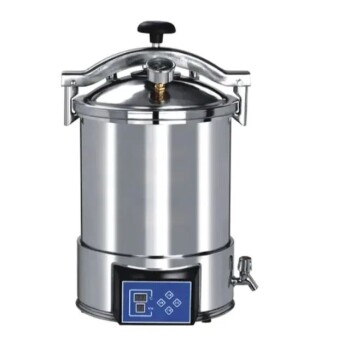
- Portable High Pressure Laboratory Autoclave Steam Sterilizer for Lab Use
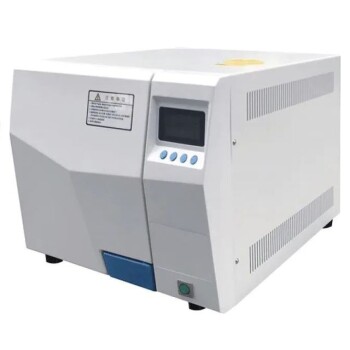
- Portable Digital Display Automatic Laboratory Sterilizer Lab Autoclave for Sterilization Pressure
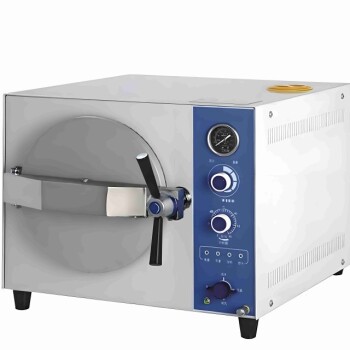
- Desktop Fast High Pressure Laboratory Autoclave Sterilizer 16L 24L for Lab Use
- Desktop Fast Laboratory Autoclave Sterilizer 35L 50L 90L for Lab Use
- Desktop Fast Laboratory Autoclave Sterilizer 20L 24L for Lab Use
People Also Ask
- Why is a laboratory high-pressure autoclave sterilizer necessary? Ensure Accuracy in Antibacterial Research
- What is the role of a laboratory high-pressure autoclave in the conversion of furfural to piperidine? Optimize Yields
- What are the two types of autoclave used in the laboratory? Gravity vs. Pre-Vacuum Explained
- What precautions should be taken during autoclave in laboratory? A Complete Safety Guide to Prevent Burns and Explosions
- What extreme conditions does a laboratory autoclave simulate? Testing Wear Resistance of Nuclear Fuel Cladding