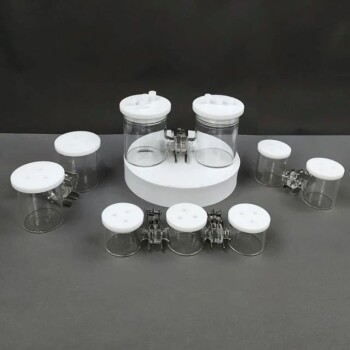
Fluoroelastomer seals are the critical defense mechanism required to maintain a strictly airtight environment when processing highly reactive halide precursors like Lithium Chloride (LiCl) and Zirconium Tetrachloride (ZrCl4). Because these materials are extremely sensitive to moisture, the seals ensure that the inert argon gas introduced during loading is trapped inside the jar, physically preventing external air from entering and causing hydrolysis or material degradation.
Core Insight: The success of synthesizing halide electrolytes hinges on absolute environmental isolation. Fluoroelastomer seals provide the necessary airtight integrity to preserve an inert atmosphere, preventing moisture-induced chemical breakdown that would render the final electrolyte useless.
The Critical Need for Environmental Isolation
The Vulnerability of Precursors
Raw materials such as LiCl and ZrCl4 are not merely sensitive to the environment; they are chemically unstable when exposed to standard atmospheric conditions.
The primary threat is moisture. Even trace amounts of humidity can interact with these chlorides.
The Consequence of Hydrolysis
If the seal integrity is compromised, external moisture enters the milling jar. This triggers hydrolysis, a chemical reaction where water molecules break the chemical bonds of the precursor materials.
This degradation fundamentally alters the composition of the mixture. It prevents the formation of the desired electrolyte structure and severely impacts the final material's purity and performance.
The Function of the Fluoroelastomer Seal
Locking in the Inert Gas
The ball milling process begins by loading jars inside a glove box filled with an inert gas, typically argon.
The fluoroelastomer seal acts as the primary containment barrier. Its job is to maintain positive pressure of the argon within the jar throughout the high-energy milling process.
Mechanical Integrity Under Stress
Ball milling involves significant kinetic energy, vibration, and potential heat generation.
Fluoroelastomer materials are selected because they maintain their sealing properties under these dynamic conditions. Unlike lesser sealing materials, they resist deformation that could create microscopic leaks during long-duration milling.
Common Pitfalls to Avoid
Overlooking Seal Condition
While fluoroelastomers are robust, they are not immune to wear and tear.
Repeated use can cause compression set or surface cracks. Using a fatigued seal is functionally equivalent to using no seal at all; it provides a false sense of security while allowing moisture ingress.
Incompatibility with Other Components
It is essential to view the seal as part of a holistic system.
While the seal prevents air ingress, using incorrect jar materials (like stainless steel instead of Zirconia) can introduce metallic impurities. Ensure that your high-quality seal is paired with chemically inert Zirconia jars to avoid contaminating the powder with iron fragments, which would reduce the electrochemical window.
Making the Right Choice for Your Goal
To ensure the success of your halide electrolyte synthesis, consider the following:
- If your primary focus is chemical purity: Prioritize inspecting the fluoroelastomer seal before every run to ensure zero tolerance for moisture-induced hydrolysis.
- If your primary focus is process consistency: Standardize your loading procedure within the argon glove box to ensure the seal traps a consistent volume of inert gas every time.
Ultimately, the fluoroelastomer seal is not just an accessory; it is the fundamental component that preserves the chemical identity of your air-sensitive materials.
Summary Table:
| Feature | Role of Fluoroelastomer Seals in Ball Milling |
|---|---|
| Primary Function | Maintains airtight integrity to trap inert Argon gas and block moisture. |
| Material Compatibility | Resists degradation from reactive precursors like LiCl and ZrCl4. |
| Mechanical Performance | Withstands high-energy vibrations and thermal stress without leaking. |
| Critical Prevention | Stops hydrolysis, preserving the electrochemical window and material purity. |
| Maintenance Key | Requires regular inspection for compression set or cracks to ensure reliability. |
Secure Your Synthesis with KINTEK Precision
Don't let moisture compromise your advanced battery research. KINTEK specializes in high-performance laboratory equipment designed for the most sensitive chemical processes. From our high-energy crushing and milling systems paired with premium fluoroelastomer-sealed Zirconia jars to our specialized high-temperature furnaces and hydraulic presses, we provide the end-to-end solutions needed for halide electrolyte development.
Whether you are working with LiCl, ZrCl4, or other reactive solids, our tools ensure absolute environmental isolation and chemical purity. Contact KINTEK today to optimize your lab's workflow and material performance.
Related Products
- High Energy Planetary Ball Mill Milling Machine for Laboratory
- Mini Planetary Ball Mill Machine for Laboratory Milling
- Laboratory Single Horizontal Jar Mill
- High Energy Vibratory Ball Mill for Lab Use
- Hybrid High Energy Vibratory Ball Mill for Lab Use
People Also Ask
- How does a planetary ball mill provide mechanical activation for scandium recovery? Maximize Your Leaching Efficiency
- What role do planetary ball mills and zirconia media play in LLZT preparation? Optimize Your Solid Electrolyte Research
- What is the function of a planetary ball mill in the preparation of high-entropy rare earth silicate multi-phase ceramics?
- What is the purpose of using a planetary ball mill for cathode material regeneration? Achieve Atomic-Level Mixing
- What is the primary function of a planetary ball mill? Mastering SiC/Al Composite Mixing for Homogeneity