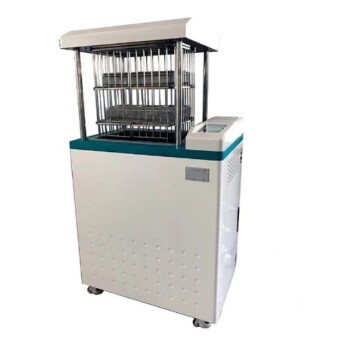
Ultrasonic cleaning is the non-negotiable standard for preparing FeCrAl coating samples prior to high-temperature corrosion testing. It utilizes cavitation-induced micro-jets to strip away microscopic processing residues, fingerprints, and oils that manual cleaning cannot reach, ensuring that the subsequent data reflects the material's actual properties rather than surface contamination.
Core Takeaway To obtain reproducible data on intrinsic HCl and KCl corrosion behavior, you must eliminate surface impurities that could chemically react under heat. Ultrasonic cleaning prevents the formation of low-melting-point eutectics and the alteration of local oxygen partial pressures, which would otherwise invalidate your test results.
The Mechanics of Microscopic Decontamination
The Power of Cavitation
Ultrasonic cleaners function by generating high-frequency sound waves in a liquid solvent. This creates cavitation bubbles—microscopic vacuums that implode with significant force against the sample surface.
Dislodging Stubborn Residues
These implosions create "micro-jets" and high-pressure waves. This physical action effectively blasts away contaminants that are chemically adhered or trapped in the surface texture of the FeCrAl coating.
Target Contaminants
The primary targets are processing residues, fingerprints, and oils. Even invisible traces of these organic compounds can drastically alter the chemical environment once the sample is subjected to high temperatures.
Why Surface Purity Determines Test Validity
Preventing Artificial Chemical Reactions
At high temperatures, surface impurities do not just burn off; they often react. Contaminants can act as localized reactants, altering the local oxygen partial pressures on the surface of the coating.
Avoiding Low-Melting-Point Eutectics
This is the most critical technical risk. Certain impurities can react with the coating or the corrosive environment to form low-melting-point eutectics.
These compounds melt at temperatures lower than the coating itself. If they form, they can accelerate degradation artificially, making the FeCrAl coating appear less corrosion-resistant than it actually is.
Ensuring Intrinsic Assessment
The goal of corrosion research is to assess the intrinsic behavior of the material against corrosive agents like HCl and KCl. If the surface is dirty, you are testing the corrosion of the contaminant mixture, not the FeCrAl coating itself.
Common Pitfalls to Avoid
Inadequate Solvent Choice
The cleaning medium matters. For FeCrAl samples, industrial-grade isopropanol or methylated spirits are typically recommended to ensure the chemical dissolution of oils matches the physical action of the ultrasound.
Ignoring the Rinse Cycle
Cleaning is a multi-step process. As noted in standard protocols, simply lifting the dirt isn't enough; you must rinse the parts (often in deionized water) to ensure the cleaning solution itself does not leave a residue.
Re-contamination Risks
The most common error is mishandling samples after the ultrasonic bath. Once cleaned, samples should never be touched with bare skin, as the oils from a single fingerprint are sufficient to induce the formation of eutectics during heating.
Ensuring Valid Experimental Data
To ensure your high-temperature corrosion tests yield publishable, accurate results, follow these guidelines:
- If your primary focus is Data Reproducibility: Ensure strictly standardized solvent types and cleaning durations to prevent variable baseline contamination levels between samples.
- If your primary focus is Mechanism Analysis: Prioritize the absolute removal of organic oils to prevent false positives caused by local oxygen pressure variations or eutectic melting.
By rigorously applying ultrasonic cleaning, you eliminate the variables of surface history, allowing the true performance of the FeCrAl coating to stand on its own.
Summary Table:
| Feature | Ultrasonic Cleaning Impact | Manual Cleaning Limitation |
|---|---|---|
| Mechanism | Cavitation-induced micro-jets | Surface-level wiping only |
| Contaminant Removal | Oils, fingerprints, and deep residues | Limited to visible surface debris |
| Chemical Impact | Prevents low-melting-point eutectics | High risk of artificial reactions |
| Data Integrity | Reflects intrinsic material properties | Skewed by surface impurities |
| Surface Texture | Reaches microscopic pores and valleys | Cannot access deep surface textures |
Maximize Your Research Precision with KINTEK
Don't let surface impurities compromise your material science data. KINTEK specializes in high-performance laboratory equipment, providing the tools you need for rigorous sample preparation and testing. From advanced ultrasonic cleaners and homogenizers to precision high-temperature furnaces (vacuum, tube, atmosphere) and high-pressure reactors, our solutions ensure your FeCrAl coatings and alloys are tested under perfect conditions.
Our value to you:
- Reliable Data: High-spec cleaning and heating systems to eliminate experimental variables.
- Comprehensive Range: Everything from sample preparation crushing systems to final-stage cooling solutions.
- Expert Support: Specialized equipment tailored for battery research, ceramics, and advanced metallurgy.
Ready to elevate your lab's testing accuracy? Contact KINTEK today for a consultation!
References
- Liam Reddy, Tanvir Hussain. Influence of KCl and HCl on a laser clad FeCrAl alloy: In-Situ SEM and controlled environment High temperature corrosion. DOI: 10.1016/j.corsci.2019.07.003
This article is also based on technical information from Kintek Solution Knowledge Base .
Related Products
- Laboratory Sterilizer Lab Autoclave Pulsating Vacuum Desktop Steam Sterilizer
- Laboratory Oscillating Orbital Shaker
- Custom PTFE Teflon Parts Manufacturer Corrosion Resistant Cleaning Rack Flower Basket
- Laboratory Scientific Electric Heating Blast Drying Oven
- Portable High Pressure Laboratory Autoclave Steam Sterilizer for Lab Use
People Also Ask
- What is the primary function of a laboratory sterilization autoclave? Master the Physics of Wet Heat Sterilization
- In what industries and applications are steam sterilizers or autoclaves used? Discover Key Uses Across 4 Major Sectors
- What precautions should be taken during autoclave in laboratory? A Complete Safety Guide to Prevent Burns and Explosions
- What extreme conditions does a laboratory autoclave simulate? Testing Wear Resistance of Nuclear Fuel Cladding
- What role does a laboratory autoclave play in HEA corrosion research? Key to Validating Advanced Reactor Materials