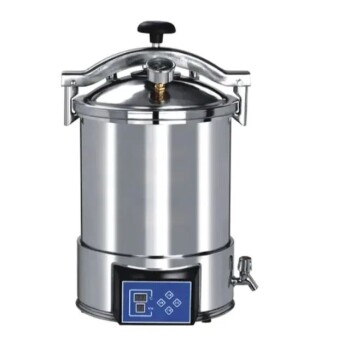
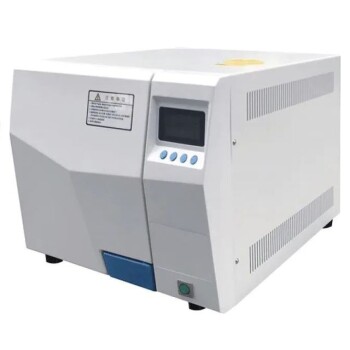
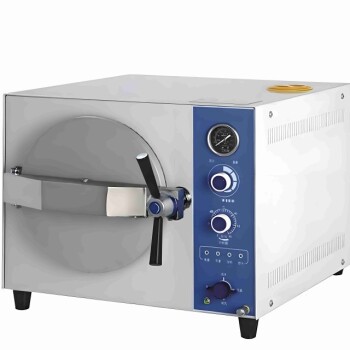
Autoclaving is the non-negotiable standard for preparing AISI 321 stainless steel samples prior to blood culture testing. This process utilizes high-temperature and high-pressure steam to completely sterilize the sample surfaces, ensuring that no external microorganisms are present to interfere with the experimental data.
Core Takeaway The autoclave process guarantees that any biological activity observed during testing is the direct result of the material’s surface properties, not environmental contamination. It eliminates variables to ensure that cell adhesion or antimicrobial effects can be definitively attributed to specific surface modifications.
The Critical Role of Sterilization
Eliminating Biological Interference
The primary function of the autoclave is to create a sterile baseline for your experiment.
By exposing the stainless steel coupons to high heat and pressure, you destroy all background microorganisms.
This prevents "noise" in your data caused by random environmental bacteria acting upon the sample.
Prerequisite for Biocompatibility
Biocompatibility assessments rely on observing how cells interact specifically with a material.
If a sample is not autoclaved, you cannot verify if cell behavior is a reaction to the steel or to pre-existing contaminants.
Sterilization is the only way to validate that observed cell adhesion behavior is genuine.
Isolating Material Performance
Verifying Surface Modifications
In many advanced applications, AISI 321 stainless steel is treated with a carbonitride modification layer or implanted with agents like silver ions.
The goal of these modifications is often to alter how biological matter sticks to or grows on the surface.
Autoclaving ensures that the test results reflect the efficacy of these specific modifications, rather than the presence of foreign organic matter.
Accurate Antimicrobial Testing
When testing against specific pathogens like Staphylococcus aureus or Listeria monocytogenes, the starting surface must be pristine.
If the sample is not sterile, you cannot prove that antimicrobial effects are derived solely from the implanted ions.
A sterilized surface ensures that any reduction in bacterial growth is strictly due to the material's engineering.
Common Pitfalls to Avoid
Inconsistent Sterilization Parameters
If the autoclave does not reach the required temperature or pressure, sterilization may be incomplete.
This leaves behind resistant spores that can bloom during the blood culture phase, leading to false positives.
Post-Autoclave Contamination
A common error involves handling the samples improperly after they have been removed from the autoclave.
Even a sterile sample can be compromised immediately if it touches a non-sterile surface before inoculation.
This negates the entire preparation process and renders the subsequent biocompatibility data invalid.
Ensuring Validity in Your Protocol
- If your primary focus is Biocompatibility: Ensure the autoclave cycle is sufficient to remove contaminants that could mask the cell adhesion properties of the carbonitride modification layer.
- If your primary focus is Antimicrobial Efficacy: Verify that the surface is sterile so that any bacterial inhibition can be attributed strictly to implanted agents like silver ions.
Reliable data begins with a contaminant-free surface, making the autoclave step the foundation of accurate material science.
Summary Table:
| Feature | Purpose in Blood Culture Testing | Impact on Data Validity |
|---|---|---|
| Sterile Baseline | Removes all background microorganisms | Prevents "noise" and experimental interference |
| Surface Validation | Isolates effects of carbonitride or silver ion layers | Ensures results reflect material performance |
| Cell Adhesion | Clears contaminants from the steel surface | Confirms genuine biocompatibility reactions |
| Pathogen Control | Starts tests with a pristine surface | Attributes antimicrobial effects solely to the material |
Elevate Your Material Research with KINTEK Precision
To achieve definitive results in biocompatibility and antimicrobial testing, the quality of your sterilization equipment is just as critical as your material engineering. KINTEK specializes in high-performance laboratory solutions designed to provide the sterile baseline your research demands.
Our extensive portfolio includes:
- High-Temperature & High-Pressure Autoclaves: Engineered for the rigorous sterilization of AISI 321 and other specialty alloys.
- Material Processing: Advanced crushing, milling, and hydraulic presses for precise sample preparation.
- Specialized Labware: High-quality ceramics, crucibles, and PTFE products to maintain sample integrity.
Don't let environmental contamination compromise your data. Partner with KINTEK for reliable, high-precision laboratory equipment and consumables tailored to your specific research needs.
Contact KINTEK Today to Optimize Your Lab Workflow
References
- F.M. El-Hossary, M. Abo El-Kassem. Effect of rf Plasma Carbonitriding on the Biocompatibility and Mechanical Properties of AISI 321 Austenitic Stainless Steel. DOI: 10.4236/ampc.2014.42006
This article is also based on technical information from Kintek Solution Knowledge Base .
Related Products
- Portable High Pressure Laboratory Autoclave Steam Sterilizer for Lab Use
- Portable Digital Display Automatic Laboratory Sterilizer Lab Autoclave for Sterilization Pressure
- Desktop Fast High Pressure Laboratory Autoclave Sterilizer 16L 24L for Lab Use
- Desktop Fast Laboratory Autoclave Sterilizer 35L 50L 90L for Lab Use
- Desktop Fast Laboratory Autoclave Sterilizer 20L 24L for Lab Use
People Also Ask
- Why is a laboratory high-pressure autoclave sterilizer necessary? Ensure Accuracy in Antibacterial Research
- What is the role of a laboratory high-pressure autoclave in the conversion of furfural to piperidine? Optimize Yields
- What are the two types of autoclave used in the laboratory? Gravity vs. Pre-Vacuum Explained
- What precautions should be taken during autoclave in laboratory? A Complete Safety Guide to Prevent Burns and Explosions
- What extreme conditions does a laboratory autoclave simulate? Testing Wear Resistance of Nuclear Fuel Cladding