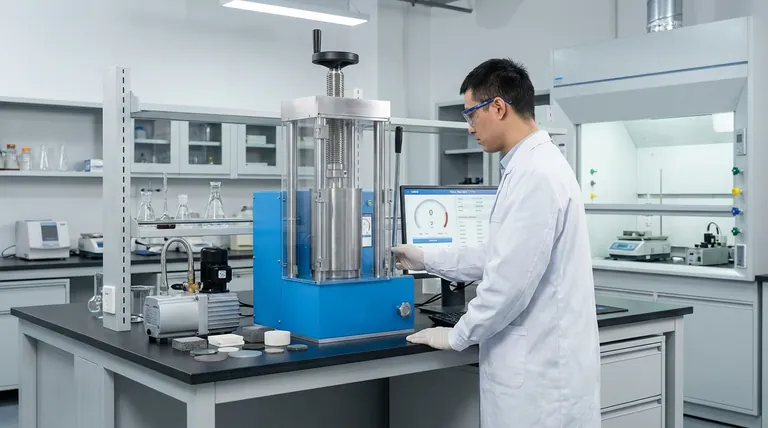
The Unseen Enemy in Material Science
Imagine a critical component—a ceramic bearing in a jet engine or a medical implant designed for decades of use. When it fails, the cause is rarely a visible, dramatic flaw. More often, the failure begins silently, from an enemy hidden deep within the material: a microscopic void, an area of slightly lower density, a weak point born during its creation.
This internal inconsistency is the quiet anxiety of materials engineering. While a part may look perfect on the outside, its performance is ultimately dictated by its internal structure. And for decades, the very methods used to form parts from powders have been creating these hidden vulnerabilities.
The Problem with Directional Force
Traditional powder compaction, known as uniaxial pressing, is an act of brute force. A piston drives powder into a rigid die, much like packing a suitcase by pushing down from the top.
The logic seems simple, but the physics are flawed. As the pressure is applied, friction arises between the powder and the rigid die walls. This friction resists the downward force, preventing it from being transmitted evenly throughout the material. The result is a component with dense regions directly under the piston and less dense, weaker regions at the corners and bottom.
These density gradients are not just minor imperfections; they are stress concentrators, the starting points for catastrophic failure under load.
Isostatic Pressure: A More Elegant Solution
Cold Isostatic Pressing (CIP) offers a fundamentally more elegant approach. Instead of a forceful push from one direction, it subjects the material to immense pressure from all directions simultaneously.
Think of an object submerged in the crushing pressure of the deep ocean. The force is applied to every point on its surface equally. CIP replicates this phenomenon in a controlled environment.
The Process, Deconstructed
The mechanics of CIP are beautiful in their simplicity.
-
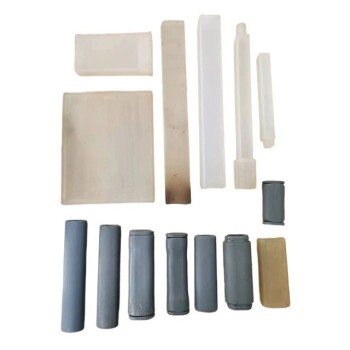
The Flexible Vessel: The raw powder—be it ceramic, metal, or a composite—is first sealed inside a flexible, elastic mold. This mold acts as the barrier between the material and the pressure medium, perfectly conforming to the powder's initial shape.
-
The Universal Force: The sealed mold is placed into a pressure chamber filled with a liquid, typically oil or water. A pump then pressurizes this liquid, sometimes to over 100,000 psi. Because the pressure is transmitted through a fluid, it is perfectly isostatic—it pushes on the flexible mold with equal force from all directions.
-
The Result: The 'Green Body': The uniform pressure collapses the mold, compacting the powder particles within. The particles are forced together so tightly that they mechanically interlock, forming a solid, handleable component called a "green body." This body has exceptional density uniformity, free from the internal stress and voids created by directional force.
The Psychological Advantage: Predictability
The true benefit of uniform density is not just strength; it is predictability. When an engineer designs a component, they rely on models that assume the material is consistent. The density gradients from uniaxial pressing violate this assumption.
CIP eliminates this uncertainty. A part formed isostatically behaves exactly as the material science predicts because its internal structure is uniform. This provides a profound sense of confidence, knowing that the component's performance will not be undermined by a hidden flaw. It transforms manufacturing from a process of approximation into one of precision integrity.
Choosing the Right Tool: CIP's Ideal Scenarios
CIP is not a replacement for all pressing methods, but a specialized tool for situations where internal quality is non-negotiable. Its selection is a strategic choice based on priorities.
When Complexity and Scale Demand Uniformity
CIP is the clear choice for applications that are difficult or impossible for conventional presses:
| Application Type | Why CIP Excels |
|---|---|
| Large or Long Parts | Uniform pressure overcomes the friction limitations that plague large-die pressing. |
| Complex Geometries | The flexible mold ensures even compaction around intricate shapes and sharp corners. |
| Hard-to-Press Materials | Ceramics, refractory metals, and tool steels compact uniformly without cracking. |
| High-Performance Components | For medical, aerospace, or industrial tools where failure is not an option. |
The Trade-off: Precision vs. Perfection
The primary trade-off with CIP is initial dimensional accuracy. Because the mold is flexible, the resulting green body doesn't have the crisp, near-net-shape finish of a part from a rigid die. It often requires secondary machining to meet final tolerances.
However, this is a conscious decision: prioritizing perfect internal integrity over initial external precision. You can always machine a surface to perfection, but you can never go back and fix a void hidden deep inside the material.
From Lab to Application: The KINTEK Advantage
Harnessing the power of isostatic pressure to create next-generation materials requires more than just theory. The journey from a novel powder formulation to a reliable, high-performance component begins in the laboratory, and it demands equipment capable of creating these extreme, controlled conditions.
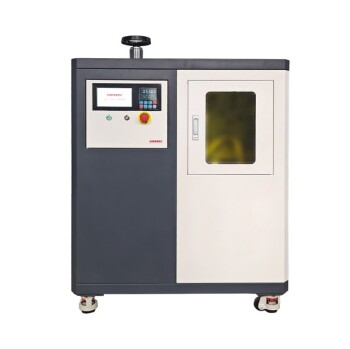
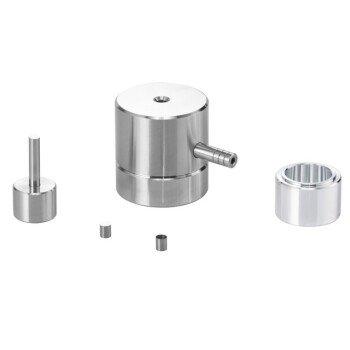
Achieving the high pressures and ensuring the safety and repeatability of the CIP process relies on specialized laboratory equipment. KINTEK provides the high-quality presses, molds, and consumables that empower researchers and engineers to move beyond the limitations of traditional methods. We provide the tools to turn the elegant physics of isostatic pressing into tangible material innovations.
For R&D focused on creating materials with unparalleled internal consistency, the right equipment is paramount. To explore the tools that make processes like Cold Isostatic Pressing possible, Contact Our Experts.
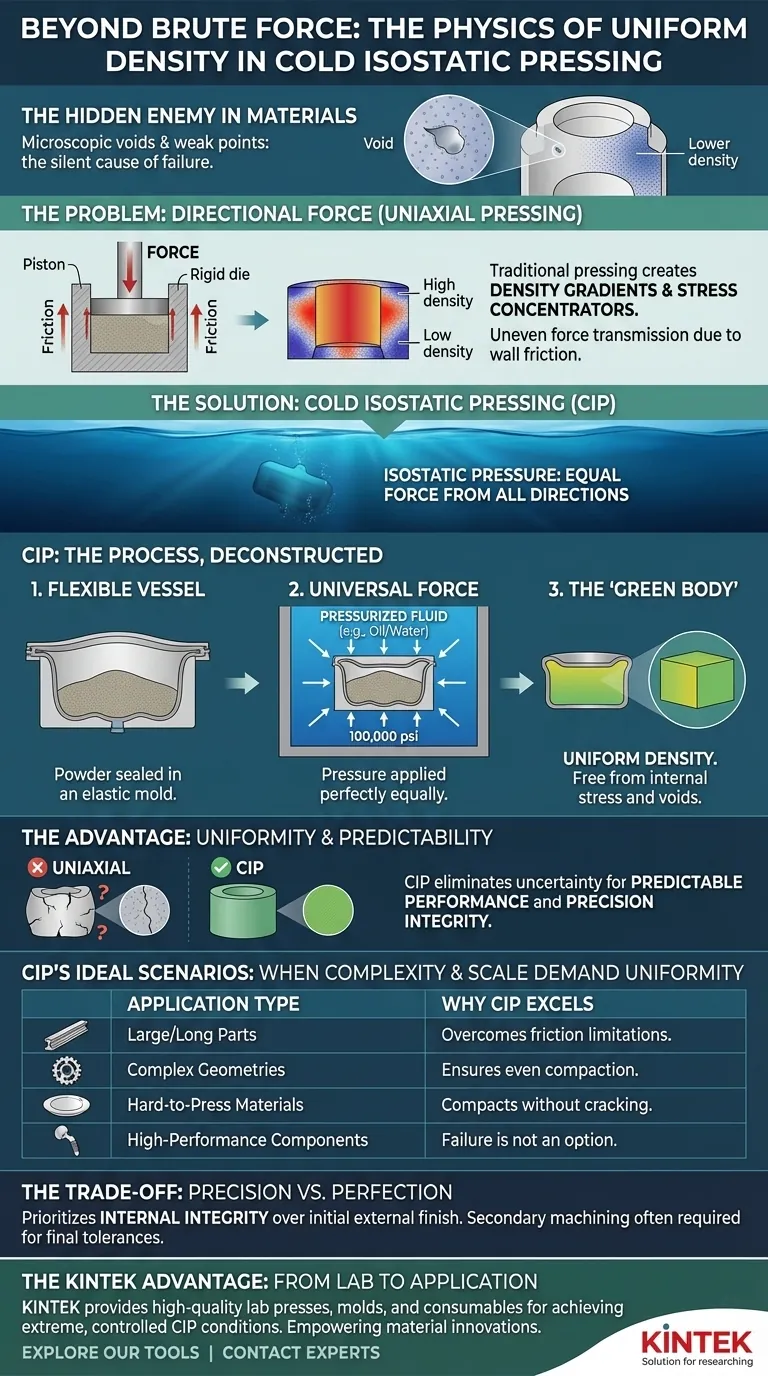
Visual Guide
Related Products
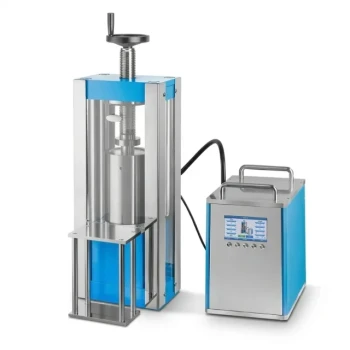
- Electric Split Lab Cold Isostatic Press CIP Machine for Cold Isostatic Pressing
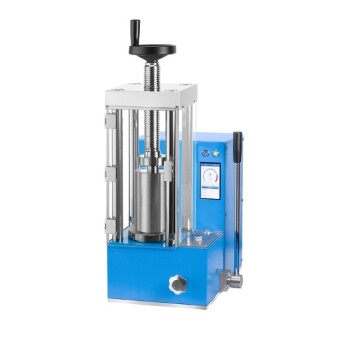
- Electric Lab Cold Isostatic Press CIP Machine for Cold Isostatic Pressing
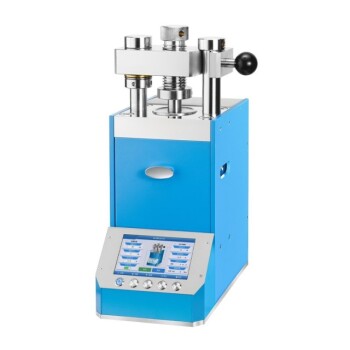
- Automatic Lab Cold Isostatic Press CIP Machine Cold Isostatic Pressing
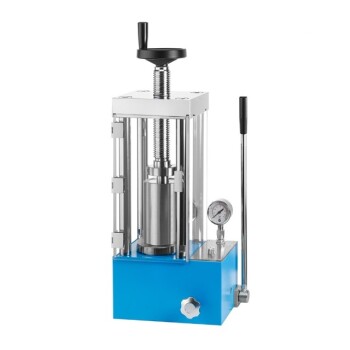
- Manual Cold Isostatic Pressing Machine CIP Pellet Press
- Warm Isostatic Press for Solid State Battery Research