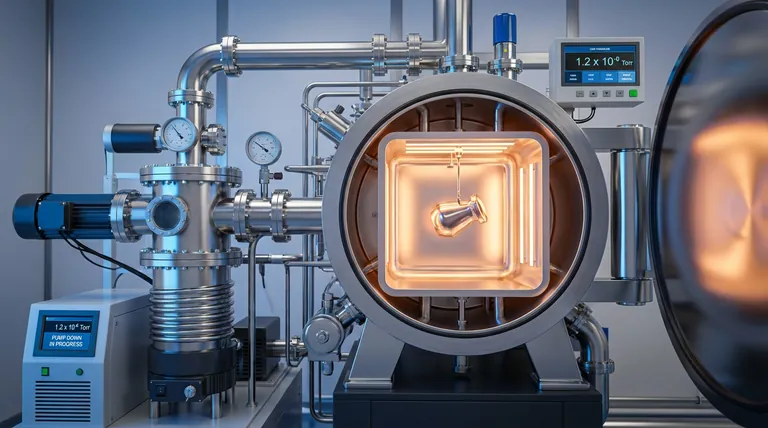
Blog The Architecture of Emptiness: Why Vacuum Level is a Decision, Not Just a Number
The Architecture of Emptiness: Why Vacuum Level is a Decision, Not Just a Number

The Architecture of Emptiness: Why Vacuum Level is a Decision, Not Just a Number

4 hours ago

The Engineering of "Nothing"

In the physical world, creating "nothing" is an incredibly expensive and complex endeavor.

We tend to think of a vacuum as a binary state: it is either empty, or it isn’t. But in materials science and laboratory engineering, emptiness is a spectrum. It is a ladder you climb, where every rung costs more money and requires more sophisticated engineering.

The difference between a rough vacuum and an ultra-high vacuum (UHV) is the difference between sweeping a floor and sterilizing an operating room.

For engineers and lab managers, the question isn't "how low can we go?" It is "how low must we go?"

The Gap Between Theory and Reality

There is often a misunderstanding about what the numbers on a spec sheet actually mean. We need to distinguish between what a machine can do in isolation and what happens when you actually use it.

Ultimate Vacuum

This is the theoretical limit. It is the lowest pressure a furnace’s pumping system can achieve in a pristine, empty, dry chamber. For a high-quality furnace with a diffusion pump, this is often around 10⁻⁶ Torr.

Operating Vacuum

This is the reality. When you introduce a workload—metal parts, ceramics, or brazing compounds—physics interferes. Materials release trapped gases when heated, a process known as outgassing.

Consequently, your operating vacuum will naturally sit higher than the ultimate vacuum, typically around 10⁻⁵ Torr. Successful thermal processing isn't about the empty chamber; it is about the system's ability to handle that outgassing and maintain purity under load.

The Machinery of Silence

The depth of the vacuum is dictated strictly by the hardware. You cannot wish a mechanical pump into performing like a diffusion pump.

  • The Rough/Medium Range: A standard mechanical pump and blower combination generally hits a floor of 20 Microns Hg. This is the workhorse level.
  • The High Vacuum Range: To break the barrier into the 10⁻⁶ Torr range, you need a diffusion pump. This creates the environment necessary for sensitive metallurgy.
  • The Ultra-High Range: Reaching 10⁻¹¹ Torr requires specialized, multi-stage systems designed for the most fragile atomic structures.

Defensive Engineering: Why We Do It

Why go through the trouble? Because oxygen is relentless.

The primary function of a vacuum furnace is protection. It creates an inert defensive perimeter around your materials. By removing air, we prevent:

  1. Oxidation: Preserving the surface finish.
  2. Decarburization: Maintaining the carbon content (and therefore hardness) of the steel.
  3. Contamination: Removing low-temperature by-products that cause defects.

If you are processing titanium or advanced ceramics, even trace amounts of atmosphere can compromise the structural integrity of the part. The vacuum isn't a feature; it is a shield.

The Economics of Perfection

There is a psychological trap in engineering called "over-specification." It is the urge to buy the most capable machine regardless of the need.

In vacuum technology, the cost curve is exponential. Moving from high vacuum to ultra-high vacuum requires advanced seals, sensitive monitoring, and significantly longer pump-down times.

The Trade-off: If you are doing standard heat treating, a medium vacuum is sufficient. Paying for UHV is a waste of capital and adds unnecessary complexity to your maintenance schedule.

However, if you are in semiconductor manufacturing, "good enough" is a failure state. You simply cannot negotiate with the physics of reactive metals.

Measuring Reliability

Two hidden metrics often matter more than the ultimate vacuum number:

  • Pump-down time: How long does it take to reach 1 x 10⁻⁴ Torr? In a high-throughput lab, a 15-minute difference per cycle accumulates into massive productivity losses over a year.
  • Leak Rate: A furnace is a vessel fighting atmospheric pressure. A quality system should maintain a leak rate of less than 5 Microns per hour. Anything higher introduces inconsistency.

Selecting the Right Tier

Your material dictates your equipment. Do not let the equipment dictate your process.

Use this framework to align your needs with the hardware:

Application Focus Required Level Typical Pressure
Standard Heat Treating / Brazing Rough / Medium Vacuum 20 Microns Hg +
Reactive Metals (Titanium) / Ceramics High Vacuum 10⁻⁵ to 10⁻⁶ Torr
Semiconductors / Research Ultra-High Vacuum (UHV) Up to 10⁻¹¹ Torr

Precision is a Partnership

Navigating the spectrum of vacuum levels requires balancing material science, throughput requirements, and budget. The goal is not the lowest number; the goal is the most reliable outcome for your specific application.

At KINTEK, we don't just sell furnaces; we engineer solutions that match your process realities. Whether you need a robust system for standard brazing or a high-precision unit for sensitive research, our experts help you find the exact "nothing" you need.

Contact Our Experts today to define the perfect atmosphere for your laboratory success.

Visual Guide
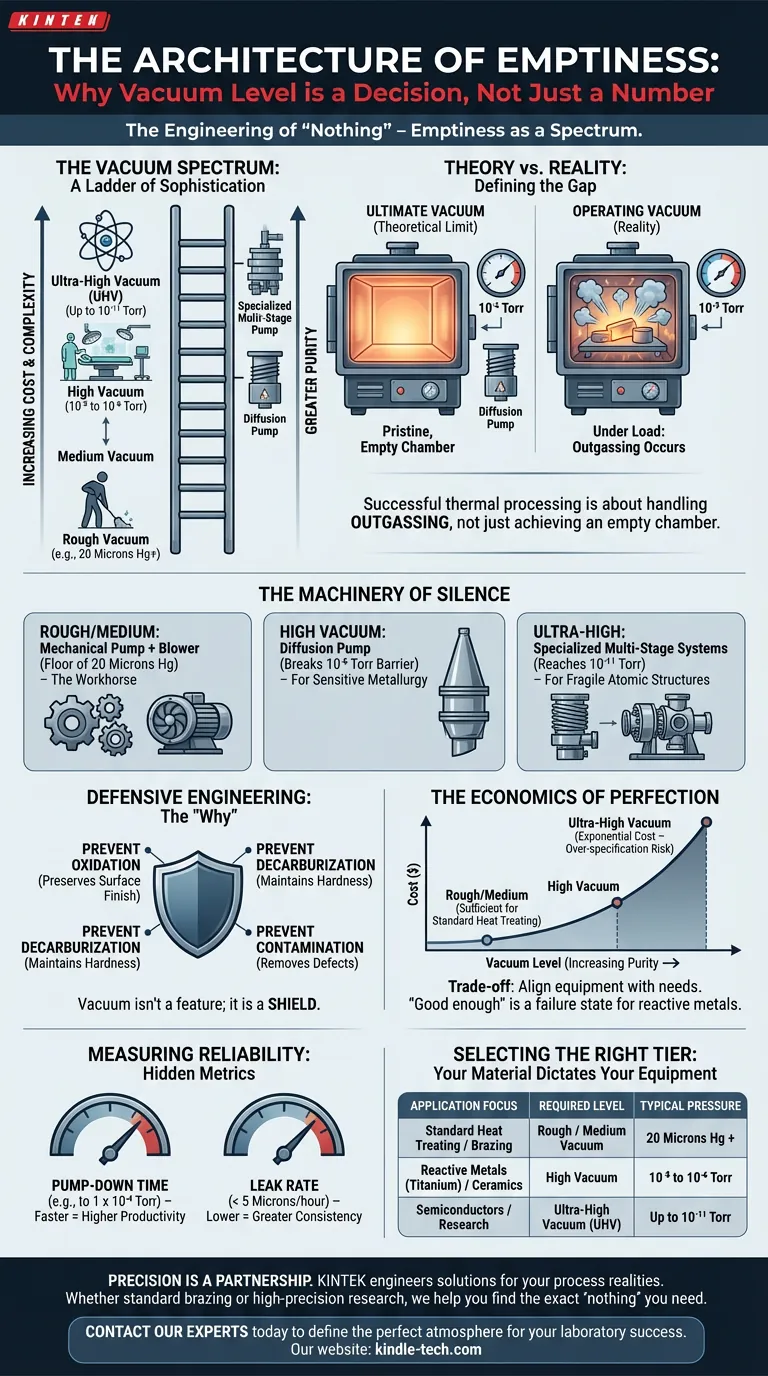
The Architecture of Emptiness: Why Vacuum Level is a Decision, Not Just a Number Visual Guide

Related Products

Related Articles

Related Products

304 316 Stainless Steel Vacuum Ball Valve Stop Valve for High Vacuum Systems

304 316 Stainless Steel Vacuum Ball Valve Stop Valve for High Vacuum Systems

Discover 304/316 stainless steel vacuum ball valves, Ideal for high vacuum systems, Ensure precise control and durability. Explore now!

Vacuum Hot Press Furnace Machine for Lamination and Heating

Vacuum Hot Press Furnace Machine for Lamination and Heating

Experience clean and precise lamination with Vacuum Lamination Press. Perfect for wafer bonding, thin-film transformations, and LCP lamination. Order now!

Vacuum Bellows for Efficient Connection and Stable Vacuum in High-Performance Systems

Vacuum Bellows for Efficient Connection and Stable Vacuum in High-Performance Systems

Discover high-quality vacuum bellows for stable vacuum in high-performance systems. Made from 304 and 316 stainless steel, these bellows ensure efficient connections and excellent sealing. Ideal for

Heated Hydraulic Press Machine with Heated Plates for Vacuum Box Laboratory Hot Press

Heated Hydraulic Press Machine with Heated Plates for Vacuum Box Laboratory Hot Press

Enhance your lab's precision with our lab press for vacuum box. Press pills and powders with ease and precision in a vacuum environment, reducing oxidation and improving consistency. Compact and easy to use with a digital pressure gauge.

Vacuum Cold Mounting Machine for Sample Preparation

Vacuum Cold Mounting Machine for Sample Preparation

Vacuum Cold Mounting Machine for precise sample prep. Handles porous, fragile materials with -0.08MPa vacuum. Ideal for electronics, metallurgy, and failure analysis.

CF Ultra-High Vacuum Observation Window Window Flange High Borosilicate Glass Sight Glass

CF Ultra-High Vacuum Observation Window Window Flange High Borosilicate Glass Sight Glass

Discover CF ultra-high vacuum observation window flanges with high borosilicate glass, perfect for semiconductor manufacturing, vacuum coating, and optical instruments. Clear observation, durable design, easy installation.

Electric Heated Hydraulic Vacuum Heat Press for Lab

Electric Heated Hydraulic Vacuum Heat Press for Lab

The Electric Vacuum Heat Press is a specialized heat press equipment that operates in a vacuum environment, utilizing advanced infrared heating and precise temperature control for high quality, rugged and reliable performance.

Stainless Steel Quick Release Vacuum Chain Three-Section Clamp

Stainless Steel Quick Release Vacuum Chain Three-Section Clamp

Discover our stainless steel quick release clamp vacuum clamp, Ideal for high vacuum applications, Strong connections, reliable sealing, Easy installation, and durable design.

Circulating Water Vacuum Pump for Laboratory and Industrial Use

Circulating Water Vacuum Pump for Laboratory and Industrial Use

Efficient circulating water vacuum pump for labs - oil-free, corrosion-resistant, quiet operation. Multiple models available. Get yours now!

Oil Free Diaphragm Vacuum Pump for Laboratory and Industrial Use

Oil Free Diaphragm Vacuum Pump for Laboratory and Industrial Use

Oil-free diaphragm vacuum pump for labs: clean, reliable, chemical-resistant. Ideal for filtration, SPE, and rotary evaporation. Maintenance-free operation.

Vacuum Cold Trap Chiller Indirect Cold Trap Chiller

Vacuum Cold Trap Chiller Indirect Cold Trap Chiller

Boost vacuum system efficiency and prolong pump life with our Indirect Cold Trap. Built-in chilling system with no need for fluid or dry ice. Compact design and easy to use.

30T 40T Split Automatic Heated Hydraulic Press Machine with Heated Plates for Laboratory Hot Press

30T 40T Split Automatic Heated Hydraulic Press Machine with Heated Plates for Laboratory Hot Press

Discover our split automatic heated lab press 30T/40T for precise sample preparation in material research, pharmacy, ceramics, and electronics industries. With a small footprint and heating up to 300°C, it's perfect for processing under vacuum environment.

Small Vacuum Heat Treat and Tungsten Wire Sintering Furnace

Small Vacuum Heat Treat and Tungsten Wire Sintering Furnace

The small vacuum tungsten wire sintering furnace is a compact experimental vacuum furnace specially designed for universities and scientific research institutes. The furnace features a CNC welded shell and vacuum piping to ensure leak-free operation. Quick-connect electrical connections facilitate relocation and debugging, and the standard electrical control cabinet is safe and convenient to operate.

Vacuum Heat Treat Sintering Brazing Furnace

Vacuum Heat Treat Sintering Brazing Furnace

A vacuum brazing furnace is a type of industrial furnace used for brazing, a metalworking process that joins two pieces of metal using a filler metal that melts at a lower temperature than the base metals. Vacuum brazing furnaces are typically used for high-quality applications where a strong, clean joint is required.

CF Ultra-High Vacuum Observation Window Stainless Steel Flange Sapphire Glass Sight Glass

CF Ultra-High Vacuum Observation Window Stainless Steel Flange Sapphire Glass Sight Glass

Discover CF ultra-high vacuum observation windows with sapphire glass and stainless steel flanges. Ideal for semiconductor manufacturing, vacuum coating, and more. Clear observation, precise control.

Lab-Scale Vacuum Induction Melting Furnace

Lab-Scale Vacuum Induction Melting Furnace

Get precise alloy composition with our Vacuum Induction Melting Furnace. Ideal for aerospace, nuclear energy, and electronic industries. Order now for effective smelting and casting of metals and alloys.

Vacuum Heat Treat Furnace with Ceramic Fiber Liner

Vacuum Heat Treat Furnace with Ceramic Fiber Liner

Vacuum furnace with polycrystalline ceramic fiber insulation liner for excellent heat insulation and uniform temperature field. Choose from 1200℃ or 1700℃ max. working temperature with high vacuum performance and precise temperature control.

Molybdenum Vacuum Heat Treat Furnace

Molybdenum Vacuum Heat Treat Furnace

Discover the benefits of a high-configuration molybdenum vacuum furnace with heat shield insulation. Ideal for high-purity, vacuum environments like sapphire crystal growth and heat treatment.

Graphite Vacuum Furnace Bottom Discharge Graphitization Furnace for Carbon Materials

Graphite Vacuum Furnace Bottom Discharge Graphitization Furnace for Carbon Materials

Bottom-out graphitization furnace for carbon materials, ultra-high temperature furnace up to 3100°C, suitable for graphitization and sintering of carbon rods and carbon blocks. Vertical design, bottom discharging, convenient feeding and discharging, high temperature uniformity, low energy consumption, good stability, hydraulic lifting system, convenient loading and unloading.

2200 ℃ Graphite Vacuum Heat Treat Furnace

2200 ℃ Graphite Vacuum Heat Treat Furnace

Discover the power of the KT-VG Graphite Vacuum Furnace - with a maximum working temperature of 2200℃, it's perfect for vacuum sintering of various materials. Learn more now.


Leave Your Message