Blog The Architecture of Silence: Why Material Choice Defines Electrochemical Truth
The Architecture of Silence: Why Material Choice Defines Electrochemical Truth

The Architecture of Silence: Why Material Choice Defines Electrochemical Truth

1 week ago

The Invisible variable

In any experiment, there is the variable you are testing, and there are the variables that test you.

We often obsess over the electrode or the electrolyte. We calculate currents and potentials down to the microvolt. But we rarely pause to consider the vessel holding it all together.

This is a blind spot.

If your containment vessel interacts with your solution, your data is compromised. The background noise becomes the signal. To get the truth, the environment must be "silent."

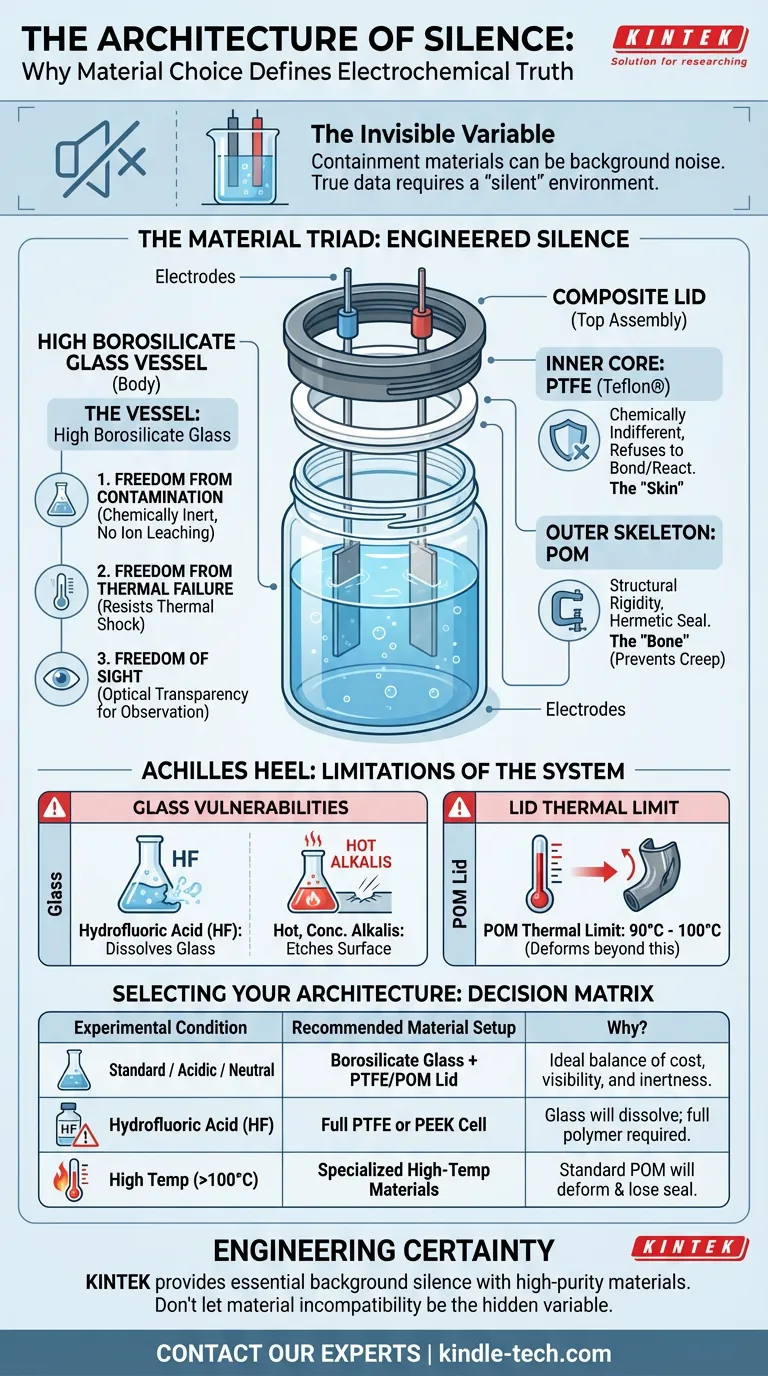
In coating evaluation electrolytic cells, this silence is engineered through a specific triad of materials: High Borosilicate Glass, PTFE, and POM.

It is not a random selection. It is a deliberate architectural choice designed to separate the observer from the reaction.

The Vessel: High Borosilicate Glass

The body of the cell is the stage. It needs to be there, but it also needs to disappear.

We use High Borosilicate Glass for the cell body. Standard glass wouldn't survive the rigors of the lab; plastic might obscure the view. Borosilicate offers three distinct "freedoms" to the engineer:

  • Freedom from Contamination: It is chemically inert to most acids and organic solvents. It does not leach ions. It ensures that the corrosion you measure is from your sample, not your jar.
  • Freedom from Thermal Failure: It resists thermal shock. You can push temperature boundaries without the catastrophic cracking associated with soda-lime glass.
  • Freedom of Sight: Data isn't just digital. Optical transparency allows you to see the bubbles, the color shifts, and the delamination.

The Lid: A Study in Duality

The lid is where the engineering gets romantic. It has to solve a paradox: it must be chemically invincible on the inside, but mechanically rigid on the outside.

One material cannot do both well. So, we use a composite approach.

1. The Inner Core: PTFE (Teflon®)

The surface facing the chemical storm is Polytetrafluoroethylene.

PTFE is the ultimate introvert of the chemical world. It refuses to bond or react with almost anything. By lining the inner core with PTFE, we ensure that the aggressive vapors and splashing electrolytes meet a wall of indifference.

2. The Outer Skeleton: POM (Polyoxymethylene)

PTFE has a flaw: it is soft. It "creeps" under pressure. You cannot thread a screw tightly into it and expect it to hold forever.

Enter POM.

Used for the external screw caps and structural rings, POM is the "bone" to the PTFE "skin." It provides the stiffness required to clamp down on the electrodes and maintain a hermetic seal against the atmosphere.

The "Achilles Heel" of Glass

Despite this careful engineering, no system is perfect. Understanding the limits of your equipment is just as important as understanding its capabilities.

The "silence" of borosilicate glass is broken by two specific conditions:

  1. Hydrofluoric Acid (HF): This acid eats glass. Using it in a standard cell will destroy your equipment and ruin your data.
  2. Hot, Concentrated Alkalis: Strong bases at high temperatures will etch the glass surface over time.

Furthermore, while the glass can handle high heat, the lid cannot. The POM components typically have a thermal limit around 90°C to 100°C. Pushing beyond this transforms a precision instrument into a warped piece of plastic.

Selecting Your Architecture

The material of your cell dictates the validity of your results.

If you choose the wrong vessel, you aren't measuring the coating; you are measuring the breakdown of your equipment.

Here is the decision matrix for the pragmatic researcher:

Experimental Condition Recommended Material Setup Why?
Standard / Acidic / Neutral Borosilicate Glass + PTFE/POM Lid Ideal balance of cost, visibility, and inertness.
Hydrofluoric Acid (HF) Full PTFE or PEEK Cell Glass will dissolve; full polymer construction is required.
High Temp (>100°C) Specialized High-Temp Materials Standard POM fittings will deform and lose seal integrity.

Engineering Certainty

At KINTEK, we believe that the best lab equipment is the kind you don't have to worry about.

Our electrolytic cells are crafted to provide that essential background silence. We use high-purity borosilicate glass and precision-machined PTFE to ensure that when you look at your data, you are seeing the chemistry, not the container.

Do not let material incompatibility become the hidden variable in your research.

Let us help you select the perfect cell architecture for your specific application. Contact Our Experts

Visual Guide
The Architecture of Silence: Why Material Choice Defines Electrochemical Truth Visual Guide

Related Products

Related Articles

Related Products

Electrode Polishing Material for Electrochemical Experiments

Electrode Polishing Material for Electrochemical Experiments

Looking for a way to polish your electrodes for electrochemical experiments? Our polishing materials are here to help! Follow our easy instructions for best results.

Custom PTFE Teflon Parts Manufacturer for Non-Standard Insulator Customization

Custom PTFE Teflon Parts Manufacturer for Non-Standard Insulator Customization

PTFE insulator PTFE has excellent electrical insulation properties in a wide temperature and frequency range.

Custom PTFE Teflon Parts Manufacturer for Acid and Alkali Resistant Chemical Powder Material Scoops

Custom PTFE Teflon Parts Manufacturer for Acid and Alkali Resistant Chemical Powder Material Scoops

Known for its excellent thermal stability, chemical resistance and electrical insulating properties, PTFE is a versatile thermoplastic material.

Custom PTFE Teflon Parts Manufacturer Laboratory High Temperature Mixing Paddle Mixer

Custom PTFE Teflon Parts Manufacturer Laboratory High Temperature Mixing Paddle Mixer

The PTFE mixing paddle mixer is a versatile and robust tool designed for laboratory use, particularly in environments requiring high resistance to chemicals and extreme temperatures. Crafted from high-quality PTFE, this mixer boasts several key features that enhance its functionality and durability.

Custom PTFE Teflon Parts Manufacturer for PTFE Ball Valve Seat

Custom PTFE Teflon Parts Manufacturer for PTFE Ball Valve Seat

Seats and inserts are vital components in the valve industry. As a key component, polytetrafluoroethylene is usually selected as the raw material.

Glassy Carbon Sheet RVC for Electrochemical Experiments

Glassy Carbon Sheet RVC for Electrochemical Experiments

Discover our Glassy Carbon Sheet - RVC. Perfect for your experiments, this high-quality material will elevate your research to the next level.

Custom PTFE Teflon Parts Manufacturer for Magnetic Stirring Bar

Custom PTFE Teflon Parts Manufacturer for Magnetic Stirring Bar

The PTFE magnetic stirring bar, made from high-quality PTFE, offers exceptional resistance to acids, alkalis, and organic solvents, coupled with high-temperature stability and low friction. Ideal for laboratory use, these stirring bars are compatible with standard flask ports, ensuring stability and safety during operations.

Custom PTFE Teflon Parts Manufacturer for Culture Dish and Evaporation Dish

Custom PTFE Teflon Parts Manufacturer for Culture Dish and Evaporation Dish

The PTFE culture dish evaporating dish is a versatile laboratory tool known for its chemical resistance and high-temperature stability. PTFE, a fluoropolymer, offers exceptional non-stick properties and durability, making it ideal for various applications in research and industry, including filtration, pyrolysis, and membrane technology.

Conductive Carbon Cloth Carbon Paper Carbon Felt for Electrodes and Batteries

Conductive Carbon Cloth Carbon Paper Carbon Felt for Electrodes and Batteries

Conductive carbon cloth, paper, and felt for electrochemical experiments. High-quality materials for reliable and accurate results. Order now for customization options.

Conductive Boron Nitride BN Ceramics Composite for Advanced Applications

Conductive Boron Nitride BN Ceramics Composite for Advanced Applications

Due to the characteristics of boron nitride itself, the dielectric constant and dielectric loss are very small, so it is an ideal electrical insulating material.

Copper Foam

Copper Foam

Copper foam has good thermal conductivity and can be widely used for heat conduction and heat dissipation of motors/electrical appliances and electronic components.

Optical Window Glass Substrate Wafer Barium Fluoride BaF2 Substrate Window

Optical Window Glass Substrate Wafer Barium Fluoride BaF2 Substrate Window

BaF2 is the fastest scintillator, sought-after for its exceptional properties. Its windows and plates are valuable for VUV and infrared spectroscopy.

Precision Machined Zirconia Ceramic Ball for Engineering Advanced Fine Ceramics

Precision Machined Zirconia Ceramic Ball for Engineering Advanced Fine Ceramics

zirconia ceramic ball have the characteristics of high strength, high hardness, PPM wear level, high fracture toughness, good wear resistance, and high specific gravity.

Ultra-Vacuum Electrode Feedthrough Connector Flange Power Electrode Lead for High-Precision Applications

Ultra-Vacuum Electrode Feedthrough Connector Flange Power Electrode Lead for High-Precision Applications

Discover the Ultra-Vacuum Electrode Feedthrough Connector Flange, perfect for high-precision applications. Ensure reliable connections in ultra-vacuum environments with advanced sealing and conductive technology.

Zirconia Ceramic Gasket Insulating Engineering Advanced Fine Ceramics

Zirconia Ceramic Gasket Insulating Engineering Advanced Fine Ceramics

Zirconia insulating ceramic gasket has high melting point, high resistivity, low thermal expansion coefficient and other properties, making it an important high temperature resistant material, ceramic insulating material and ceramic sunscreen material.

Lab Blown Film Extrusion Three Layer Co-Extrusion Film Blowing Machine

Lab Blown Film Extrusion Three Layer Co-Extrusion Film Blowing Machine

Lab blown film extrusion is mainly used to detect the feasibility of film blowing of polymer materials and the colloid condition in the materials, as well as the dispersion of colored dispersions, controlled mixtures, and extrudates;

UV Lamp Trolley for Laboratory and Hospital Use

UV Lamp Trolley for Laboratory and Hospital Use

The UV lamp trolley is made of cold-rolled plate sprayed with plastic, and adopts a double-lamp structure; it is movable, foldable, and equipped with universal wheels, which is very convenient to use.

Metallographic Specimen Mounting Machine for Laboratory Materials and Analysis

Metallographic Specimen Mounting Machine for Laboratory Materials and Analysis

Precision metallographic mounting machines for labs—automated, versatile, and efficient. Ideal for sample prep in research and quality control. Contact KINTEK today!

Vacuum Hot Press Furnace Machine for Lamination and Heating

Vacuum Hot Press Furnace Machine for Lamination and Heating

Experience clean and precise lamination with Vacuum Lamination Press. Perfect for wafer bonding, thin-film transformations, and LCP lamination. Order now!

Laboratory Disc Rotary Mixer for Efficient Sample Mixing and Homogenization

Laboratory Disc Rotary Mixer for Efficient Sample Mixing and Homogenization

Efficient Laboratory Disc Rotary Mixer for Precise Sample Mixing, Versatile for Various Applications, DC Motor and Microcomputer Control, Adjustable Speed and Angle.


Leave Your Message