There is a specific kind of heartbreak reserved for scientists. It occurs when a week’s worth of data is invalidated not by a flaw in theory, but by a microscopic crack in a sealing ring.
Chemistry is unforgiving of entropy. In an electrolytic cell system, the difference between a breakthrough and background noise often comes down to the physical integrity of the vessel.
Maintenance is not merely a chore to be endured between experiments. It is a control variable.
At its core, maintenance is the discipline of standardization.
By implementing a three-phase protocol—pre-flight inspection, active monitoring, and post-experiment hygiene—you transform your equipment from an unpredictable variable into a reliable constant.
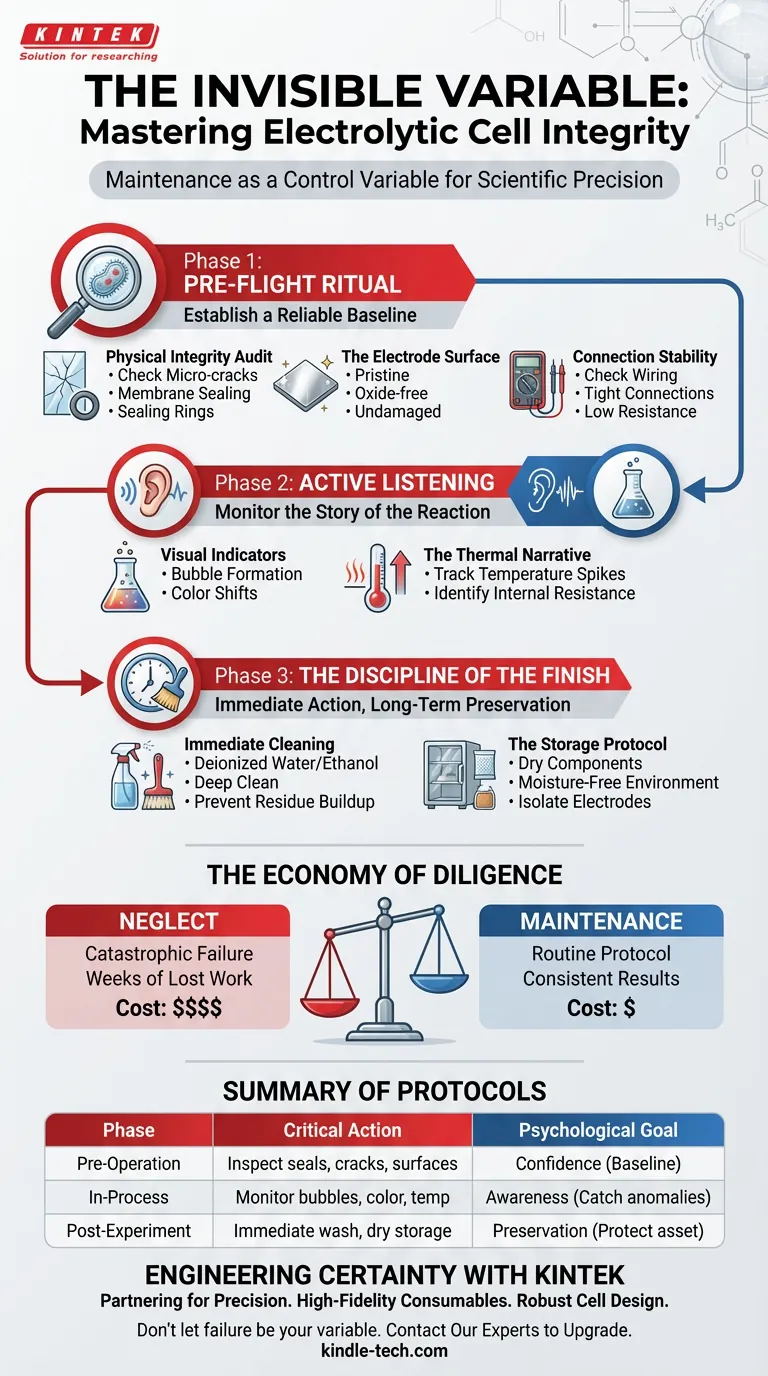
Phase 1: The Pre-Flight Ritual
Great surgeons check their instruments before the patient enters the room. Great electrochemists check their cells before the current flows.
The goal here is establishing a reliable baseline. If the starting conditions fluctuate, the results are meaningless.
Physical Integrity Audit
Before adding electrolyte, inspect the cell body. Look for:
- Micro-cracks: These are stress points waiting to become leaks.
- Membrane seating: Ensure components are aligned perfectly.
- Sealing rings: Rubber ages. If a seal looks dry or brittle, it is a liability.
The Electrode Surface
The electrode is where the magic happens. It is the stage for the reaction.
- It must be pristine.
- It must be free of oxides.
- It must be undamaged.
A contaminated electrode doesn't just reduce efficiency; it actively lies to you by altering the reaction kinetics.
Connection Stability
Electrical resistance is the enemy of precision. Check wiring for wear and tear. Ensure connections are tight. A loose wire introduces noise that no software filter can truly remove.
Phase 2: Active Listening
Once the experiment begins, maintenance shifts from "inspection" to "monitoring."
You are looking for the story the reaction is telling you. Does it match the script?
Visual Indicators
Watch the theatre of the cell:
- Bubble Formation: Is the rate consistent with expected current density?
- Color Shifts: Is the electrolyte changing color as predicted, or is a contaminant reacting?
The Thermal Narrative
Heat is energy leaving the system.
Track temperature fluctuations rigorously. An unexpected spike in temperature is rarely a good sign—it usually indicates high internal resistance or an unintended side reaction consuming your energy.
Phase 3: The Discipline of the Finish
The most dangerous time for an electrolytic cell is the hour after the experiment ends.
This is when human psychology works against equipment longevity. You are tired. You have your data. You want to go home.
But chemistry does not care about your fatigue.
Immediate Cleaning
Residue that is soft today will be concrete tomorrow. Cleaning must be non-negotiable and immediate.
- First pass: Deionized water or ethanol.
- Deep clean: Dilute acids or bases (only as per manufacturer specs) to strip oxides.
The Storage Protocol
Corrosion sleeps in moisture.
- Dry every component thoroughly.
- Store in a moisture-free environment.
- Isolate electrodes to prevent physical scratching.
The Economy of Diligence
There is always a trade-off between the time spent on maintenance and the time spent running experiments.
However, this is often a false dichotomy.
The cost of neglect is always higher than the cost of maintenance.
Skipping a 10-minute cleaning protocol saves you 10 minutes today, but it risks a catastrophic failure that costs you weeks of work next month.
Replacing a $5 sealing ring is infinitely cheaper than repeating a $5,000 experiment.
Summary of Protocols
| Phase | Critical Action | Psychological Goal |
|---|---|---|
| Pre-Operation | Inspect seals, cracks, and electrode surfaces. | Confidence: Establishing a known baseline. |
| In-Process | Monitor bubbles, color, and temperature. | Awareness: Catching anomalies before they become failures. |
| Post-Experiment | Immediate wash and dry storage. | Preservation: protecting the asset for the future. |
Engineering Certainty with KINTEK
At KINTEK, we understand that an electrolytic cell is not just a glass jar. It is a precision instrument designed to facilitate discovery.
We build our equipment to withstand the rigors of the laboratory, but even the finest engineering requires partnership.
How we support your discipline:
- High-Fidelity Consumables: Our electrodes and seals are manufactured for durability, giving you a longer window of peak performance.
- Robust Cell Design: Engineered to be easily disassembled and cleaned, reducing the friction of your maintenance routine.
When you combine our precision hardware with a rigorous maintenance mindset, you eliminate the noise. You are left with pure science.
Don't let equipment failure become your variable.
Contact Our Experts to discuss how KINTEK can upgrade your electrochemical setup today.
Visual Guide
Related Products
- PTFE Electrolytic Cell Electrochemical Cell Corrosion-Resistant Sealed and Non-Sealed
- Super Sealed Electrolytic Electrochemical Cell
- Electrolytic Electrochemical Cell with Five-Port
- H Type Electrolytic Cell Triple Electrochemical Cell
- Electrolytic Electrochemical Cell Gas Diffusion Liquid Flow Reaction Cell
Related Articles
- Electrolytic Batteries A Solution to the Growing Energy Demands
- The Art of Resistance: Why Your Electrolytic Cell Needs Breathing Room
- The Architecture of Invisibility: Deconstructing the "All-Quartz" Cell
- The Architecture of Certainty: Mastering Control in Multifunctional Electrolytic Cells
- The Silent Partner: Why Material Choice in Electrochemistry is a Matter of Trust