Blog The Silent Partner: Why Material Choice in Electrochemistry is a Matter of Trust
The Silent Partner: Why Material Choice in Electrochemistry is a Matter of Trust

The Silent Partner: Why Material Choice in Electrochemistry is a Matter of Trust

14 hours ago

The Architecture of Invisible Variables

In experimental science, the vessel is never just a container. It is a variable.

If you read the history of failed experiments, you rarely find a dramatic explosion. You find data that "drifted." You find ghost peaks in a voltammogram. You find results that couldn't be replicated because the environment quietly interfered with the reaction.

This is the central tension of electrochemistry: The observer effect.

You need to contain a reaction to measure it, but the container itself must not participate. It must be invisible. It must be silent.

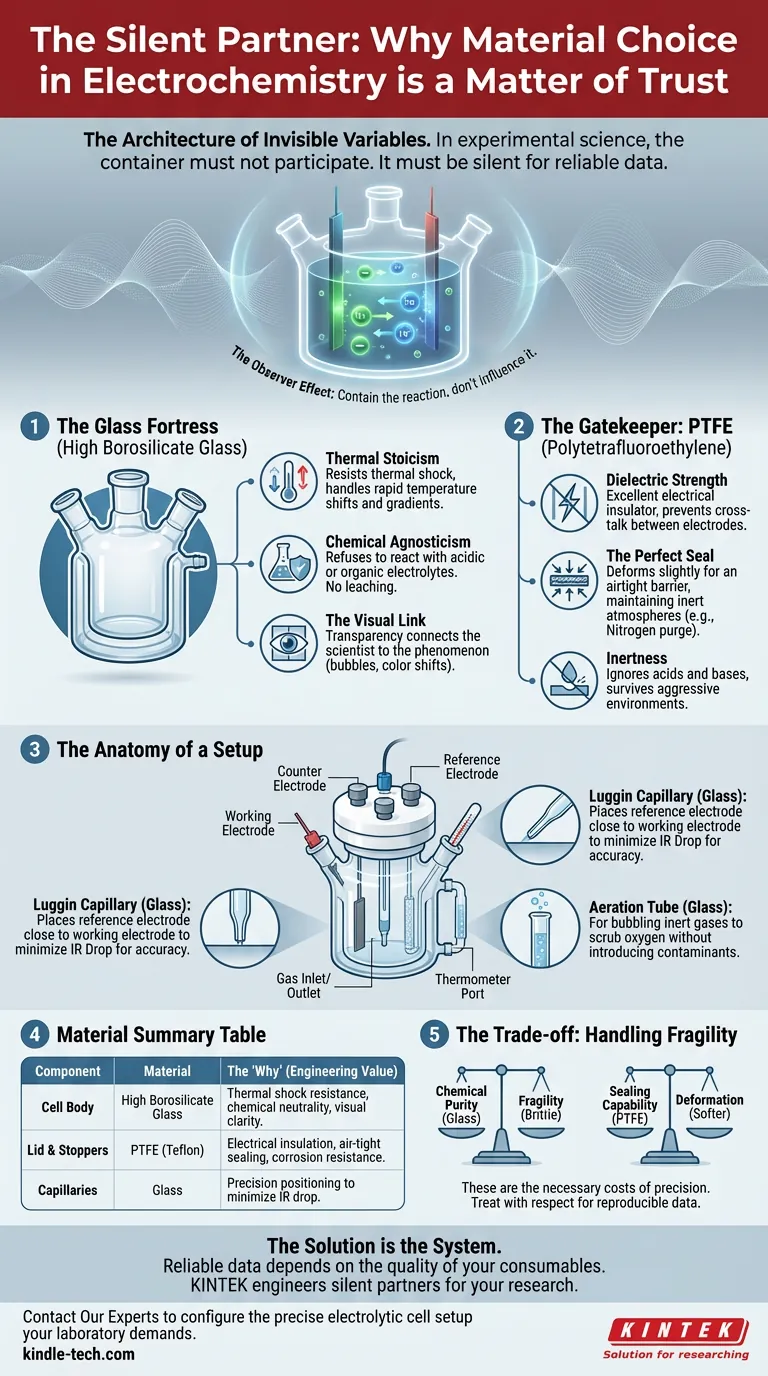
This is why the design of a five-port water bath electrolytic cell is not a matter of aesthetics. It is a matter of trust. The specific combination of High Borosilicate Glass and Polytetrafluoroethylene (PTFE) creates a sanctuary where the only chemistry happening is the chemistry you intended.

Here is the engineering logic behind that silence.

The Glass Fortress

The body of the cell is crafted from high borosilicate glass.

Standard glass is a chaotic material. It expands unevenly when heated and leaches ions into aggressive solutions. In sensitive electrochemical setups, standard glass is a saboteur.

High borosilicate glass is chosen for a specific psychological comfort: Certainty.

1. Thermal Stoicism

Electrolytic experiments often require precise temperature control via a water bath. This involves circulating hot or cold fluids around the cell jacket.

Borosilicate glass has an extremely low coefficient of thermal expansion. It resists "thermal shock." It allows you to shift temperatures rapidly without the catastrophic cracking that plagues cheaper materials. It holds the pressure of the thermal gradient without complaining.

2. Chemical Agnosticism

The glass must be chemically "agnostic." It cannot take a side.

Whether you are using acidic electrolytes or organic solvents, borosilicate glass refuses to react. This ensures that the ions you detect are the ones you added, not silicates leaching from the walls of your vessel.

3. The Visual Link

There is a romantic aspect to the transparency of glass. You need to see the gas bubbles forming on the electrode. You need to witness the color shift. Transparency connects the scientist to the phenomenon.

The Gatekeeper: PTFE

While the body is glass, the lid and stoppers are machined from Polytetrafluoroethylene (PTFE), commonly known as Teflon.

If the glass is the fortress, the PTFE lid is the gatekeeper.

In a five-port configuration, the lid is the most vulnerable point. It is where the outside world (oxygen, dust, humidity) tries to get in, and where the electrodes (high voltage) try to short out.

PTFE handles this chaos through three properties:

  1. Dielectric Strength: It is a phenomenal electrical insulator. It prevents cross-talk or short circuits between the working, counter, and reference electrodes, even when they are millimeters apart.
  2. The Perfect Seal: PTFE is slightly softer than metal or glass. When you tighten a stopper, it deforms microscopically to create an airtight seal, vital for maintaining inert atmospheres (like Nitrogen purging).
  3. Inertness: Like the glass body, PTFE ignores acids and bases. It survives environments that would dissolve other polymers.

The Anatomy of a Setup

The materials dictate the function. Because we use glass and PTFE, we can engineer specific tools that improve data fidelity.

  • The Luggin Capillary: Made of glass, this narrow tube allows you to place the reference electrode extremely close to the working electrode. This reduces the "IR Drop" (voltage loss due to solution resistance), a common source of measurement error.
  • The Aeration Tube: Also glass, allowing for the bubbling of inert gases to scrub oxygen from the system without introducing contaminants.

Material Summary

Component Material The "Why" (Engineering Value)
Cell Body High Borosilicate Glass Thermal shock resistance, chemical neutrality, visual clarity.
Lid & Stoppers PTFE (Teflon) Electrical insulation, air-tight sealing, corrosion resistance.
Capillaries Glass Precision positioning to minimize IR drop.

The Trade-off: Handling Fragility

There is no such thing as a perfect material. There are only trade-offs.

The price you pay for the chemical purity of borosilicate glass is fragility. It is brittle. A moment of carelessness when clamping the cell to a stand can shatter the jacket.

The price you pay for the sealing capability of PTFE is deformation. It is softer than metal. If you overtighten the electrodes, the ports can warp over time, compromising the seal.

These are not defects; they are the necessary costs of precision. Treat the equipment with the respect a surgical instrument deserves, and it will return the favor with reproducible data.

Designing Your Experiment

When you understand the materials, you stop fighting the equipment and start using it.

  • For Accuracy: Trust the glass Luggin capillary to bridge the gap to your working electrode.
  • For Air-Sensitivity: Trust the PTFE seal to hold your Nitrogen purge.
  • For Versatility: Use the five ports. The glass transparency allows you to insert pH meters and thermometers without guessing their position.

The Solution is the System

In the end, you aren't just buying a glass jar. You are buying a controlled environment.

At KINTEK, we understand that the reliability of your data is capped by the quality of your consumables. We engineer our electrochemical cells to be the silent partners in your research—chemically inert, thermally stable, and meticulously designed.

Don't let your "invisible variables" ruin a perfect hypothesis.

Contact Our Experts today to configure the precise electrolytic cell setup your laboratory demands.

Visual Guide
The Silent Partner: Why Material Choice in Electrochemistry is a Matter of Trust Visual Guide

Related Products

Related Articles

Related Products

Electrolytic Electrochemical Cell for Coating Evaluation

Electrolytic Electrochemical Cell for Coating Evaluation

Looking for corrosion-resistant coating evaluation electrolytic cells for electrochemical experiments? Our cells boast complete specifications, good sealing, high-quality materials, safety, and durability. Plus, they're easily customizable to meet your needs.

Electrolytic Electrochemical Cell Gas Diffusion Liquid Flow Reaction Cell

Electrolytic Electrochemical Cell Gas Diffusion Liquid Flow Reaction Cell

Looking for a high-quality gas diffusion electrolysis cell? Our liquid flow reaction cell boasts exceptional corrosion resistance and complete specifications, with customizable options available to suit your needs. Contact us today!

Double-Layer Water Bath Electrolytic Electrochemical Cell

Double-Layer Water Bath Electrolytic Electrochemical Cell

Discover the temperature-controllable electrolytic cell with a double-layer water bath, corrosion resistance, and customization options. Complete specifications included.

H-Type Double-Layer Optical Electrolytic Electrochemical Cell with Water Bath

H-Type Double-Layer Optical Electrolytic Electrochemical Cell with Water Bath

Double-layer H-type optical water bath electrolytic cells, with excellent corrosion resistance and a wide range of specifications available. Customization options are also available.

Quartz Electrolytic Electrochemical Cell for Electrochemical Experiments

Quartz Electrolytic Electrochemical Cell for Electrochemical Experiments

Looking for a reliable quartz electrochemical cell? Our product boasts excellent corrosion resistance and complete specifications. With high-quality materials and good sealing, it's both safe and durable. Customize to meet your needs.

Electrode Fixture for Electrochemical Experiments

Electrode Fixture for Electrochemical Experiments

Upgrade your experiments with our customizable Electrode Fixtures. High-quality materials, acid and alkali resistant, and safe and durable. Discover our complete models today.

H Type Electrolytic Cell Triple Electrochemical Cell

H Type Electrolytic Cell Triple Electrochemical Cell

Experience versatile electrochemical performance with our H-type Electrolytic Cell. Choose from membrane or non-membrane sealing, 2-3 hybrid configurations. Learn more now.

Customizable Fuel Cell Stack Components for Diverse Applications

Customizable Fuel Cell Stack Components for Diverse Applications

Introducing the FS Fuel Cell Stack Components. This modular assembly is designed for ease of use and offers reliable performance for various electrochemical applications, particularly in hydrogen fuel cell research and development, and educational settings.

Customizable CO2 Reduction Flow Cell for NRR ORR and CO2RR Research

Customizable CO2 Reduction Flow Cell for NRR ORR and CO2RR Research

The cell is meticulously crafted from high-quality materials to ensure chemical stability and experimental accuracy.

Custom PTFE Teflon Parts Manufacturer for Culture Dish and Evaporation Dish

Custom PTFE Teflon Parts Manufacturer for Culture Dish and Evaporation Dish

The PTFE culture dish evaporating dish is a versatile laboratory tool known for its chemical resistance and high-temperature stability. PTFE, a fluoropolymer, offers exceptional non-stick properties and durability, making it ideal for various applications in research and industry, including filtration, pyrolysis, and membrane technology.

Custom PTFE Teflon Parts Manufacturer for PTFE Bottle Oil Fume Sampling Tube

Custom PTFE Teflon Parts Manufacturer for PTFE Bottle Oil Fume Sampling Tube

PTFE products are generally called "non-stick coating", which is a synthetic polymer material that replaces all hydrogen atoms in polyethylene with fluorine.

Customizable Swagelok Type Test Cells for Advanced Battery Research Electrochemical Analysis

Customizable Swagelok Type Test Cells for Advanced Battery Research Electrochemical Analysis

The KINTEK Swagelok-type test cell is a modular, T-shaped device constructed from high-quality, chemically inert materials.

400-700nm Wavelength Anti Reflective AR Coating Glass

400-700nm Wavelength Anti Reflective AR Coating Glass

AR coatings are applied on optical surfaces to reduce reflection. They can be a single layer or multiple layers that are designed to minimize reflected light through destructive interference.

Molybdenum Disilicide (MoSi2) Thermal Elements Electric Furnace Heating Element

Molybdenum Disilicide (MoSi2) Thermal Elements Electric Furnace Heating Element

Discover the power of Molybdenum Disilicide (MoSi2) Heating Element for high-temperature resistance. Unique oxidation resistance with stable resistance value. Learn more about its benefits now!

Electron Beam Evaporation Coating Oxygen-Free Copper Crucible and Evaporation Boat

Electron Beam Evaporation Coating Oxygen-Free Copper Crucible and Evaporation Boat

Electron Beam Evaporation Coating Oxygen-Free Copper Crucible enables precise co-deposition of various materials. Its controlled temperature and water-cooled design ensure pure and efficient thin film deposition.

Twin Screw Extruder Plastic Granulation Machine

Twin Screw Extruder Plastic Granulation Machine

Twin screw extruder plastic granulation machine is designed for the mixing and processing experiments of engineering plastics, modified plastics, waste plastics and masterbatches.

Silicon Carbide SiC Thermal Heating Elements for Electric Furnace

Silicon Carbide SiC Thermal Heating Elements for Electric Furnace

Experience the advantages of Silicon Carbide (SiC) Heating Element: Long service life, high corrosion and oxidation resistance, fast heating speed, and easy maintenance. Learn more now!

Laboratory manual slicer

Laboratory manual slicer

Manual microtome is a high-precision cutting device designed for laboratories, industry and medical fields. It is suitable for the preparation of thin slices of various materials such as paraffin samples, biological tissues, battery materials, food, etc.

KF ISO Stainless Steel Vacuum Flange Blind Plate for High Vacuum Systems

KF ISO Stainless Steel Vacuum Flange Blind Plate for High Vacuum Systems

Discover KF/ISO stainless steel vacuum flange blind plates, ideal for high vacuum systems in semiconductor, photovoltaic, and research labs. High-quality materials, efficient sealing, and easy installation.<|end▁of▁sentence|>

lab cryogenic grinding use liquid-nitrogen for pulverizing plastic raw materials and heat sensitive materials

lab cryogenic grinding use liquid-nitrogen for pulverizing plastic raw materials and heat sensitive materials

Discover the KT-CG01 Liquid Nitrogen Cryogenic Pulverizer, Ideal for Plastic and Heat-Sensitive Material Pulverization, Preserving Material Integrity and Delivering Ultra-Fine Results.


Leave Your Message