Blog The Art of Resistance: Why Your Electrolytic Cell Needs Breathing Room
The Art of Resistance: Why Your Electrolytic Cell Needs Breathing Room

The Art of Resistance: Why Your Electrolytic Cell Needs Breathing Room

2 weeks ago

The Path of Least Resistance

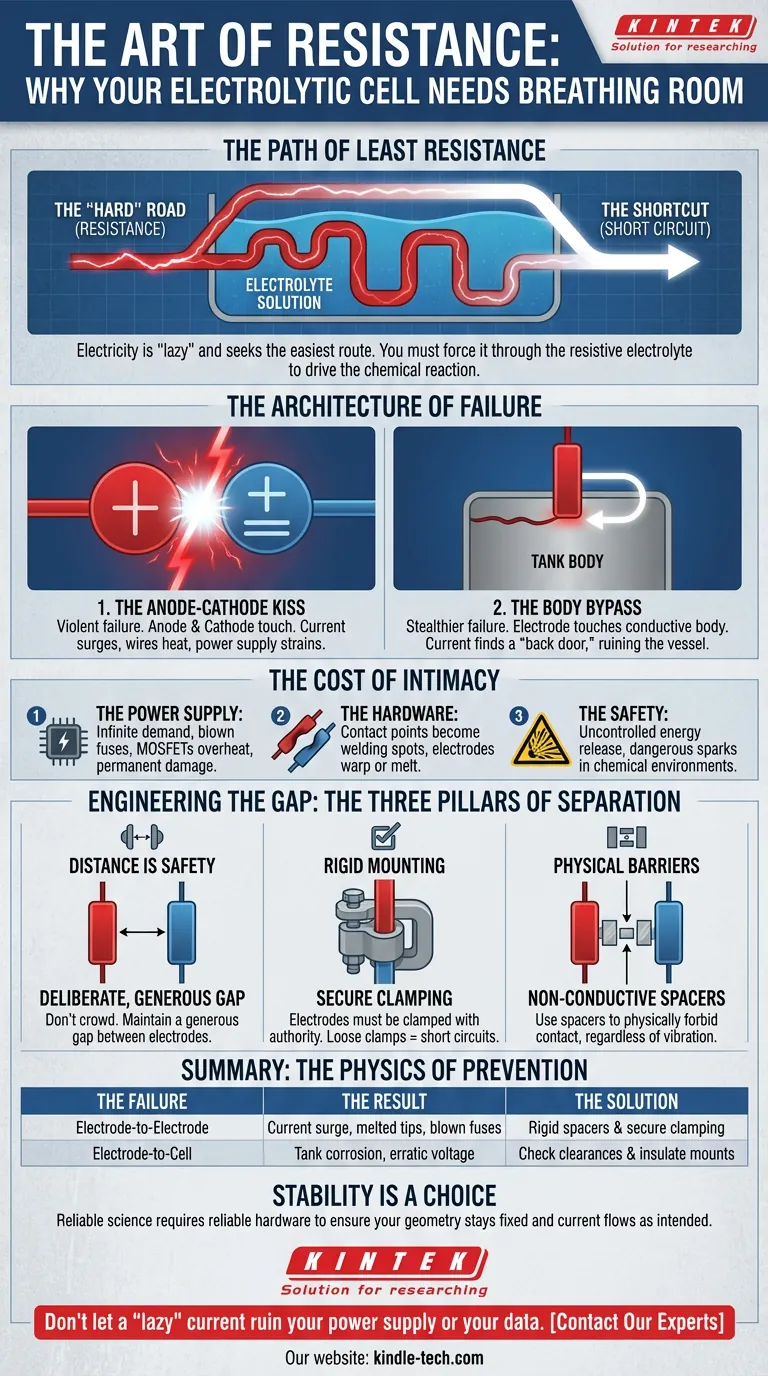
Electricity is fundamentally lazy. It is a force of nature that constantly seeks the easiest route from point A to point B.

In an electrolytic cell, your job is to act as a dam builder. You are forcing electricity to take the "hard" road—traveling through the resistive electrolyte solution to drive a chemical reaction.

When you fail to maintain that resistance, the current finds a shortcut. This is the short circuit. It is not just a technical glitch; it is the electricity bypassing your instructions.

To prevent this, we must understand the physical geometry of the cell. The safety of your experiment relies on the empty space between components as much as the components themselves.

The Architecture of Failure

A short circuit is rarely a mystery. It is almost always a failure of spatial discipline.

When the intended high-resistance path (the electrolyte) is bypassed by a zero-resistance path (direct contact), the system collapses. The power supply, seeing no resistance, dumps its maximum current instantly.

Here is how the architecture fails:

1. The Anode-Cathode Kiss

This is the most violent failure. The anode and cathode are meant to be partners, not lovers.

If they touch, even for a millisecond, the electrolyte is removed from the equation. The current surges. The wires heat up. The power supply strains against its own limitations.

2. The Body Bypass

This is the stealthier failure.

If an electrode touches the conductive body of the tank or cell, the current finds a "back door." It might skip the reaction entirely or enter the cell wall, corroding the equipment and ruining the vessel.

The Cost of Intimacy

Why does this matter? Because in high-amperage systems, the consequences of contact are thermodynamic, not just electrical.

  • The Power Supply: It tries to feed an infinite demand. Fuses blow. MOSFETs overheat. The unit can be permanently destroyed.
  • The Hardware: The point of contact becomes a welding spot. Electrodes warp or melt.
  • The Safety: A short circuit is an uncontrolled release of energy. In a lab environment containing chemicals, sparks are unacceptable.

Engineering the Gap

Prevention is not about hope; it is about rigidity.

You cannot rely on manual positioning alone. Gravity, thermal expansion, and the bubbling vibration of electrolysis all conspire to move your electrodes together.

You must engineer the gap.

The Three Pillars of Separation

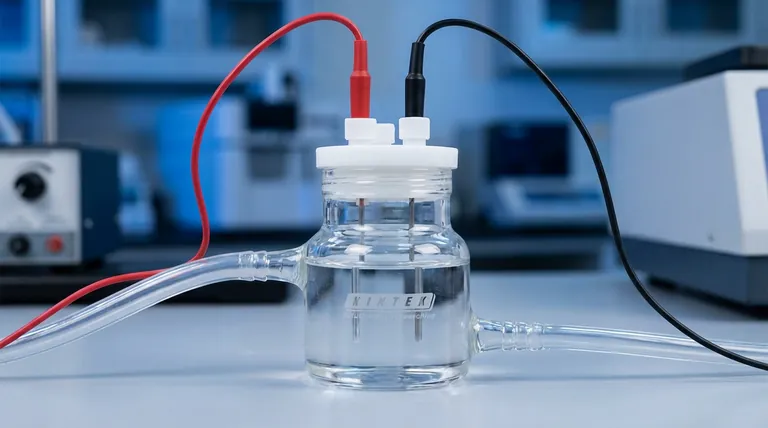
  • Distance is Safety: Don't crowd the cell. Maintain a deliberate, generous gap between the anode and cathode.
  • Rigid Mounting: Electrodes should not dangle. They must be clamped with authority. A loose clamp is a short circuit waiting to happen.
  • Physical Barriers: Use non-conductive spacers. These are small plastic or ceramic guides that physically forbid the electrodes from touching, regardless of vibration.

Summary: The Physics of Prevention

The Failure The Result The Solution
Electrode-to-Electrode Current surge, melted tips, blown fuses Rigid spacers & secure clamping
Electrode-to-Cell Tank corrosion, erratic voltage Check clearances & insulate mounts

Stability is a Choice

The difference between a failed experiment and a breakthrough often comes down to the quality of the setup.

At KINTEK, we understand that reliable science is built on reliable hardware. We provide the lab equipment and consumables that ensure your geometry stays fixed, your spacing stays true, and your current flows exactly where you intend it to.

Don't let a "lazy" current ruin your power supply or your data.

Contact Our Experts

Visual Guide

The Art of Resistance: Why Your Electrolytic Cell Needs Breathing Room Visual Guide

Related Products

Related Articles

Related Products

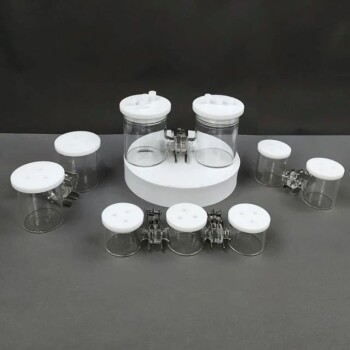
Optical Water Bath Electrolytic Electrochemical Cell

Optical Water Bath Electrolytic Electrochemical Cell

Upgrade your electrolytic experiments with our Optical Water Bath. With controllable temperature and excellent corrosion resistance, it's customizable for your specific needs. Discover our complete specifications today.

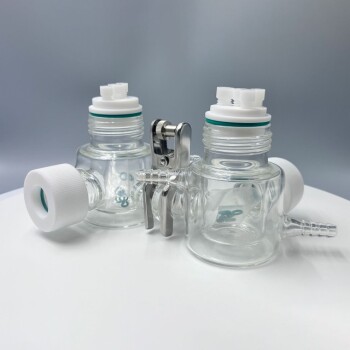
Super Sealed Electrolytic Electrochemical Cell

Super Sealed Electrolytic Electrochemical Cell

Super-sealed electrolytic cell offers enhanced sealing capabilities, making it ideal for experiments that require high airtightness.

Double Layer Five-Port Water Bath Electrolytic Electrochemical Cell

Double Layer Five-Port Water Bath Electrolytic Electrochemical Cell

Experience optimal performance with our Water Bath Electrolytic Cell. Our double-layer, five-port design boasts corrosion resistance and longevity. Customizable to fit your specific needs. View specs now.

Double-Layer Water Bath Electrolytic Electrochemical Cell

Double-Layer Water Bath Electrolytic Electrochemical Cell

Discover the temperature-controllable electrolytic cell with a double-layer water bath, corrosion resistance, and customization options. Complete specifications included.

Quartz Electrolytic Electrochemical Cell for Electrochemical Experiments

Quartz Electrolytic Electrochemical Cell for Electrochemical Experiments

Looking for a reliable quartz electrochemical cell? Our product boasts excellent corrosion resistance and complete specifications. With high-quality materials and good sealing, it's both safe and durable. Customize to meet your needs.

H Type Electrolytic Cell Triple Electrochemical Cell

H Type Electrolytic Cell Triple Electrochemical Cell

Experience versatile electrochemical performance with our H-type Electrolytic Cell. Choose from membrane or non-membrane sealing, 2-3 hybrid configurations. Learn more now.

PTFE Electrolytic Cell Electrochemical Cell Corrosion-Resistant Sealed and Non-Sealed

PTFE Electrolytic Cell Electrochemical Cell Corrosion-Resistant Sealed and Non-Sealed

Choose our PTFE Electrolytic Cell for reliable, corrosion-resistant performance. Customize specifications with optional sealing. Explore now.

Side Window Optical Electrolytic Electrochemical Cell

Side Window Optical Electrolytic Electrochemical Cell

Experience reliable and efficient electrochemical experiments with a side window optical electrolytic cell. Boasting corrosion resistance and complete specifications, this cell is customizable and built to last.

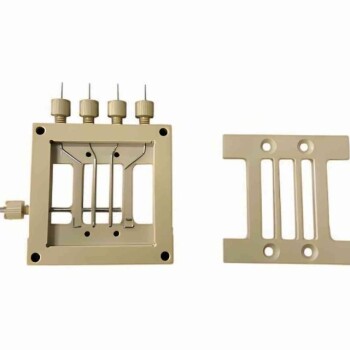
Customizable PEM Electrolysis Cells for Diverse Research Applications

Customizable PEM Electrolysis Cells for Diverse Research Applications

Custom PEM test cell for electrochemical research. Durable, versatile, for fuel cells & CO2 reduction. Fully customizable. Get a quote!

Electrolytic Electrochemical Cell for Coating Evaluation

Electrolytic Electrochemical Cell for Coating Evaluation

Looking for corrosion-resistant coating evaluation electrolytic cells for electrochemical experiments? Our cells boast complete specifications, good sealing, high-quality materials, safety, and durability. Plus, they're easily customizable to meet your needs.

Multifunctional Electrolytic Electrochemical Cell Water Bath Single Layer Double Layer

Multifunctional Electrolytic Electrochemical Cell Water Bath Single Layer Double Layer

Discover our high-quality Multifunctional Electrolytic Cell Water Baths. Choose from single or double-layer options with superior corrosion resistance. Available in 30ml to 1000ml sizes.

Thin-Layer Spectral Electrolysis Electrochemical Cell

Thin-Layer Spectral Electrolysis Electrochemical Cell

Discover the benefits of our thin-layer spectral electrolysis cell. Corrosion-resistant, complete specifications, and customizable for your needs.

Metal Disc Electrode Electrochemical Electrode

Metal Disc Electrode Electrochemical Electrode

Elevate your experiments with our Metal Disk Electrode. High-quality, acid and alkali resistant, and customizable to fit your specific needs. Discover our complete models today.

Glassy Carbon Electrochemical Electrode

Glassy Carbon Electrochemical Electrode

Upgrade your experiments with our Glassy Carbon Electrode. Safe, durable, and customizable to fit your specific needs. Discover our complete models today.

Glassy Carbon Sheet RVC for Electrochemical Experiments

Glassy Carbon Sheet RVC for Electrochemical Experiments

Discover our Glassy Carbon Sheet - RVC. Perfect for your experiments, this high-quality material will elevate your research to the next level.

Electrode Polishing Material for Electrochemical Experiments

Electrode Polishing Material for Electrochemical Experiments

Looking for a way to polish your electrodes for electrochemical experiments? Our polishing materials are here to help! Follow our easy instructions for best results.

Desktop Fast Laboratory Autoclave Sterilizer 35L 50L 90L for Lab Use

Desktop Fast Laboratory Autoclave Sterilizer 35L 50L 90L for Lab Use

The desktop fast steam sterilizer is a compact and reliable device used for rapid sterilization of medical, pharmaceutical, and research items. It efficiently sterilizes surgical instruments, glassware, medicines, and resistant materials, making it suitable for various applications.

Laboratory Sterilizer Lab Autoclave Pulsating Vacuum Desktop Steam Sterilizer

Laboratory Sterilizer Lab Autoclave Pulsating Vacuum Desktop Steam Sterilizer

The pulsating vacuum desktop steam sterilizer is a compact and reliable device used for rapid sterilization of medical, pharmaceutical, and research items.

Custom PTFE Teflon Parts Manufacturer for PTFE Mesh F4 Sieve

Custom PTFE Teflon Parts Manufacturer for PTFE Mesh F4 Sieve

PTFE mesh sieve is a specialized test sieve designed for particle analysis in various industries, featuring a non-metallic mesh woven from PTFE filament. This synthetic mesh is ideal for applications where metal contamination is a concern . PTFE sieves are crucial for maintaining the integrity of samples in sensitive environments, ensuring accurate and reliable results in particle size distribution analysis.

Laboratory manual slicer

Laboratory manual slicer

Manual microtome is a high-precision cutting device designed for laboratories, industry and medical fields. It is suitable for the preparation of thin slices of various materials such as paraffin samples, biological tissues, battery materials, food, etc.


Leave Your Message