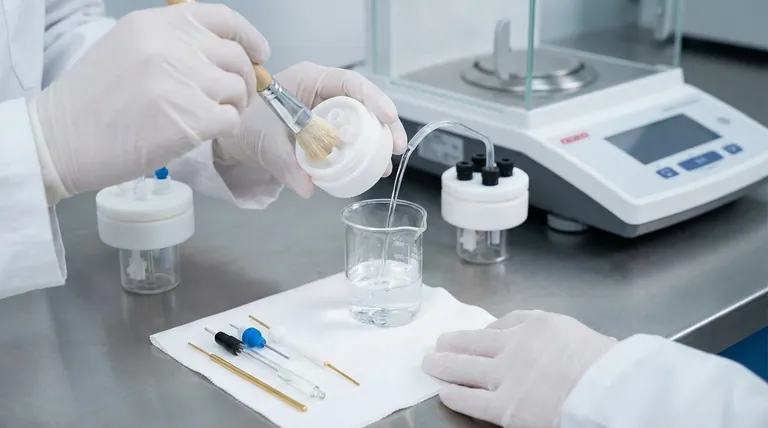
Science has a messy secret.
We tend to romanticize the breakthrough—the moment the data reveals a new truth. But we rarely discuss the mundane rituals that make that truth possible.
In electrochemistry, your equipment is not a passive container; it is an active participant in your data.
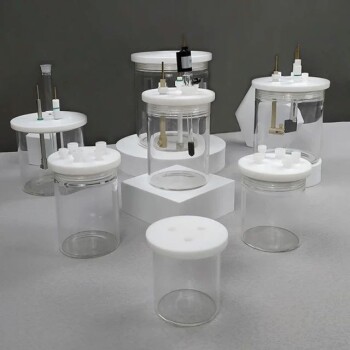
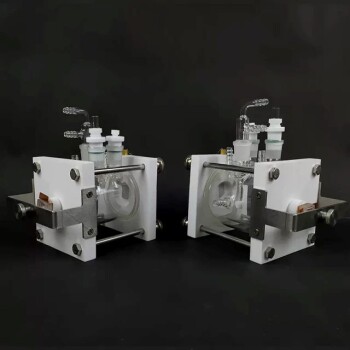
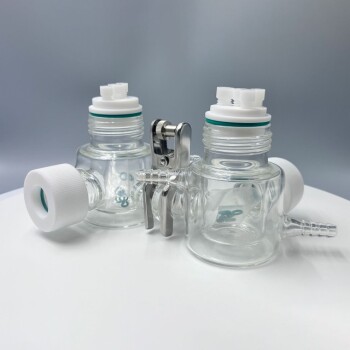
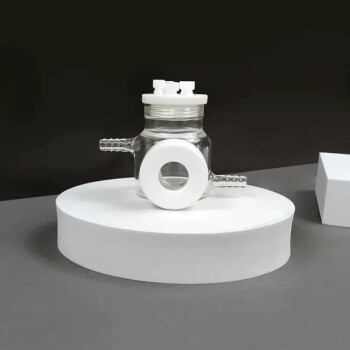
A super-sealed electrolytic cell is a marvel of isolation. It is designed to create a microscopic universe where you control the variables. But the moment you neglect maintenance, entropy enters the system. A microscopic scratch, a trace of residue, or a compromised seal introduces "noise" that masquerades as data.
Here is how to maintain the integrity of that closed universe, ensuring that what you measure is the reaction, not the residue.
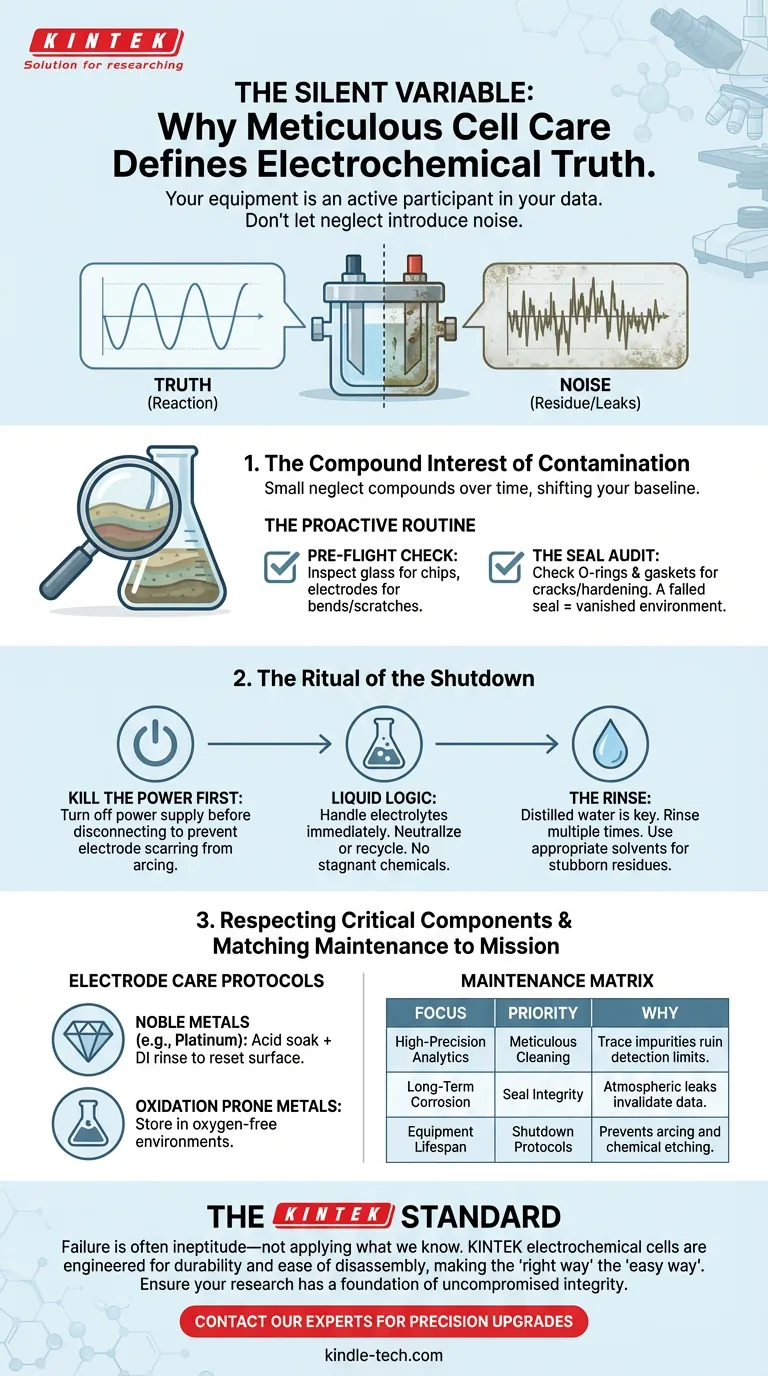
The Compound Interest of Contamination
Morgan Housel often speaks about how small things compound over time. The same applies to your electrode surfaces.
A single unfinished cleaning cycle seems harmless. But residue builds up. Reaction byproducts accumulate. Suddenly, your baseline shifts. You aren't measuring the chemistry of your analyte anymore; you are measuring the history of your glassware.
The Proactive Routine Maintenance is not a chore to be done when things break. It is a discipline to prevent breakage.
- The Pre-Flight Check: Before every experiment, inspect the glass for chips. Check the electrodes. Are they bent? Scratched?
- The Seal Audit: A "super-sealed" cell relies entirely on the integrity of its O-rings and gaskets. Look for hardening or cracks. If the seal fails, the atmosphere leaks in, and your controlled environment vanishes.
The Ritual of the Shutdown
There is a distinct difference between "stopping" an experiment and "shutting down" a system. The former is abrupt; the latter is procedural.
The majority of equipment damage happens in the transition states—turning things on and turning them off.
The Safe Power-Down Sequence
- Kill the Power First: Always turn off the power supply before disconnecting circuits. Disconnecting a live load can cause electrical arcing, which scars sensitive electrode surfaces.
- Liquid Logic: Handle used electrolytes immediately. Neutralize or recycle them based on their chemical properties. Never leave stagnant chemicals in the cell.
- The Rinse: Distilled water is your best friend. Rinse multiple times. For stubborn residues, use appropriate solvents.
Respecting the Critical Components
The glass body is just the stage. The actors are the electrodes.
Electrodes are often made of noble metals or sensitive materials. They possess a "memory." If you scratch a platinum surface, you alter its active surface area, changing your current density calculations.
Care Protocols:
- Noble Metals: For platinum, a soak in dilute acid (e.g., 1M nitric acid) followed by a deionized water rinse resets the surface.
- Oxidation Prone Metals: These demand an oxygen-free environment. Store them in protective solutions or dry boxes.
Matching Maintenance to Mission
Not all experiments carry the same risks. Your maintenance protocol should adapt to your specific scientific goals.
| If your focus is... | Your maintenance priority is... | Why? |
|---|---|---|
| High-Precision Analytics | Meticulous Cleaning | Trace impurities ruin detection limits. |
| Long-Term Corrosion | Seal Integrity | Atmospheric leaks invalidate long-duration data. |
| Equipment Lifespan | Shutdown Protocols | Preventing arcing and chemical etching saves money. |
The KINTEK Standard
Atul Gawande argues that failure in the modern world is rarely due to ignorance; it is due to ineptitude—the failure to apply what we know.
We know we should clean the cell. We know we should check the seals. But in the rush of research, we skip steps.
At KINTEK, we design lab equipment with the understanding that the scientist's time is precious. Our electrochemical cells are engineered for durability and ease of disassembly, making the "right way" the "easy way."
Your research deserves a foundation of uncompromised integrity. Don't let a dirty cell be the variable that disproves your hypothesis.
Contact Our Experts to discuss upgrading your laboratory setup with equipment designed for precision and longevity.
Visual Guide
Related Products
- PTFE Electrolytic Cell Electrochemical Cell Corrosion-Resistant Sealed and Non-Sealed
- Super Sealed Electrolytic Electrochemical Cell
- Electrolytic Electrochemical Cell with Five-Port
- H Type Electrolytic Cell Triple Electrochemical Cell
- Electrolytic Electrochemical Cell Gas Diffusion Liquid Flow Reaction Cell
Related Articles
- Electrolytic Batteries A Solution to the Growing Energy Demands
- The Art of Resistance: Why Your Electrolytic Cell Needs Breathing Room
- The Architecture of Invisibility: Deconstructing the "All-Quartz" Cell
- The Architecture of Certainty: Mastering Control in Multifunctional Electrolytic Cells
- The Silent Partner: Why Material Choice in Electrochemistry is a Matter of Trust