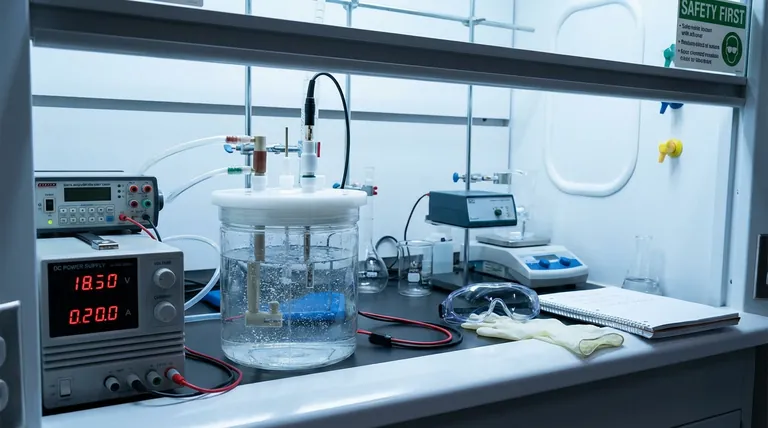
The Architecture of Risk
Chemistry is, at its core, the study of change. But change requires energy, and in an electrolytic cell, that energy is constrained within a fragile vessel.
There is a distinct tension in operating a super-sealed electrolytic cell. You are inducing reactions that do not want to happen naturally—forcing current through a solution to break bonds and create new ones.
The danger isn't usually the science itself. The danger is the gap between the procedure and the operator’s complacency.
Safe operation isn't merely a checklist; it is a discipline. It is the understanding that you are managing a trifecta of hazards: the chemical, the electrical, and the physical.
The Foundation: Respecting the System
Before a single volt is applied, the safety of the experiment is already determined. It begins with the environment.
A sealed cell creates a micro-environment of intense reactivity. However, the macro-environment—your lab—must be built to handle failure.
Ventilation is not optional. The fume hood is your primary containment system. If the seal fails, or if the cell is opened after a run, toxic gases must be swept away immediately. To operate outside a fume hood is to trust that a glass seal is perfect. An engineer knows that nothing is perfect.
The Manual is the Map. Every specific cell has tolerance limits for pressure and temperature. Ignoring the manual is like driving in a foreign country without a map; you might arrive, but you are likely to crash along the way.
The Invisible Hazard: Electrical Integrity
In a three-electrode system (working, counter, and reference), you are the conductor of an invisible orchestra. The voltage drives the reaction, but it also seeks the path of least resistance.
If you touch a live electrode, you become that path.
The rule is simple: Zero contact when energized.
Ensure the cell is connected to the power supply and detection instruments before hitting the switch. The wiring must be inspected for degradation. A frayed wire is not just a nuisance; in a conductive environment, it is a spark waiting for a flammable vapor.
The Chemistry of Pressure
A "super-sealed" cell is designed to keep the outside world out. But it also keeps the inside world in.
Electrolysis generates gas. In a sealed vessel, gas generation equals pressure accumulation.
Monitor the reaction. You are looking for:
- Unexpected color changes.
- Rapid bubbling.
- Deposits on the electrodes.
If the pressure builds beyond the glass's tensile strength, the vessel fails. This is why active monitoring is critical. You must be ready to execute an emergency shutdown the moment the system deviates from the expected model.
The Paradox of Glass
We use glass because it is chemically inert and transparent. We need to see the reaction.
But glass is the "Achilles' heel" of the laboratory. It is rigid, brittle, and unforgiving.
Handling: The cell body must be supported securely. A slip doesn't just mean broken equipment; it means a spill of electrically charged, corrosive fluid.
The Integrity Check: Before every run, inspect the seal. A faulty seal defeats the purpose of the equipment and invites leaks.
The Cleaning Trap: This is where most accidents happen. The experiment is over, the adrenaline fades, and you rush to clean up.
- Never use metal brushes. A microscopic scratch on the glass creates a stress riser. Under pressure or heat, that scratch becomes a crack.
- Watch your chemistry. Mixing acidic and alkaline cleaning agents (like nitric acid and sodium hydroxide) creates a violent exothermic reaction. Do not create a volcano inside your delicate equipment.
The Safety Protocol Checklist
Safety is what happens when you remove the element of surprise. Use this systemic approach to govern your workflow.
Phase 1: Preparation
- Review the operation manual and specific reaction parameters.
- Confirm fume hood ventilation is active.
- Don full PPE: Chemical safety goggles and protective gloves.
- Inspect glass for scratches and wires for fraying.
Phase 2: Execution
- Connect electrodes while the power is off.
- Monitor voltage and current continuously.
- Watch for gas buildup or abnormal thermal spikes.
- Maintain a "hands-off" policy regarding live components.
Phase 3: Termination
- Power down completely before touching the cell.
- Allow the system to return to ambient temperature.
- Clean using non-abrasive tools and compatible solvents.
Summary of Hazards
| Hazard Type | The Risk | The Defense |
|---|---|---|
| Chemical | Burns, toxic inhalation, exothermic reactions. | PPE, Fume Hood, Compatible Cleaning Agents. |
| Electrical | Shock, short circuits, sparks. | Check connections off-power; inspect wiring. |
| Physical | Glass implosion/explosion, cuts, leaks. | Gentle handling; no metal brushes; seal inspection. |
Engineering Certainty
In the laboratory, equipment should not be a variable. It should be a constant.
The difference between a successful experiment and a hazardous incident often comes down to the quality of the materials and the discipline of the operator. You provide the discipline; we provide the materials.
KINTEK specializes in high-quality lab equipment designed to withstand the rigors of electrochemical research. Our electrolytic cells are engineered for precise sealing and durability, giving you the confidence to focus on the science, not the glass.
Contact Our Experts to discuss how our solutions can enhance the safety and precision of your laboratory environment.
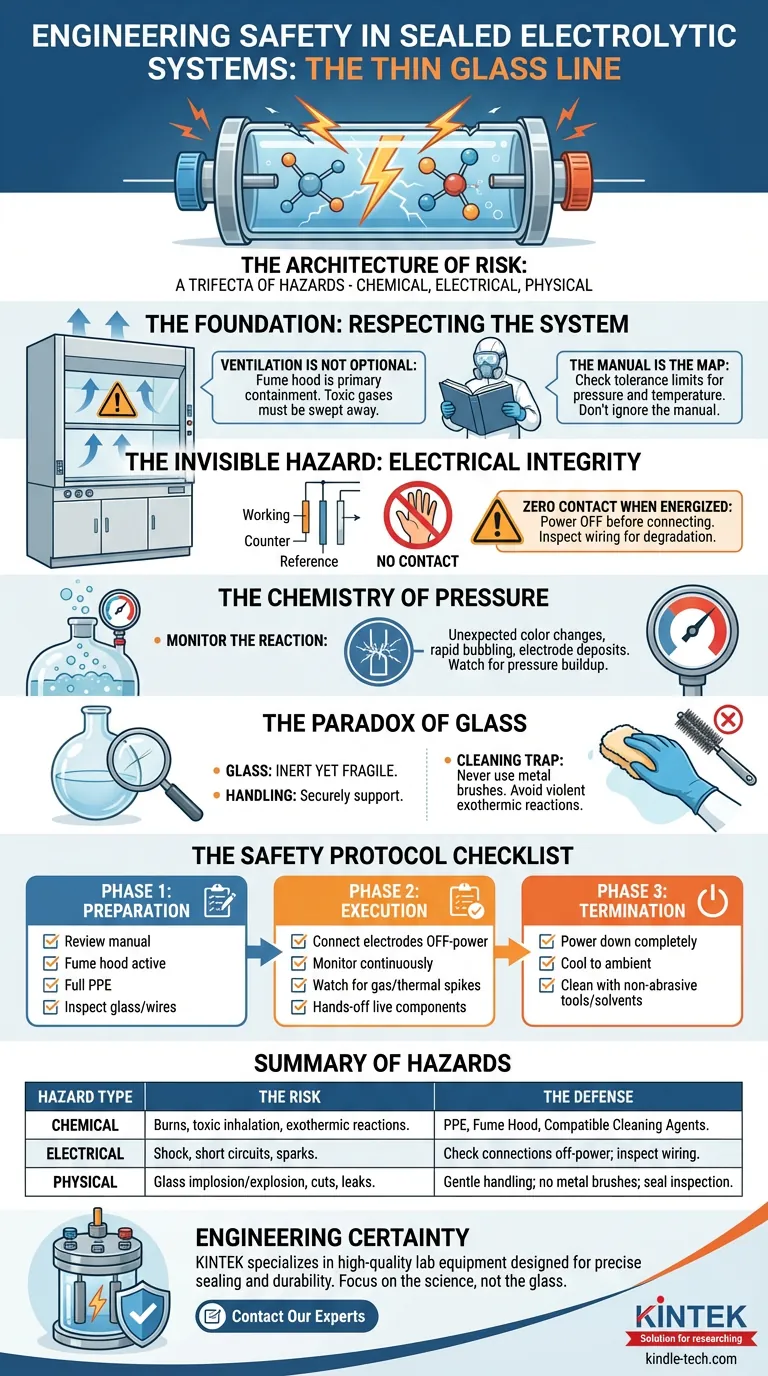
Visual Guide
Related Products
- PTFE Electrolytic Cell Electrochemical Cell Corrosion-Resistant Sealed and Non-Sealed
- Super Sealed Electrolytic Electrochemical Cell
- Electrolytic Electrochemical Cell with Five-Port
- H Type Electrolytic Cell Triple Electrochemical Cell
- Electrolytic Electrochemical Cell Gas Diffusion Liquid Flow Reaction Cell
Related Articles
- Electrolytic Batteries A Solution to the Growing Energy Demands
- The Art of Resistance: Why Your Electrolytic Cell Needs Breathing Room
- The Architecture of Invisibility: Deconstructing the "All-Quartz" Cell
- The Architecture of Certainty: Mastering Control in Multifunctional Electrolytic Cells
- The Silent Partner: Why Material Choice in Electrochemistry is a Matter of Trust