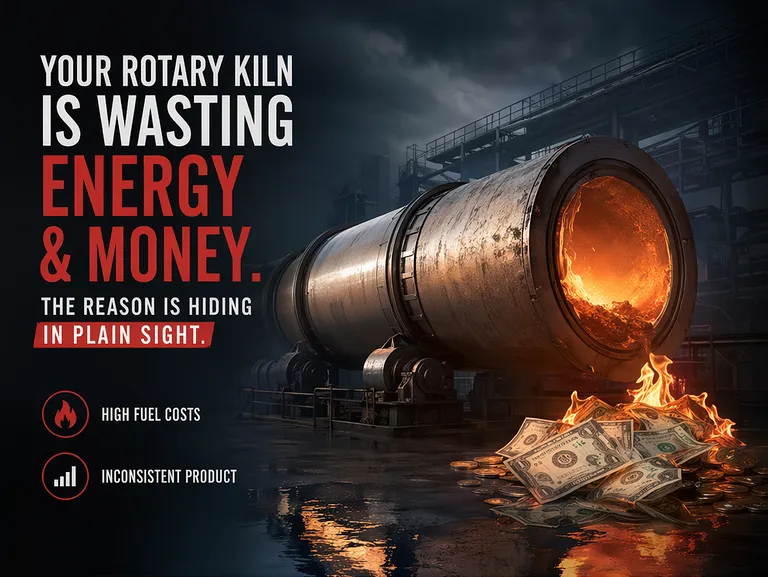
Is your rotary kiln burning through fuel while delivering inconsistent results? You crank up the heat, adjust the feed rate, and tweak the rotation speed, yet the quality of your final product remains a lottery. Some of it is perfect, some is under-processed, and some is burnt. It feels like you're operating a black box, and it's a frustrating, expensive cycle.
If this scenario sounds familiar, you are not alone.
The Frustrating Ritual of 'Tweak and Pray'
Across countless industries—from cement and minerals to specialty chemicals—engineers and lab technicians face this exact struggle. The conventional wisdom is to treat the symptoms:
- "The product isn't heated enough." So, you increase the burner temperature, watching your energy bills skyrocket.
- "The material is passing through too quickly." So, you slow the kiln's rotation, hoping for longer exposure, only to create new problems like clumping or uneven flow.
- "The output is inconsistent." So, you end up with entire batches of off-spec material that must be reprocessed or discarded, wasting both time and valuable resources.
These "solutions" are often just shots in the dark. They fail because they ignore the fundamental physics happening inside the kiln. The real problem isn't just about how much heat you generate; it's about how effectively that heat gets into your material.
The Revelation: Your Kiln Isn't a Tunnel, It's an Engine
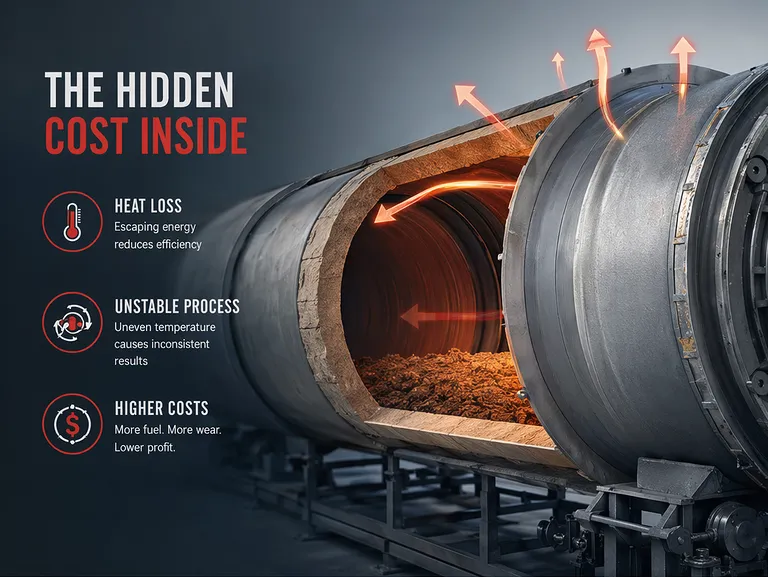
Here is the core misunderstanding: many treat a rotary kiln like a simple heated tube. You put material in one end, hot gas flows over it, and a finished product comes out the other.
The truth is, a high-efficiency rotary kiln is a sophisticated thermal processing engine, and its most critical component is often the most overlooked: the internal chain system.
Imagine trying to boil a large pot of water by holding a powerful blowtorch above the surface. Most of the heat would simply roll off and escape into the air, wasting enormous energy. You'd get some steam, but it would be wildly inefficient. The logical solution is to put the pot directly on a stove, allowing heat to transfer via conduction.
The chains inside a rotary kiln perform this exact function. They are not just there to stir things up.
Meet the Unsung Hero: The Dual-Function Chain System
A kiln's chain system is a masterclass in thermal engineering, serving two critical roles simultaneously:
-
A Massive Heat Exchanger: As the kiln rotates, the dense curtains of chains are lifted through the stream of hot process gas, absorbing immense heat—heat that would otherwise fly straight out the exhaust stack. They then dip down into the bed of raw material, transferring this stored heat directly into it through conduction. This continuous cycle is the single most important factor in a kiln's thermal efficiency.
-
A Material Conditioner: The physical action of the chains is just as important. They lift and shower the material through the hot gas, breaking up the solid bed and exposing a massive amount of surface area for even heating. This prevents the formation of clumps and "mud rings" that cause blockages, and ensures every particle receives a uniform thermal treatment.
Simply turning up your burner without an effective chain system is like revving a car's engine while it's stuck in neutral. You make a lot of noise and burn a lot of fuel, but you don't go anywhere efficiently. This is why your "common fixes" fail—they don't address the core problem of inefficient heat transfer.
From Understanding to Control: Choosing the Right Tool
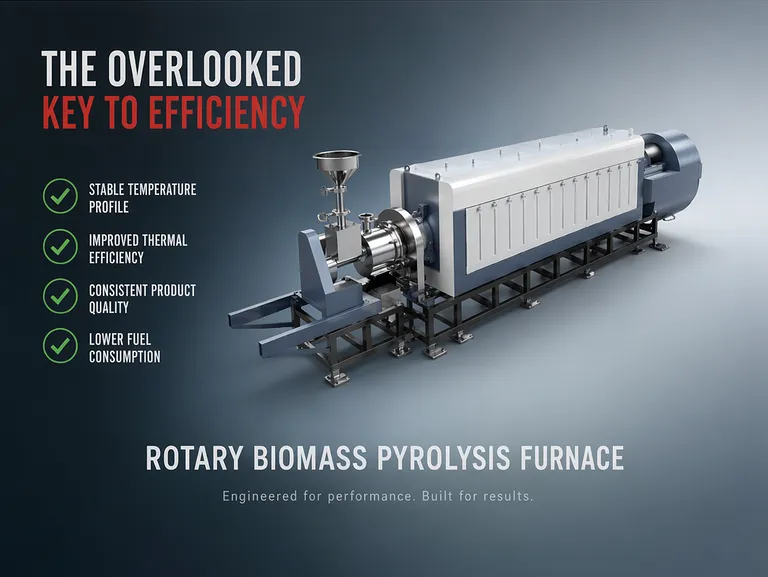
To truly control your thermal process, you must control the heat transfer. This means using a tool designed from the ground up with these first principles in mind, whether on an industrial scale or in a laboratory setting.
This is where the gap between a simple heated tube and a true laboratory-scale thermal processing unit becomes clear. To develop reliable and scalable processes, you need lab equipment that accurately simulates the conditions of a high-performance industrial kiln. Your lab kiln must do more than just get hot; it must intelligently transfer that heat.
KINTEK's specialized lab equipment and consumables are engineered for precisely this. We understand that replicating the dual function of heat exchange and material conditioning is non-negotiable for achieving meaningful, scalable results. Our systems are designed not just as ovens, but as miniature processing engines, allowing you to move from guesswork to precise, data-driven optimization.
Beyond Fixing Problems: Unlocking New Process Potential
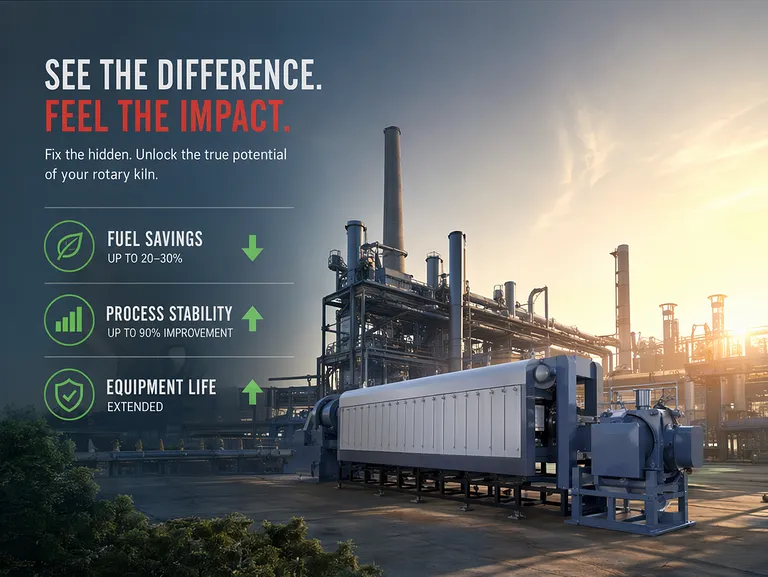
When your lab kiln stops being an unpredictable "black box" and becomes a precise, reliable instrument, you don't just solve problems—you unlock new capabilities.
- Accelerate R&D: You can rapidly test new formulations and material compositions with confidence, knowing your results are consistent and repeatable.
- De-risk Scale-Up: You can simulate and troubleshoot production issues at the lab scale, confident that the thermal principles will translate to your full-size operations.
- Enhance Quality Control: You can precisely analyze how different raw materials will behave in the kiln, preventing costly production errors before they happen.
By mastering the fundamental principles of thermal processing, you transform your lab from a place of trial-and-error into a hub of innovation.
Stop fighting the symptoms of an inefficient process. It's time to address the root cause and take control. Our team is ready to help you bridge the gap between your current challenges and your future potential, ensuring your lab work translates directly into production success. To discuss your unique project and discover how the right tools can revolutionize your thermal processing, Contact Our Experts.
Related Products
- Electric Rotary Kiln Small Rotary Furnace Biomass Pyrolysis Plant
- Electric Rotary Kiln Continuous Working Small Rotary Furnace Heating Pyrolysis Plant
- Electric Rotary Kiln Small Rotary Furnace for Activated Carbon Regeneration
- Electric Rotary Kiln Pyrolysis Furnace Plant Machine Calciner Small Rotary Kiln Rotating Furnace
- Vacuum Sealed Continuous Working Rotary Tube Furnace Rotating Tube Furnace
Related Articles
- Your Rotary Kiln Isn't an Oven: The Secret to Consistent Thermal Processing
- Mastering Rotary Kilns: A Comprehensive Guide to Operation, Applications, and Maintenance
- Your Rotary Kiln Process is Failing. The Problem Isn't Temperature—It's Purity.
- Why More Fuel Isn't Fixing Your Rotary Kiln—And What Will
- Optimizing Industrial Processes: Rotary Kiln and Laboratory Furnace Solutions