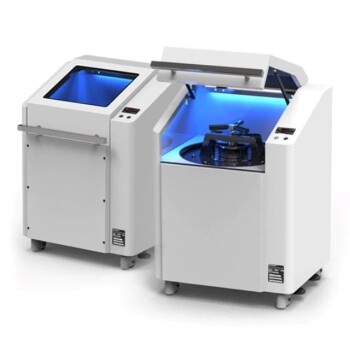
Grinding balls serve as the primary kinetic energy transfer medium in the mechanical alloying of Al-Cu powders. By subjecting the metallic powder to high-frequency, intense impacts, these hardened steel components provide the necessary energy to induce severe plastic deformation. This process drives grain refinement and facilitates the solid-state reaction required to alloy aluminum and copper without melting.
The fundamental role of grinding balls is to convert mechanical kinetic energy into internal chemical and deformation energy within the powder particles. This conversion powers the repeated fracturing and cold welding cycles necessary to achieve uniform mixing and solid solutions.
The Mechanism of Energy Transfer
Converting Kinetic Energy to Deformation
The core function of the grinding ball is to act as a carrier of kinetic energy. As the milling jar rotates, the balls acquire significant speed and momentum.
When these balls collide with the Al-Cu powder, that kinetic energy is instantly transferred to the particles. This impact provides the activation energy required to plastically deform the metal, altering its internal structure.
Driving Grain Refinement
The intense impact from the grinding balls forces the powder particles to undergo severe strain.
This strain causes the crystalline grains within the aluminum and copper to fracture and shrink. Over time, this continuous bombardment refines the grain size down to the micron level, increasing the surface area available for reaction.
Facilitating Solid-State Diffusion
Mechanical alloying relies on mixing elements in a solid state, rather than melting them.
Grinding balls facilitate this by repeatedly flattening, fracturing, and cold-welding the particles together. This mechanical "kneading" forces atomic-level diffusion between the aluminum and copper, eventually creating a uniform alloy with a homogeneous chemical composition.
Optimizing the Milling Environment
The Role of Ball Diameter
The size of the grinding ball directly influences the type of energy transfer.
Larger balls (e.g., 15mm or 20mm) carry higher mass and deliver greater impact energy. This is essential for the initial crushing of large particles and fracturing hard materials.
Smaller balls (e.g., 10mm) offer a lower impact force but a much higher contact frequency. This increased frequency ensures superior powder refinement and more uniform mixing of the final alloy.
Strategic Size Mixing
Using a mix of varying ball diameters often yields the best results.
This approach balances the high-impact energy needed for crushing with the high-frequency contact needed for refinement. It optimizes the collision energy distribution, ensuring the process is both efficient and comprehensive.
Ball-to-Powder Weight Ratio
The ratio of grinding media to powder is a critical variable, often set around 10:1 or 15:1 for high-efficiency processing.
A higher ratio increases the number of collisions per unit of time. This accelerates the alloying process and ensures that sufficient kinetic energy is available to drive the formation of solid solutions.
Understanding the Trade-offs
The Risk of Contamination
While high-hardness steel balls are necessary for effective energy transfer, they are not indestructible.
During intense collisions, the grinding media effectively wears down. This can introduce impurities, such as iron or carbon, into your Al-Cu powder mixture.
Balancing Energy and Purity
There is a direct tension between milling intensity and material purity.
Increasing the milling duration or impact energy (to achieve finer grains) increases the likelihood of abrasive wear on the balls and jars. You must carefully monitor the process to keep these impurities within acceptable limits for your specific alloy application.
Making the Right Choice for Your Goal
To achieve the best results in your Al-Cu mechanical alloying project, select your grinding media based on your specific outcome requirements:
- If your primary focus is rapid particle size reduction: Prioritize larger diameter balls and a higher ball-to-powder ratio to maximize impact energy for crushing.
- If your primary focus is homogeneity and solid solution formation: Utilize smaller diameter balls or a mixed-size distribution to maximize collision frequency and mixing uniformity.
- If your primary focus is material purity: Select high-wear-resistance stainless steel media and optimize milling time to minimize the introduction of iron or carbon contaminants.
Success in mechanical alloying lies in balancing the kinetic energy required for reaction against the limits of your materials.
Summary Table:
| Parameter | Influence on Al-Cu Alloying | Best Use Case |
|---|---|---|
| Large Ball Size | High impact energy; fractures large particles | Initial crushing & hard materials |
| Small Ball Size | High contact frequency; superior refinement | Homogenization & fine mixing |
| Ball-to-Powder Ratio | Controls collision density & process speed | High-efficiency alloying (10:1 - 15:1) |
| Material Hardness | Affects energy transfer & contamination risk | Balancing purity vs. milling intensity |
Elevate Your Material Synthesis with KINTEK
Precision in mechanical alloying starts with the right equipment. KINTEK specializes in high-performance laboratory solutions, providing the durable crushing and milling systems and high-purity grinding media essential for achieving perfect Al-Cu solid solutions.
Beyond milling, our comprehensive portfolio supports every stage of your research, from high-temperature furnaces (vacuum, tube, and muffle) for heat treatment to hydraulic presses for pelletizing and high-pressure reactors for advanced synthesis.
Ready to optimize your grain refinement and alloy homogeneity? Contact our technical experts today to find the ideal milling configuration and laboratory consumables for your specific application.
Related Products
- Laboratory Jar Ball Mill with Alumina Zirconia Grinding Jar and Balls
- Laboratory Ball Mill Jar Mill with Metal Alloy Grinding Jar and Balls
- Laboratory Jar Mill with Agate Grinding Jar and Balls
- High Energy Planetary Ball Mill Milling Machine for Laboratory
- Laboratory Micro Tissue Grinding Mill Grinder
People Also Ask
- What are the primary functions of using a ball mill for BZCY72 powder? Achieve High Purity and Enhanced Sintering
- In what way does a laboratory ball mill affect material properties when modifying PHBV/pulp fiber composites?
- Why is a laboratory ball mill required for ultra-fine fly ash? Unlock Nano-Scale Adsorption Power
- What is the function of a laboratory ball mill in the preparation of AMMCs? Optimize Dispersion & Grain Refinement
- What is the function of a laboratory ball mill in the pretreatment of waste tire char (WTC)? Optimize Material Reactivity