Hydrodynamic parameters, specifically stirring speed, determine the upper limit of your enzymatic hydrolysis efficiency. By maintaining a high stirring speed (typically exceeding 300 rpm) in a stirred batch reactor, you directly reduce the system's viscosity and increase the Reynolds number. This physical agitation is essential for maximizing the contact surface area between enzymes and the lignocellulose substrate, ensuring the reaction is driven by chemical kinetics rather than limited by poor mixing.
The efficiency of enzymatic hydrolysis relies on overcoming physical barriers before chemical ones. High stirring speeds and optimized reactor internals are required to prevent mass-transfer limitations, ensuring that high-viscosity, high-solid substrates remain in constant contact with enzymes for maximum glucose yield.
The Physics of Mixing and Yield
Reducing Apparent Viscosity
Lignocellulose substrates often create high-viscosity environments that impede fluid motion.
High stirring speeds break down this resistance. By inputting sufficient kinetic energy (e.g., >300 rpm), you significantly lower the apparent viscosity of the slurry, allowing the mixture to flow more freely.
Increasing the Reynolds Number
The Reynolds number is a dimensionless quantity that predicts flow patterns.
Higher stirring speeds increase this number, transitioning the fluid dynamics from laminar to turbulent flow. This turbulence is critical because it aggressively transports enzymes to the substrate surface, rather than relying on slow diffusion.
Preventing Mass-Transfer Limitations
Reaction rates are controlled by two factors: how fast the chemicals react (kinetics) and how fast they find each other (mass transfer).
Insufficient stirring results in a mass-transfer-controlled reaction. In this state, the enzymes are ready to work, but they physically cannot reach the substrate fast enough. This leads to a significant and avoidable drop in production output.
Optimizing Reactor Geometry
The Role of the Anchor Impeller
Speed alone is often not enough; the shape of the agitator matters.
An anchor impeller is particularly effective in these systems. It sweeps the entire diameter of the reactor, ensuring that material near the walls is continuously reintegrated into the bulk mixture.
Enhancing Shear with Baffles
To maximize efficiency, the reactor must utilize internal fluid baffles alongside the impeller.
Baffles disrupt the flow to prevent radial swirling, where the fluid effectively moves as a solid block without mixing. Instead, baffles promote fluid shear forces, which micro-mix the reactants and improve homogeneity.
Handling High-Solid Loads
Commercial viability often requires processing high concentrations of solids (e.g., 15 wt% solid content).
The combination of high stirring speed and reinforced mixing mechanisms keeps these heavy solids suspended. This allows for sustained enzyme contact over long reaction periods, often lasting between 120 and 166 hours, resulting in high titers of monomeric sugars.
Understanding the Trade-offs
Energy Consumption vs. Yield
While higher speeds generally improve yield, they increase power consumption linearly or exponentially depending on the flow regime.
You must identify the "critical speed" where the reaction shifts from mass-transfer control to kinetic control. Increasing speed beyond this point wastes energy with diminishing returns on glucose yield.
Mechanical Constraints
Running a reactor at high speeds (>300 rpm) for extended durations (up to 166 hours) places significant stress on equipment.
The motor, shaft, and seals must be rated to handle the torque required to mix high-viscosity slurries without failure.
Making the Right Choice for Your Goal
To optimize your enzymatic hydrolysis process, align your hydrodynamic parameters with your production targets:
- If your primary focus is Maximum Glucose Yield: Prioritize stirring speeds above 300 rpm and utilize baffles to ensure the reaction is never limited by mass transfer.
- If your primary focus is High-Solid Processing: Implement anchor impellers to maintain suspension of 15 wt% loads and prevent settling over long reaction times.
True process efficiency is achieved when the physical mixing environment is as robust as the biological chemistry it supports.
Summary Table:
| Parameter | Impact on Efficiency | Physical Mechanism |
|---|---|---|
| Stirring Speed (>300 rpm) | High | Reduces apparent viscosity; transitions flow from laminar to turbulent. |
| Reynolds Number | High | Increases turbulence, ensuring enzymes reach substrate surfaces rapidly. |
| Anchor Impellers | High | Sweeps reactor walls to prevent settling of high-viscosity, high-solid loads. |
| Internal Baffles | Medium | Disrupts radial swirling to promote fluid shear forces and homogeneity. |
| Mass Transfer | Critical | Prevents the physical barrier from limiting chemical reaction kinetics. |
Maximize Your Lab’s Hydrolysis Efficiency with KINTEK
Don’t let mass-transfer limitations stall your production. KINTEK specializes in high-performance laboratory equipment designed to handle high-viscosity and high-solid substrates with ease. Whether you require stirred batch reactors with reinforced motor torque for high-speed mixing, precision crushing and milling systems for substrate preparation, or advanced high-temperature high-pressure reactors, we provide the tools to ensure your reactions are driven by kinetics, not poor mixing.
Ready to scale your yield? Our experts can help you select the ideal impeller geometry and reactor configuration to achieve your 15 wt% solid load targets.
Contact KINTEK today for a consultation
References
- Ricard Garrido, Omar Pérez Navarro. Potential Use of Cow Manure for Poly(Lactic Acid) Production. DOI: 10.3390/su142416753
This article is also based on technical information from Kintek Solution Knowledge Base .
Related Products
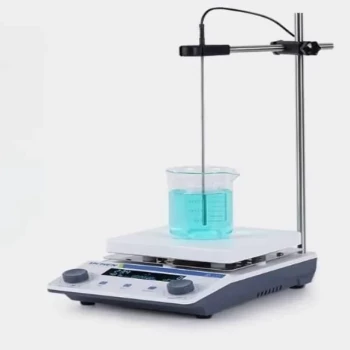
- Laboratory Small Constant Temperature Heated Magnetic Stirrer Heater and Stirrer
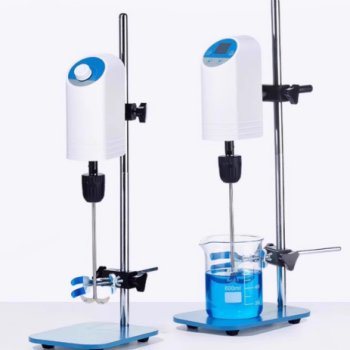
- High Performance Laboratory Stirrers for Diverse Applications
- Mini SS High Pressure Autoclave Reactor for Laboratory Use
- Stainless High Pressure Autoclave Reactor Laboratory Pressure Reactor
- Customizable Laboratory High Temperature High Pressure Reactors for Diverse Scientific Applications
People Also Ask
- What role does a magnetic stirrer with heating play in ZnO nanoparticle synthesis? Precision Control for Quality Results
- What role does a constant temperature heating magnetic stirrer play in MFC-HAp synthesis? Achieve Material Homogeneity
- What is the function of a laboratory magnetic stirrer in Ni–Cr–P electrodeposition? Optimize Ion Transport & Coating
- Why is a laboratory magnetic stirrer required for benzoic acid esters? Boost Reaction Speed & Yield with High RPM
- What role does a laboratory magnetic stirrer play in TiO2 and TiO2-Ag sol preparation? Master Chemical Kinetics