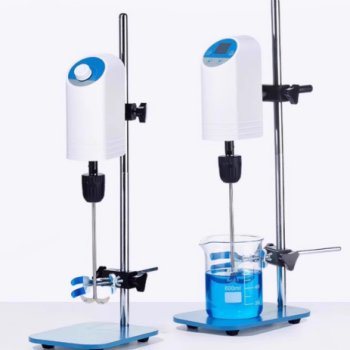
Stirring equipment significantly enhances degradation efficiency in homogeneous Advanced Oxidation Processes (AOPs) by generating forced convection. This mechanical action ensures that pollutants, oxidants, and catalysts achieve complete microscopic contact, directly influencing the rate at which organic matter is destroyed.
By eliminating concentration gradients, stirring facilitates the efficient mass transfer required for hydroxyl radicals to capture and mineralize organic contaminants effectively.
The Mechanics of Enhanced Degradation
The Role of Forced Convection
Stirring equipment, whether magnetic or mechanical, introduces forced convection into the wastewater system.
This physical movement is not merely about bulk mixing; it is necessary to ensure pollutants achieve full microscopic contact with added oxidants and catalysts.
Eliminating Concentration Gradients
Without active mixing, chemical concentrations can vary significantly across the reaction vessel.
Stirring eliminates these concentration gradients, ensuring that the ratio of oxidants to pollutants remains uniform throughout the system.
This uniformity prevents the formation of localized areas where reaction rates stall due to a lack of reagents.
Facilitating Mass Transfer
The core requirement for AOP efficiency is efficient mass transfer.
This physical transport brings the reactants together, allowing the chemistry to function.
Without this transfer, the reagents remain isolated, and the oxidation potential of the system is wasted.
Maximizing Hydroxyl Radical Interaction
The ultimate goal of these processes is for hydroxyl radicals to destroy the molecular structure of organic matter.
Stirrers ensure these radicals can quickly "capture" and react with pollutants before the radicals recombine or are scavenged.
This interaction directly determines the final mineralization efficiency of the wastewater treatment.
Understanding the Trade-offs
The Risk of Insufficient Mixing
If the stirring mechanism is underpowered or poorly designed, concentration gradients will persist.
This leads to incomplete mineralization, as pockets of wastewater may never come into contact with the necessary density of hydroxyl radicals.
Dependency on Contact Time
Because hydroxyl radicals are highly reactive and short-lived, the system is intolerant of delays in mixing.
If mass transfer is slower than the reaction kinetics, the process becomes diffusion-controlled, limiting the overall speed of degradation regardless of how much oxidant is added.
Making the Right Choice for Your Goal
To maximize the efficacy of your Advanced Oxidation Process, consider how mixing aligns with your specific objectives:
- If your primary focus is Maximum Mineralization: Ensure your stirring speed is high enough to induce vigorous forced convection, eliminating all "dead zones" in the reactor.
- If your primary focus is Process Consistency: Use reliable stirring equipment to maintain a perfectly homogeneous mixture, ensuring reproducible results by preventing concentration gradients.
Effective stirring transforms a static mixture into a dynamic environment where hydroxyl radicals can successfully destroy organic contaminants.
Summary Table:
| Factor | Impact of Stirring | Benefit for AOP Efficiency |
|---|---|---|
| Mass Transfer | Facilitates rapid movement of reactants | Overcomes diffusion limits for faster reaction |
| Concentration Gradients | Eliminates localized reagent clusters | Ensures uniform pollutant-to-oxidant ratio |
| Contact Type | Promotes microscopic contact | Increases collision frequency between radicals and organics |
| Fluid Dynamics | Introduces forced convection | Prevents 'dead zones' and ensures complete mineralization |
| Kinetic Control | Shifts process from diffusion-controlled to reaction-controlled | Maximizes the oxidation potential of hydroxyl radicals |
Elevate Your Chemical Research with KINTEK Precision
To achieve complete mineralization in Advanced Oxidation Processes, high-performance mixing and reactor control are non-negotiable. KINTEK specializes in advanced laboratory equipment designed to meet the rigorous demands of wastewater treatment research and material synthesis.
Our extensive portfolio includes:
- Magnetic and Mechanical Stirring Solutions: Engineered for uniform mass transfer and forced convection.
- High-Temperature & High-Pressure Reactors: Including autoclaves, CVD, and PECVD systems for advanced chemical engineering.
- Comprehensive Lab Tools: From electrolytic cells and electrodes to ultrasonic homogenizers and hydraulic presses.
Ready to eliminate concentration gradients and ensure reproducible results? Contact our technical experts today to find the perfect equipment configuration for your lab's specific needs.
References
- Manickavachagam Muruganandham, M. Swaminathan. Recent Developments in Homogeneous Advanced Oxidation Processes for Water and Wastewater Treatment. DOI: 10.1155/2014/821674
This article is also based on technical information from Kintek Solution Knowledge Base .
Related Products
- High Performance Laboratory Stirrers for Diverse Applications
- Laboratory Small Constant Temperature Heated Magnetic Stirrer Heater and Stirrer
- Custom PTFE Teflon Parts Manufacturer for Magnetic Stirring Bar
People Also Ask
- How does a laboratory stirrer influence MOF product quality? Master Precision in Non-Solvothermal Synthesis
- What critical role does a Laboratory Stirrer play during leaching? Enhance Titanium-Magnesium Waste Recovery
- What is the primary function of laboratory stirring equipment in the preparation of compost leachate? Optimize Extraction
- What is a laboratory mixer? A Guide to Achieving Perfect Sample Homogeneity
- What is a laboratory mixer used for? Choose the Right Tool for Liquids or Solids